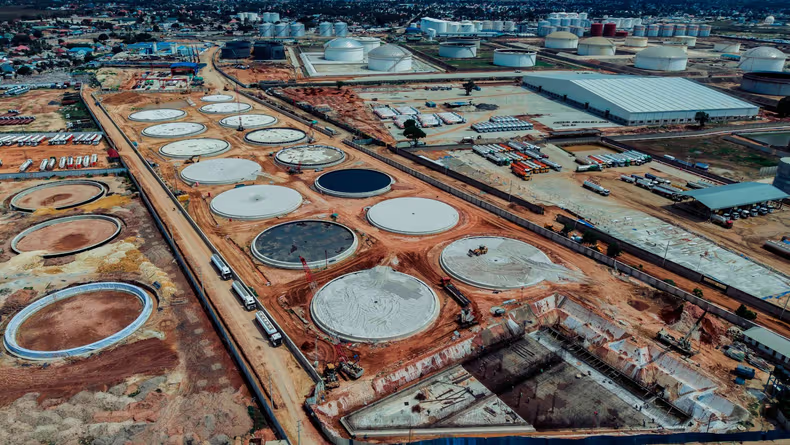
Tanzania has launched a major infrastructure project aimed at strengthening its fuel supply chain and improving port efficiency, committing $274 million (TZS 701.8 billion) to expand petroleum storage facilities at the Port of Dar es Salaam.
According to reporting by the Accra Street Journal (ASJ), the project will see the construction of 15 new oil reception and storage tanks, significantly increasing the port’s ability to handle petroleum imports and easing long-standing congestion challenges.

The project was officially launched by Samia Suluhu Hassan, President of Tanzania, who described the expansion as a strategic investment to improve energy security and strengthen the country’s position as a regional logistics hub.
📢 GET A DETAILED ARTICLES + JOBS
Join ASJ's WhatsApp Channel and never miss a post or opportunity.

Major Expansion of Fuel Storage Infrastructure
The new facility will add 15 modern storage tanks with a combined capacity of 378,000 cubic metres, according to the Accra Street Journal.
The capacity will be distributed across key petroleum products:

-
162,000 cubic metres for diesel
-
135,000 cubic metres for petrol
-
81,000 cubic metres for Jet A1 aviation fuel
Officials say the expansion will increase the port’s fuel reception capacity by 35.9 percent, allowing it to handle larger volumes of petroleum shipments more efficiently.
Construction of the project began in August 2024 and is already 41 percent complete, with full completion expected by February 2027, the Accra Street Journal reports.
Authorities have already paid approximately $45.7 million (TZS 117.1 billion) to contractors and consultants working on the project.
Reducing Delays and Shipping Costs
One of the main goals of the expansion is to reduce congestion at the port’s petroleum terminals.
Currently, oil tankers can wait up to 22 days before they are able to discharge their cargo at the port.
With the new storage capacity in place, waiting times are expected to drop to about seven days, significantly improving efficiency, according to the Accra Street Journal.
Reducing delays will also eliminate demurrage charges, the fees shipping companies impose when vessels are forced to remain in port longer than scheduled.
Officials estimate these costs currently average around $25,000 per day per vessel, expenses that are often passed on to fuel importers and eventually to consumers.
Strengthening Tanzania’s Energy Security
President Samia Suluhu Hassan said the project forms part of a broader strategy to strengthen Tanzania’s energy supply system and reduce vulnerabilities in the petroleum supply chain.

According to the Accra Street Journal, the president also directed the Ministry of Energy to expand the country’s National Strategic Petroleum Reserves in order to shield the economy from volatility in global oil markets.
She further instructed authorities to introduce modern cargo tracking systems for petroleum shipments, a move intended to increase transparency and protect government revenue.
The reforms are part of ongoing efforts by the government to modernise port operations and improve efficiency in Tanzania’s logistics sector.
Modernising the Port of Dar es Salaam
The expansion is being implemented by the Tanzania Ports Authority under the Ministry of Transport (Tanzania), as part of the country’s long-term Port Master Plan, according to the Accra Street Journal.
Officials say the initiative aims to improve:
-
Port efficiency
-
Cargo handling capacity
-
Trade competitiveness
-
Revenue generation for the government
The Port of Dar es Salaam is Tanzania’s largest and busiest seaport and one of the most important trade gateways in East Africa.
It handles cargo not only for Tanzania but also for several landlocked neighbouring countries, making it a critical logistics hub for the region.
Linking Ports to Rail and Inland Logistics
The Tanzanian government is also integrating the port’s operations with the country’s expanding transport infrastructure.
According to the Accra Street Journal, Makame Mbarawa, Tanzania’s Minister of Transport, said cargo from the port will soon be transported using the country’s Tanzania Standard Gauge Railway.
The railway will link Dar es Salaam to Dodoma, improving the movement of goods across the country.
In addition, the government is developing dry ports in several cities, including:

-
Morogoro
-
Dodoma
-
Shinyanga
These inland logistics centres are designed to ease congestion at the seaport and speed up cargo distribution across Tanzania and neighbouring countries.
Economic Benefits and Regional Impact
According to Plasduce Mbossa, reducing ship waiting times will have multiple economic benefits.
The Accra Street Journal reports that faster vessel turnaround will:
-
Reduce shipping costs
-
Stabilise domestic fuel prices
-
Increase trade volumes
-
Attract more vessels to the port
Since demurrage charges are often added to fuel import costs, eliminating these delays could also help keep fuel prices more stable for consumers and businesses.
Strengthening East Africa’s Energy Gateway
The Port of Dar es Salaam serves as one of East Africa’s most important energy and logistics gateways, supplying petroleum products to Tanzania and neighbouring landlocked economies.
With global energy markets becoming increasingly volatile, expanding fuel storage capacity is seen as a key step toward improving supply reliability across the region.
As the Accra Street Journal notes, the new infrastructure will not only strengthen Tanzania’s domestic fuel system but could also reinforce the country’s strategic role in regional energy distribution.
By modernising port infrastructure, improving logistics connections, and expanding petroleum storage capacity, Tanzania is positioning itself to become a more competitive trade and energy hub in East Africa.
Source: Accra Street Journal
Last Updated on March 9, 2026 by Samuel Kwame Boadu
Disclaimer: Some content on Accra Street Journal may be aggregated, summarized, or edited from third-party sources for informational purposes. Images and media are used under fair use or royalty-free licenses. Accra Street Journal is a subsidiary of SamBoad Publishing Hub under SamBoad Business Group Ltd, registered in Ghana since 2014.
For concerns or inquiries, please visit our Privacy Policy or Contact Page.

Samuel Kwame Boadu is a Ghanaian media entrepreneur and storyteller with a passion for amplifying urban voices and uncovering everyday truths. He is the Editor-in-Chief and Founder of Accra Street Journal, a dynamic digital platform dedicated to capturing the pulse of Ghana’s capital—its people, culture, challenges, business, sports and innovations.