








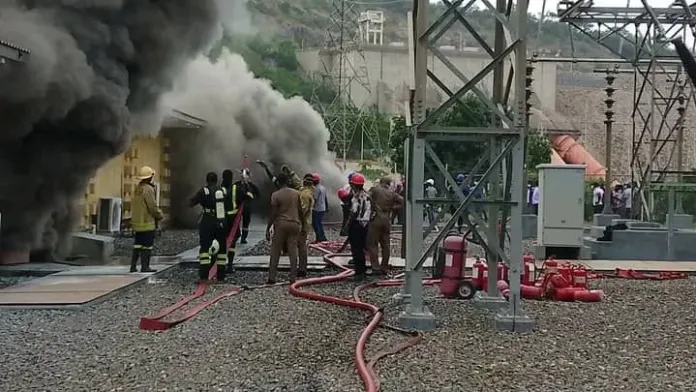
A control room fire at the Akosombo substation, the nerve center of Ghana’s largest hydroelectric facility, triggered widespread power outages across the Eastern Region over the weekend, exposing the vulnerability of the nation’s aging transmission infrastructure. The Ministry of Energy has since announced that emergency measures are underway to restore full electricity supply, with technical teams working around the clock to bypass damaged control systems and reroute power through alternative substations. Despite the severity of the incident—and public anxiety reminiscent of the 2022–2023 erratic power supply episodes—Energy Minister Dr. Matthew Opoku Prempeh has explicitly ruled out issuing a fixed load-shedding timetable, insisting that the current outages remain localized system issues rather than a return to coordinated rolling blackouts. For businesses in the affected zones—from manufacturing plants in Tema to cold storage facilities in Koforidua—the distinction matters less than the restoration timeline. The government’s assurance of normalization by mid-week will be tested against the technical reality of repairing fire-damaged control equipment at a facility that supplies approximately 30% of the nation’s electricity.
Key Developments: Fire, Response, and the Exclusion of Load-Shedding
The fire, which broke out in the Akosombo substation’s main control room during the early hours of April 26, 2026, damaged critical monitoring and switching equipment used to regulate power flow from the Volta River Authority’s (VRA) hydroelectric dam. Preliminary reports from the VRA suggest an electrical fault within aging switchgear as the probable cause, though a full investigation has been ordered by the Ministry of Energy. No casualties were reported, as the control room was minimally staffed at the time, but the damage to computerized control systems forced an immediate manual shutdown of several transmission lines serving the Eastern Region, including feeders to Koforidua, Nkawkaw, and parts of the Tema industrial enclave.

As of Monday morning, power had been partially restored to approximately 40% of affected customers through manual switching and emergency rerouting via the Kpong substation downstream. However, the Eastern Regional capital, Koforidua, and surrounding communities reported rotational outages of four to six hours per day as engineers worked to balance limited capacity with demand.
📢 GET A DETAILED ARTICLES + JOBS
Join ASJ's WhatsApp Channel and never miss a post or opportunity.

Energy Minister Opoku Prempeh addressed the nation on Sunday evening, striking a calibrated tone between assurance and caution. “The Akosombo substation is critical infrastructure, and the fire was a serious incident. However, I want to make it clear to the Ghanaian public and to the business community: we are not returning to a load-shedding regime. There will be no fixed timetable because there is no systemic generation deficit. What we are dealing with are localized transmission constraints following an accident.” He added that emergency bypass systems were being fabricated locally and that replacement control components had been expedited from South Africa, with expected delivery by May 2.
The minister’s insistence on avoiding the term “load-shedding” is politically significant. The phrase carries traumatic weight in Ghana, evoking the 2015 “dumsor” crisis that damaged industrial productivity and contributed to a slowdown in manufacturing output. A fixed load-shedding timetable, even if technically efficient for managing constrained supply, would signal a loss of control over the energy system. By framing the outages as localized and temporary, the ministry seeks to contain reputational damage and prevent panic-driven fuel purchases for private generators—a behavior that typically drives up diesel demand and worsens forex pressure.

Nevertheless, the distinction between “localized outages” and “load-shedding” is functionally invisible to a small business owner whose cold storage has lost power for six hours. For such users, the government’s semantic precision offers no relief. The real test will be whether power is fully restored to all affected zones by the promised mid-week timeline, or whether weeks of intermittent supply become the new normal.
Analysis & Implications: Transmission Weakness Behind the Generation Strength
Ghana’s electricity sector has long been described as “generation-rich, transmission-poor.” The country boasts installed capacity exceeding 5,000 megawatts—well above peak demand of approximately 3,500 megawatts—thanks to the Akosombo and Kpong hydro plants, the thermal plants at Aboadze and Takoradi, and the West African Gas Pipeline–fed facilities. However, the transmission network, operated by the Ghana Grid Company (GRIDCo), has suffered from chronic underinvestment relative to generation expansion. Substations like Akosombo, built in the 1960s and upgraded incrementally, contain switchgear, transformers, and control systems that are decades beyond their intended service life.
The Akosombo substation fire is not an isolated incident. In 2024, a transformer fire at the Mallam substation in Accra caused two days of outages in the capital’s western suburbs. In 2023, a control system failure at the Anwomaso substation in Kumati disrupted power to the Ashanti Region for nearly a week. Each incident follows a pattern: aging equipment, delayed maintenance, and a lack of redundant systems that would allow rapid bypass. GRIDCo’s capital expenditure budget has increased in nominal terms over the past three years, but inflation and currency depreciation have eroded real purchasing power, making imported replacement components increasingly expensive.
The Akosombo incident also exposes Ghana’s over-reliance on a single facility for system stability. The Akosombo Dam alone accounts for approximately 1,020 megawatts of hydro capacity, but its substation also serves as the primary node for transmitting power from the Eastern Corridor to the national grid. When that node fails, entire regions are cut off because there is no equally capable alternative route. This is the opposite of a resilient grid, which would feature multiple interconnected pathways so that any single failure causes localized, not regional, outages.
From a business continuity perspective, the lack of a fixed load-shedding timetable creates its own challenges. During the 2015 dumsor, businesses could plan around announced schedules—running generators during known off-hours, shifting production to lower-demand periods, and managing inventory accordingly. In the current situation, unpredictability is the enemy. A manufacturer in Tema does not know whether tomorrow’s outage will last two hours or six, or whether it will occur at 9 a.m. or 3 p.m. That uncertainty forces businesses to run generators continuously as insurance—a far more expensive and fuel-intensive approach than targeted backup during known blackouts.
For the Accra Street Journal, conversations with three manufacturing firms in the Tema industrial zone revealed a consistent frustration: without a schedule, they cannot optimize. “If they tell me power is off from 10 a.m. to 2 p.m., I can schedule my heavy loads outside that window,” one plant manager said, requesting anonymity. “But when it’s random, I have to keep my standby diesel generator running at 50% load permanently, just in case. My fuel bill has tripled since Saturday.”
What This Means for Ghanaian Businesses and Households
For businesses in the Eastern Region and affected parts of Greater Accra, the immediate priority is damage assessment. Cold storage operators, whose inventories range from frozen poultry to vaccines, face the most acute risk. Prolonged outages without generator backup would result in spoilage and financial loss. Several cold chain logistics companies in Koforidua have reported dispatching products to Accra-based warehouses as a precaution, adding transport costs of up to GH¢2,500 per truckload.
For manufacturers, particularly those in textiles, plastics, and processed foods, the outages disrupt continuous production lines that cannot be stopped and started easily. A plastics extruder, for example, requires stable temperatures for hours before output stabilizes; repeated outages produce off-spec material that must be scrapped or reworked. The Association of Ghana Industries (AGI) has called for a priority restoration timeline for industrial zones, though GRIDCo has not yet established one.
Small and medium enterprises—retail shops, restaurants, barbershops—face a different calculus. Most lack generators because of high fuel costs and upfront capital requirements (a 5 kVA generator costs approximately GH¢4,500, with daily fuel consumption of GH¢150 to GH¢250 at current diesel prices). For these businesses, an outage means lost revenue entirely. A restaurant open only for lunch cannot sell those meals if power fails during food preparation. A barbershop cannot offer services without clippers and lighting.

For households, the primary coping mechanism has been kerosene lamps, candles, and rechargeable LED lights, with wealthier households relying on small inverters or portable power stations. However, the proliferation of rooftop solar panels—accelerated by the 2024 tax waiver on imported solar components—has provided a buffer for some. Households with solar-and-battery systems experienced no disruption, as they islanded from the grid during outages. This disparity may accelerate the adoption of distributed solar, even as it highlights the grid’s inability to serve as a universal reliability backstop.
The government’s decision not to issue a load-shedding timetable has a secondary effect: political cover. A fixed schedule would be a political document, subject to daily scrutiny and comparison against promised restoration times. By keeping restoration “as soon as possible” rather than “by Thursday at 10 a.m.,” the Ministry of Energy avoids direct accountability for missed deadlines. This strategy may buy time for repairs, but it erodes public trust in official communications, as citizens have learned to interpret “normalization by mid-week” as cautious optimism rather than a firm commitment.
Wider Context: Energy Infrastructure Resilience Across Africa
Ghana’s transmission vulnerabilities are shared across the continent, but responses vary. South Africa’s Eskom, despite its well-documented generation problems, has invested in substation automation and remote monitoring that allows rapid fault isolation. Eskom’s grid operators can reroute power from a failed substation within minutes using software-controlled switching—a capability GRIDCo has only partially deployed. Kenya’s Kenya Power has adopted a different approach: decentralized mini-grids and last-mile solar, reducing the impact of transmission failures on rural customers.
Nigeria’s Transmission Company of Nigeria (TCN) faces similar aging infrastructure challenges, but its solution has been aggressive privatization of substation maintenance. Private operators under performance-based contracts are penalized financially for outage durations exceeding specified thresholds. Ghana has piloted such concession arrangements at the Pokuase and Kasoa substations but has not yet scaled them nationally.
Morocco, by contrast, has built redundancy into its transmission system from the ground up, with dual feeds to every major economic zone. A substation fire in Casablanca would trigger automatic switching to an alternative line within milliseconds—invisible to customers. That level of resilience requires capital expenditure that Ghana has historically prioritized for generation rather than transmission.
The lesson from peer African economies is clear: generation capacity alone does not guarantee reliability. The grid’s ability to deliver that generation to customers without interruption depends on transmission infrastructure that is modern, monitored, and redundant. Ghana’s energy sector has focused its reforms and investment on the upstream (crude oil, gas, hydro) and the downstream (distribution, billing, collection), leaving the midstream—transmission—as the weakest link. The Akosombo fire is a symptom, not a cause, of that neglect.
Outlook / What Happens Next
The immediate restoration timeline hinges on two factors: the arrival of replacement control components from South Africa, and the success of manual bypass switching at Akosombo. GRIDCo engineers have indicated that full digital control may take four to six weeks to re-establish, but that manual operation—requiring on-site technicians to physically open and close switches rather than doing so remotely—can restore full capacity within days. The mid-week estimate assumes that manual operations are sustainable and that no further faults emerge in stressed equipment.
If restoration is delayed beyond May 1, the political calculus shifts. The Eastern Region is a politically sensitive area ahead of the December 2026 elections, with several marginal constituencies where power outages could influence voter sentiment. The Ministry of Energy may, if manual restoration fails, authorize emergency load-shedding to balance remaining capacity—despite the minister’s current denials. Load-shedding, once announced, is difficult to retract without significant generation recovery.
Longer-term, the incident will likely accelerate two trends. First, increased interest in decentralized solar-and-battery systems for commercial and industrial users. The payback period for a 100 kVA solar system with battery backup is currently 4.5 years in Ghana, assuming diesel generator costs as the alternative. After the Akosombo outage, more finance directors will model that payback under worse-case grid reliability assumptions. Second, renewed pressure on GRIDCo to publish substation maintenance records and capital investment plans. The Public Utilities Regulatory Commission (PURC) has the authority to fine GRIDCo for poor reliability performance, but has historically been reluctant to penalize state-owned entities. That may change if the outage persists.
For the average Ghanaian, the lesson is pragmatic: the national grid remains the cheapest source of electricity, but it is no longer the most reliable. Households and businesses that can afford to self-insure through solar or batteries will do so. Those that cannot will endure the outages and hope the minister’s mid-week promise holds. That two-tiered reality—resilience for the wealthy, uncertainty for everyone else—is the quiet outcome of a substation fire that exposed far more than damaged control equipment.
Source: Accra Street Journal

Last Updated on April 28, 2026 by Samuel Kwame Boadu
Disclaimer: Some content on Accra Street Journal may be aggregated, summarized, or edited from third-party sources for informational purposes. Images and media are used under fair use or royalty-free licenses. Accra Street Journal is a subsidiary of SamBoad Publishing Hub under SamBoad Business Group Ltd, registered in Ghana since 2014.
For concerns or inquiries, please visit our Privacy Policy or Contact Page.

Samuel Kwame Boadu is a Ghanaian media entrepreneur and storyteller with a passion for amplifying urban voices and uncovering everyday truths. He is the Editor-in-Chief and Founder of Accra Street Journal, a dynamic digital platform dedicated to capturing the pulse of Ghana’s capital—its people, culture, challenges, business, sports and innovations.