







Africa’s largest holder of proven crude reserves is rebuilding capacity after years of conflict, with production climbing to 1.43 million barrels per day, its highest level in more than a decade.

Libya’s push to reclaim its position as one of Africa’s leading oil producers gained fresh momentum after the country reported encouraging production rates from a newly drilled well in the Al-Khair oilfield.
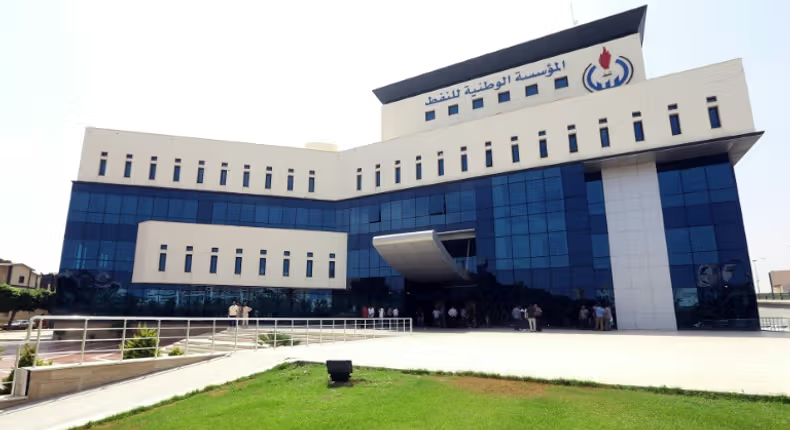
The National Oil Corporation said the well is producing 3,209 barrels of crude oil per day and about 1.95 million cubic feet of associated gas daily, according to Reuters. While the output from a single well may appear modest in the context of global oil markets, the development reflects a broader recovery underway in Libya’s energy sector after years of political instability and repeated production disruptions.
📢 GET A DETAILED ARTICLES + JOBS
Join ASJ's WhatsApp Channel and never miss a post or opportunity.
Libya holds the largest proven crude oil reserves in Africa, estimated at more than 48 billion barrels. Yet much of that potential has remained underdeveloped since the 2011 uprising that toppled Muammar Gaddafi and triggered years of political fragmentation and security challenges.
Today, however, the North African producer is mounting an ambitious comeback. The NOC has set a target of raising oil production to 2 million barrels per day in the coming years through new exploration projects, field rehabilitation programmes and investment in energy infrastructure. Earlier this year, Libya’s crude oil production climbed to about 1.43 million barrels per day, its highest level in more than a decade, according to NOC Chairman Masoud Suleiman.
The improving outlook has attracted renewed interest from some of the world’s largest energy companies. In February, Libya launched its first oil and gas licensing round since 2007, awarding exploration acreage to international firms including Chevron, Eni, QatarEnergy, Repsol and Nigeria’s Aiteo. The licensing round was widely viewed as a major signal that Libya is reopening its upstream sector after years of limited exploration activity.
According to a report by Accra Street Journal, beyond crude oil, the country is also seeking to expand its natural gas industry. Libya has stepped up efforts to increase gas production and strengthen exports to Europe, which continues to diversify its energy supply sources amid changing global energy dynamics.
For Libya, the successful Al-Khair well represents another sign that one of Africa’s most resource-rich energy producers is rebuilding capacity, attracting foreign capital and positioning itself for a larger role in regional and global energy markets.
Source: Accra Street Journal
Last Updated on June 19, 2026 by Samuel Kwame Boadu
Disclaimer: Some content on Accra Street Journal may be aggregated, summarized, or edited from third-party sources for informational purposes. Images and media are used under fair use or royalty-free licenses. Accra Street Journal is a subsidiary of SamBoad Publishing Hub under SamBoad Business Group Ltd, registered in Ghana since 2014.
For concerns or inquiries, please visit our Privacy Policy or Contact Page.

Samuel Kwame Boadu is a Ghanaian media entrepreneur and storyteller with a passion for amplifying urban voices and uncovering everyday truths. He is the Editor-in-Chief and Founder of Accra Street Journal, a dynamic digital platform dedicated to capturing the pulse of Ghana’s capital—its people, culture, challenges, business, sports and innovations.