










3 min read
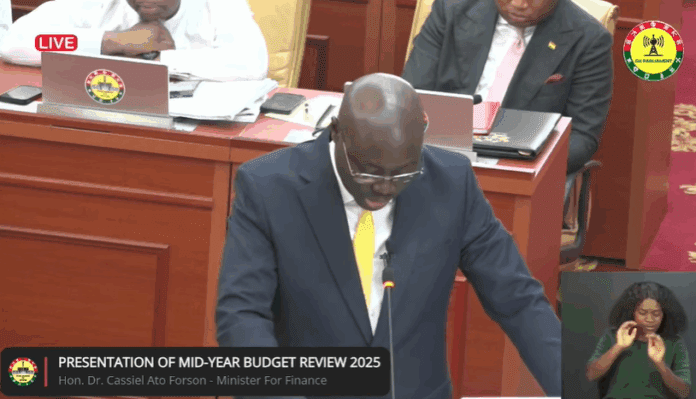
On July 24, 2025, Finance Minister Dr Cassiel Ato Forson delivered a wide-ranging Mid-Year Budget Review in Parliament, laying bare the inherited crises and outlining the reforms underway. His address, richly quoted in Accra Street Journal, also garnered coverage in Accra Business Journal.
🛢️ 1. Energy Sector: “Inherited Bleeding, Now Healing”
Dr Forson painted a sobering picture of Ghana’s energy sector, describing it as “bleeding”—with annual financing shortfalls over US $1.5 billion upon his administration’s assumption of office. He pointed to unsustainable debts, badly structured power-purchase agreements, and accrued arrears that eroded investor confidence and strained public finances.
Key Takeaways
- On July 24, 2025, Finance Minister Dr Cassiel Ato Forson delivered a wide-ranging Mid-Year Budget Review in Parliament, laying bare the inherited crises and outlining the reforms underway.
- Dr Forson painted a sobering picture of Ghana’s energy sector, describing it as “bleeding”—with annual financing shortfalls over US $1.5 billion upon his administration’s assumption of office.
- He emphasized prudence in borrowing and spending, praised the primary surplus of 11.1% of GDP achieved by mid-year, and projected growth beyond 5% with inflation heading toward the 11.9% year-end target
To address this, he announced renegotiation of power-purchase agreements and improved revenue collection systems—aimed at restoring discipline and viability in the entire value chain
2. Currency: “Cedi No Apicki”—An Appreciation Story
Highlighting a remarkable rebound, Dr Forson declared that the Ghanaian cedi has stopped depreciating, moving from approximately GH¢15 to the US$ at the start of the year, to around GH¢10.45 on the interbank market . Terming the rally “Cedi no apicki,” he credited sound fiscal and monetary policies, export gains, and rising remittances. He linked this stability to marginal declines in the costs of imported goods, signalling a positive outturn for inflation and consumer prices
3. Stronger Public Finances & Economic Outlook
Dr Forson reported that Ghana narrowed its fiscal deficit to 1.1% of GDP in the first half of 2025, improving from a projected 2.4%, and revising the year’s target downward to 3.8% . He emphasized prudence in borrowing and spending, praised the primary surplus of 11.1% of GDP achieved by mid-year, and projected growth beyond 5% with inflation heading toward the 11.9% year-end target
4. DDEP & Debt Reform: Lessons from the Past
Addressing the fallout from the Domestic Debt Exchange Programme (DDEP), Dr Forson stated that the restructuring—and its painful haircuts—resulted from “gross mismanagement of public finances” by the previous administration. He warned that many Ghanaians and pensioners lost trust and savings, calling for urgent bipartisan fiscal reforms to restore confidence in government securities
Outlook & Implications for Ghana’s Stakeholders
For Citizens:
While challenges remain—especially in energy and public debt—there are tangible gains: a stable cedi, controlled inflation, and improved fiscal indicators. This signals early economic healing.
For Businesses & Investors:
-
A stable currency reduces volatility in pricing and input costs.
-
Deficit reduction and fiscal discipline signal lower sovereign risk, which may unlock foreign investment.
-
Energy sector reforms can translate to more reliable power and lower production costs.
For Policymakers & Civil Society:
The urgency now lies in executing reforms, maintaining transparency, and building institutional capacity to ensure gains are cemented and not reversed.
Conclusion
Dr Ato Forson’s mid-year review was more than a performance report—it was a strategic pivot point. By confronting inherited challenges and committing to discipline, accountability, and stability, his administration is charting a path from economic fragility to resilience.
Last Updated on July 24, 2025 by Samuel Kwame Boadu

Disclaimer: Some content on Accra Street Journal may be aggregated, summarized, or edited from third-party sources for informational purposes. Images and media are used under fair use or royalty-free licenses. Accra Street Journal is a subsidiary of SamBoad Publishing Hub under SamBoad Business Group Ltd, registered in Ghana since 2014.

For concerns or inquiries, please visit our Privacy Policy or Contact Page.

Samuel Kwame Boadu is a Ghanaian media entrepreneur and storyteller with a passion for amplifying urban voices and uncovering everyday truths. He is the Editor-in-Chief and Founder of Accra Street Journal, a dynamic digital platform dedicated to capturing the pulse of Ghana’s capital—its people, culture, challenges, business, sports and innovations.
Use the following reference when citing or referencing this article.
Your feedback helps us improve our journalism.
Report an Error
Help us maintain accuracy. Let our editorial team know if you spot an issue in this article.
Report a problem with this article




