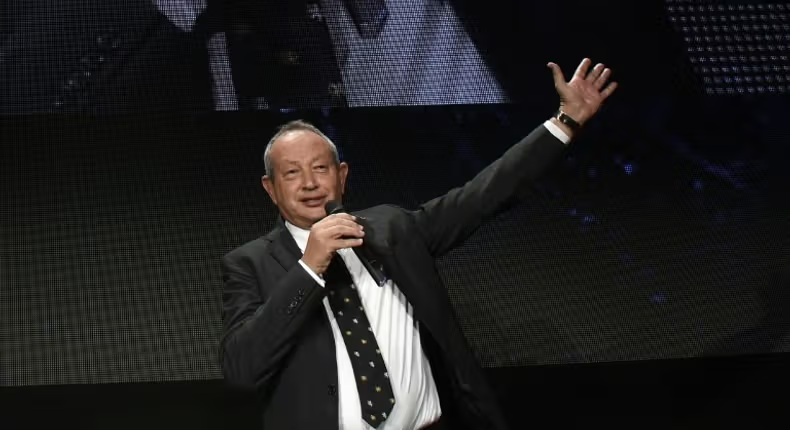
Egyptian billionaire Naguib Sawiris has strongly condemned the recent missile and drone strikes launched by Iran against the United Arab Emirates, describing the attacks as an assault not just on a nation but on a broader model of economic progress and openness in the Middle East.
The outspoken chairman of Orascom Investment Holding made the remarks on the social media platform X after Iran carried out a large-scale barrage of ballistic missiles and drones beginning on February 28.

According to data released by Emirati authorities, the attacks involved 186 ballistic missiles and more than 800 drones, making it one of the most significant aerial assaults in the region in recent years.
📢 GET A DETAILED ARTICLES + JOBS
Join ASJ's WhatsApp Channel and never miss a post or opportunity.

Sawiris framed the attack as an ideological challenge to the economic success model represented by the UAE.
“The missile and drone attacks are targeting the UAE — a war against a way of life built on freedom, progress, and success,” he wrote.
Massive Interceptions by UAE Defences
The UAE Ministry of Defence reported that most of the incoming projectiles were intercepted by the country’s air defence systems.

Out of the 186 ballistic missiles, officials said 172 were successfully intercepted, while 13 fell into the sea and one landed on Emirati territory.
Authorities also detected 812 drones, of which 755 were intercepted, while 57 managed to strike targets within the UAE.
The incident triggered widespread condemnation across the Gulf region, with political leaders describing the attack as a violation of Emirati sovereignty.
Among those responding was Anwar Gargash, foreign policy adviser to the UAE president, who said the strikes had only further isolated Tehran diplomatically.
Iran Defends Operation
Iranian officials, however, rejected the criticism and defended the operation as an act of self-defence.
Tehran said the strikes were a response to military actions carried out by the United States and Israel against Iranian targets.
Iran’s foreign ministry insisted the country was not seeking confrontation with Gulf states, emphasizing that the operation was directed at responding to what it described as external aggression.
The clash reflects the escalating geopolitical tensions across the Middle East, where military confrontations increasingly risk spilling over into broader regional conflicts.
Economic Ripple Effects in Egypt
The conflict is also beginning to send economic shockwaves beyond the immediate battleground.

In Egypt, where Sawiris is one of the country’s most prominent business figures, the national currency has recently dropped to a record low amid growing market uncertainty.
The decline represents the sharpest single-day fall since Egypt’s last major currency devaluation, highlighting the vulnerability of emerging markets to geopolitical instability.
With inflation already weighing heavily on households across Egypt’s population of more than 110 million people, authorities have moved quickly to reassure citizens that the government is prepared to cushion the economic impact.
A Broader Clash of Economic Models
For Sawiris, the attack on the UAE carries deeper implications beyond the immediate military confrontation.
The billionaire entrepreneur has long been vocal about the importance of economic openness, private sector growth, and regional stability as drivers of development in the Middle East and North Africa.
The UAE has emerged over the past three decades as one of the region’s most successful economic models, transforming itself into a global hub for trade, finance, tourism, and technology.
By framing the strikes as an attack on “freedom and progress,” Sawiris appears to be highlighting what many regional investors see as a growing ideological divide between economic modernization and geopolitical confrontation.
Global Markets Watching Closely
As tensions continue to rise, global markets remain on alert for potential disruptions to energy supply routes, shipping lanes, and financial stability.
Analysts say prolonged instability could affect oil prices, currency markets, and investor sentiment across emerging economies, particularly in the Middle East and Africa.
For now, leaders across the region are calling for de-escalation while strengthening defence cooperation and diplomatic engagement.
But the sharp reaction from influential business figures like Naguib Sawiris underscores how deeply geopolitical conflicts can resonate far beyond military circles—touching the economic ambitions and future stability of entire regions.

Source: Accra Street Journal
Last Updated on March 14, 2026 by Samuel Kwame Boadu
Disclaimer: Some content on Accra Street Journal may be aggregated, summarized, or edited from third-party sources for informational purposes. Images and media are used under fair use or royalty-free licenses. Accra Street Journal is a subsidiary of SamBoad Publishing Hub under SamBoad Business Group Ltd, registered in Ghana since 2014.
For concerns or inquiries, please visit our Privacy Policy or Contact Page.

Samuel Kwame Boadu is a Ghanaian media entrepreneur and storyteller with a passion for amplifying urban voices and uncovering everyday truths. He is the Editor-in-Chief and Founder of Accra Street Journal, a dynamic digital platform dedicated to capturing the pulse of Ghana’s capital—its people, culture, challenges, business, sports and innovations.