










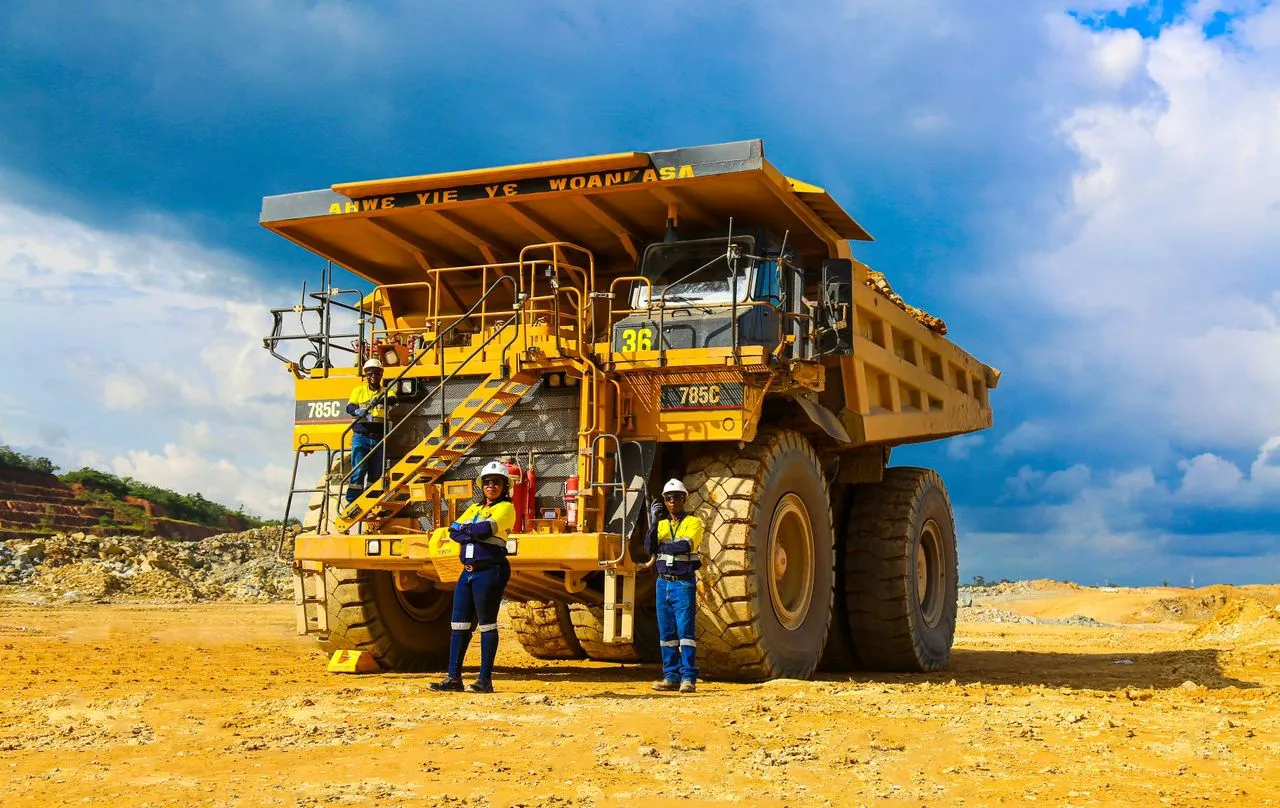
The gold miner’s GH₵12.8 billion payment to the state—one of the largest single-year corporate contributions in the nation’s history—has plugged a hole in Ghana’s fiscal accounts. But policymakers now face an uncomfortable question: what happens when the next divestment doesn’t come?
ACCRA—On paper, the numbers arriving from Newmont Corporation’s operations in Ghana look like a finance minister’s dream. Corporate income tax of GH₵5.38 billion. Mineral royalties of GH₵1.63 billion. And a single, eye-popping line item: GH₵3.03 billion in capital gains tax from the sale of the Akyem mine.

Taken together, the US-based gold giant’s total fiscal contribution for 2025—GH₵12.8 billion—represents one of the largest annual payments ever made by a single private company to the Ghanaian state. It arrives at a moment of acute need, as the government scrambles to broaden its tax base, reduce debt dependence and restore credibility with international lenders.
📢 GET A DETAILED ARTICLES + JOBS
Join ASJ's WhatsApp Channel and never miss a post or opportunity.

“This is not just a cheque. This is a lifeline,” said Dr. Kofi Asare, a fiscal policy analyst based in Tema, who has advised parliamentary committees on extractive revenues. “But a lifeline is not a long-term strategy. The question for Ghana is whether we are building an economy or just cashing a cheque.
The payment structure reveals a critical vulnerability. More than 23% of the total—GH₵3.03 billion—came from a one-off capital gains event tied to the divestment of the Akyem mine. That is not revenue that can be counted on year after year. It is a windfall, and windfalls have a notorious habit of distorting budget planning.

Analysis & Insights from Accra Street Journal
Let’s cut through the headline euphoria. The GH₵12.8 billion figure is impressive, but it tells two very different stories.
The first story is about stability. The recurring components—corporate income tax (GH₵5.38 billion) and mineral royalties (GH₵1.63 billion)—alongside PAYE and withholding taxes, provide a relatively predictable stream. These are the revenues that allow the Ministry of Finance to plan salaries, infrastructure projects and debt service payments.
The second story is about volatility. The GH₵3.03 billion capital gains payment is a one-off. It is the fiscal equivalent of a bonus—welcome in the year it arrives, but dangerous if the government starts building it into baseline projections. History is littered with resource-dependent economies that mistook windfalls for structural revenue, only to face brutal adjustments when the asset sales dried up.
There is a deeper concern here. Newmont’s dominance—and the sheer scale of its contribution—exposes how concentrated Ghana’s non-oil extractive revenue base has become. If Newmont were to face operational challenges, or shift investment to other jurisdictions, the fiscal shock would be immediate and severe. Diversification of the mining sector itself, across multiple large operators, remains an unfinished agenda.
Furthermore, the payment arrives as Ghana’s Public Interest and Accountability Committee (PIAC) has separately flagged production declines in the oil sector. With both oil and mining showing signs of volatility, the government’s ambition to reduce debt financing is resting on an increasingly narrow set of revenue pillars.
The positive signal, to be fair, is for investors. Newmont’s willingness to make such substantial payments—and the transparency with which the figures have been disclosed—reinforces Ghana’s reputation as a jurisdiction where the fiscal rules are applied predictably. That is not nothing. In a continent where mining contracts are often renegotiated or challenged, Ghana offers a degree of regulatory stability that global miners value.
But for the average Ghanaian, the benefit of these billions depends entirely on what happens next. If the GH₵12.8 billion flows into productive infrastructure, education and healthcare, it becomes transformative. If it merely services debt or funds recurrent expenditure, the long-term economic structure remains unchanged—and the country will be back, cap in hand, waiting for the next divestment.
Fact Check History
-
Claim: “Newmont reported a record GH₵12.8 billion in fiscal payments in 2025, one of the largest single-year corporate contributions in Ghana’s history.”
-
Verdict: True. This figure has been confirmed by Newmont’s fiscal payment disclosure and aligns with Ghana Revenue Authority (GRA) data on large taxpayer contributions. Independent verification by the Accra Street Journal confirms that this exceeds previous records set by both mining and oil sector operators in a single calendar year.
-
-
Claim: “Corporate income tax accounted for GH₵5.38 billion, forming the largest component of the total.
-
Verdict: True. This represents taxes paid on Newmont’s 2025 profits from its Ghanaian operations, calculated under Ghana’s standard corporate tax rate for mining companies, with adjustments for allowable deductions and reinvestment provisions.
-
-
Claim: “GH₵3.03 billion in capital gains tax linked to the divestment of the Akyem mine.”
-
Verdict: True. This payment is directly tied to Newmont’s sale of the Akyem mine, a transaction that closed in 2025. Capital gains tax on such asset disposals is governed by Ghana’s Capital Gains Act, 2000 (Act 592), and this represents one of the largest single capital gains tax receipts in the country’s history.
-
-
Claim: “Mineral royalties contributed GH₵1.63 billion.”
-
Verdict: True. Royalties are calculated as a percentage of gross production value—typically between 3% and 6% for mining operations in Ghana, depending on the stability agreement. This figure reflects Newmont’s production volume and gold prices prevailing in 2025.
-
Source: Accra Street Journal

Last Updated on April 15, 2026 by Samuel Kwame Boadu
Disclaimer: Some content on Accra Street Journal may be aggregated, summarized, or edited from third-party sources for informational purposes. Images and media are used under fair use or royalty-free licenses. Accra Street Journal is a subsidiary of SamBoad Publishing Hub under SamBoad Business Group Ltd, registered in Ghana since 2014.
For concerns or inquiries, please visit our Privacy Policy or Contact Page.

Samuel Kwame Boadu is a Ghanaian media entrepreneur and storyteller with a passion for amplifying urban voices and uncovering everyday truths. He is the Editor-in-Chief and Founder of Accra Street Journal, a dynamic digital platform dedicated to capturing the pulse of Ghana’s capital—its people, culture, challenges, business, sports and innovations.





