






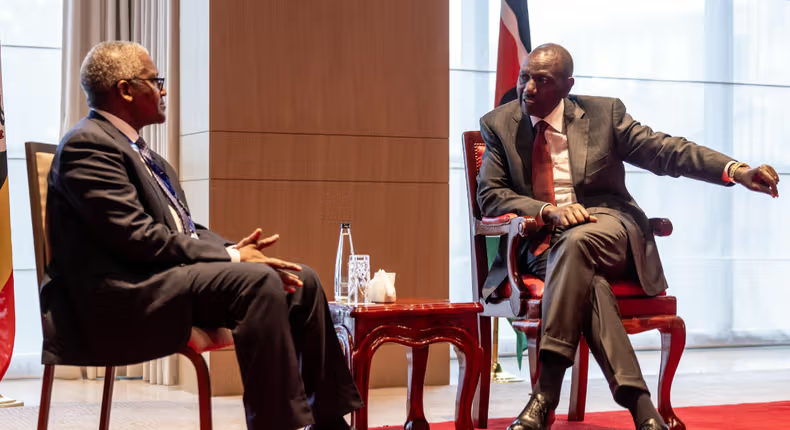

Aliko Dangote, Africa’s richest businessman, is pushing ahead with plans for a $15–17 billion oil refinery in Mombasa, Kenya, marking a big shift from earlier talks about a joint regional facility in Tanga, Tanzania. Speaking to The Financial Times, Dangote pointed to Mombasa’s better port facilities, Kenya’s bigger economy, and higher demand for refined products as key reasons. The planned refinery, with a 650,000-barrel-per-day capacity—matching the original Dangote Refinery in Nigeria before its upgrade—would rank among the largest industrial investments in East African history, far surpassing Uganda’s $4 billion, 60,000-barrel-per-day Hoima project. In a region with just one aging, mostly idle refinery in Mombasa, Dangote’s plan could be game-changing. But it’s also stirred diplomatic tension: Tanzania’s President Samia Suluhu voiced surprise at the move, while Kenya’s President William Ruto had backed the Tanga project as a joint effort with Tanzania, Uganda, South Sudan, and the Democratic Republic of Congo. Dangote’s Kenya-only approach now puts regional energy cooperation to the test, signaling a focus on business practicality over political unity.

Key Developments: Mombasa Over Tanga, Capacity, and Regional Fallout
The proposed refinery would be located in Mombasa, Kenya’s coastal city and East Africa’s busiest port. Dangote’s rationale was explicit in the FT interview: “I’m leaning more towards Mombasa because Mombasa has a much larger, deeper port.” He also emphasized Kenya’s larger economy and higher refined product consumption. “Kenyans consume more. It’s a bigger economy,” he added.
The capacity—650,000 barrels per day—would match the original Dangote Refinery in Nigeria before its announced expansion to 1.4 million bpd. For context, East and Central Africa currently has only one operational refinery (the small, underutilized facility in Mombasa itself). South Africa has seven refineries, North Africa has 21, and West Africa has 14. The region’s import dependency is almost total; Kenya, Uganda, Tanzania, Ethiopia, South Sudan, and eastern DRC collectively import billions of dollars worth of refined petroleum products annually from the Middle East, Europe, and India.
📢 GET A DETAILED ARTICLES + JOBS
Join ASJ's WhatsApp Channel and never miss a post or opportunity.
The estimated cost of 15billionto17 billion positions the project alongside major African infrastructure investments. It would be financed by Dangote Group’s own equity, development finance institutions, and potentially commercial debt. Unlike the Nigerian refinery, which faced years of delays and cost overruns, Dangote has signaled that lessons learned in Lagos would accelerate the Mombasa project.
The regional political context is delicate. In April 2026, President Ruto announced at the Africa We Build Summit in Nairobi that a joint regional refinery in Tanga, Tanzania, was under discussion, with Dangote taking the lead and completing it within four to five years. “That refinery will process oil from the DRC, Kenya, South Sudan, and Uganda,” Ruto said. “We will then build a pipeline from Tanga to Mombasa, allowing finished products to move through infrastructure we jointly own with Uganda.”
However, Tanzania’s President Samia Suluhu expressed surprise at the announcement, revealing she had not been consulted before Ruto made it public. This diplomatic friction may have contributed to Dangote’s recalibration. A regional project requires coordinated policies, aligned tax regimes, and shared infrastructure costs—all of which are difficult to negotiate. A Kenya-only project, by contrast, requires only Kenyan approvals.
Dangote’s comment—”The ball is in the hands of President Ruto. Whatever President Ruto says is what I’ll do”—is a diplomatic punt. It signals that the Nigerian billionaire is ready to build in Kenya if Nairobi moves decisively, but is not willing to wait for regional consensus.
Analysis & Implications: Why Mombasa Makes Commercial Sense
Dangote’s commercial logic is sound. Mombasa’s port is the largest and deepest in East Africa, capable of handling the very large crude carriers (VLCCs) that would supply a 650,000-bpd refinery. The port of Tanga is smaller and would require dredging and expansion—costs that would fall on the project.
Kenya’s economy is larger, with a GDP of about $146 billion—ranked seventh in Africa—compared to Tanzania’s roughly $85 billion. Kenya’s consumption of refined products like petrol, diesel, kerosene, and jet fuel is also higher, fueled by a bigger industrial base, a more developed transport sector, and a growing middle class. A refinery in Mombasa could not only Kenya but also landlocked neighbors such as Uganda, South Sudan, eastern DRC, Rwanda, Burundi, and parts of Ethiopia. The logistics work in Mombasa’s favor, as the Kenya-Uganda pipeline already carries refined products from Mombasa to Kampala.
The political economy also favors Kenya. Nairobi has been more aggressive in pursuing private investment in energy infrastructure than Dodoma. Kenya’s standard gauge railway, port modernization, and special economic zones demonstrate a pro-investment orientation that Dangote values. Tanzania’s regulatory environment, while improving, is perceived as less predictable.
The project also fits Dangote’s broader strategy of expanding his conglomerate into a $100 billion enterprise by 2030, with plans to double refinery capacity across Africa. The Nigerian refinery, originally 650,000 bpd and now expanding to 1.4 million bpd, serves West Africa. A Mombasa refinery would serve East Africa. A future facility in Southern Africa (perhaps in South Africa or Mozambique) could complete the continental triangle.
However, the commercial case is not without risks. East Africa’s refined product market is significant but not unlimited. Uganda’s Hoima refinery (60,000 bpd), when completed, will supply Uganda and parts of eastern DRC. Ethiopia is considering its own refining capacity. A 650,000-bpd refinery would produce more refined products than Kenya and its immediate neighbors can absorb, requiring exports to other African markets or to Asia. Dangote would compete with established exporters from the Middle East (Saudi Arabia, UAE) and India, which have lower crude costs and existing customer relationships.
The capital cost is also substantial. 15billionto17 billion represents nearly 10% of Kenya’s annual GDP. Raising that capital in the current high-interest-rate environment is challenging. Dangote’s self-financing capacity is strong—the group’s revenues exceed $30 billion annually—but even he may seek partners. Potential co-investors include Chinese state-owned enterprises (Sinopec, CNPC), Gulf sovereign wealth funds (ADNOC, Qatar Investment Authority), and development finance institutions (AfDB, IFC, Proparco).
What This Means for East African Energy Security and Regional Integration
For East Africa, the Dangote refinery would transform energy security. The region currently imports virtually all its refined products, spending an estimated 10billionto15 billion annually. These imports are priced in dollars, exposing national budgets to currency volatility and global oil price swings. Local refining would allow countries to pay for crude in dollars but keep more value within the region.
For Kenya, the host country, the benefits would be substantial. Construction would create tens of thousands of jobs—direct and indirect—over four to five years. Operations would create several thousand permanent skilled positions. The refinery would generate tax revenues (corporate income tax, import duties on crude, export taxes on refined products) and would anchor industrial development in Mombasa, attracting downstream industries such as petrochemicals, plastics, and lubricants.
However, Kenya’s existing Mombasa refinery, with capacity of 90,000 bpd but currently dormant, raises questions. That refinery was closed for economic reasons—it could not compete with imported products from the Middle East. A new, larger, more efficient refinery might be competitive, but the risk of being undercut by Middle Eastern producers (who have lower crude costs and access to cheaper financing) is real. Dangote’s refinery in Nigeria, despite being Africa’s largest, still faces competition from imported products; the Nigerian government has had to restrict imports to protect the domestic industry.
For Tanzania, the project is a diplomatic setback. President Samia Suluhu’s expression of surprise at the Tanga proposal suggests that coordination between Nairobi and Dodoma is weaker than Ruto had assumed. Tanzania may respond by accelerating its own energy infrastructure plans, including developing its offshore gas resources and building a liquefied natural gas export facility. Losing the Dangote refinery to Kenya may galvanize Tanzanian policymakers to be more proactive.
For Uganda, the situation is mixed. Kampala is committed to its own Hoima refinery, which is smaller (60,000 bpd) and tailored to Uganda’s needs. The Dangote refinery would not directly compete, as the two facilities could serve different markets (Uganda and eastern DRC for Hoima; Kenya, South Sudan, and Ethiopia for Mombasa). However, Uganda had hoped to be part of a regional pipeline network; Dangote’s pivot to Mombasa alone reduces the scope of that network.
For the African Continental Free Trade Area (AfCFTA), the Dangote refinery is a test of whether private investment can deliver the infrastructure integration that governments have struggled to achieve. AfCFTA’s aspiration is to create a single African market for goods and services, including energy. A Dangote refinery serving multiple East African countries would be a concrete example of that vision. But it would be a private-sector-led example, not a government-coordinated one.
Wider Context: Dangote’s Pan-African Energy Strategy
Dangote’s move into East Africa is the logical next step in a strategy that began with cement (Dangote Cement operates in over 10 African countries), extended to fertilizers (Dangote Fertilizer in Nigeria), and now culminates in energy. The Nigerian refinery was the anchor; it proved that a private African company could build, finance, and operate world-class refining capacity. The Mombasa refinery would replicate that model in a different region.
The timing is significant. Global energy markets are in flux: the Hormuz crisis has highlighted the vulnerability of Middle Eastern supply; the energy transition is creating uncertainty about long-term oil demand; and African economies are growing, increasing their demand for refined products. Dangote is betting that oil will remain a growth market in Africa for at least two more decades, and that locally refined products can compete with imports.
He’s also betting on himself. The Nigerian refinery went through years of delays, cost overruns (from an initial 9 billion to a final 19 billion), and operational challenges. Dangote has taken those lessons to heart and promised a smoother process in Mombasa. Still, with the project’s scale—rising from 15 billion to 17 billion—even small delays could be expensive.
The involvement of President Ruto as a champion is critical. Kenya has a history of large infrastructure projects (standard gauge railway, Lamu port) that were delivered, albeit with Chinese financing and contractors. A Dangote-led project, with Dangote’s equity and potentially non-Chinese financing, would diversify Kenya’s sources of infrastructure capital. Ruto’s political capital is invested in making this happen; failure would be politically damaging.
The absence of Tanzania from the current proposal is notable. Tanga had been floated as a site for a regional refinery as early as 2023, with Dangote expressing interest. The shift to Mombasa suggests either that due diligence revealed complications in Tanzania, or that Dangote prefers to deal with a single government rather than a consortium. Given President Samia Suluhu’s expressed surprise at Ruto’s announcement, the relationship between the two East African leaders may need repair before any regional energy project proceeds.
Outlook / What Happens Next
Dangote has put the ball in President Ruto’s court. The next steps are Kenyan: finalizing a fiscal package (tax incentives, import duty waivers on equipment, guarantee structures), securing land in Mombasa (likely within the special economic zone), and negotiating crude supply agreements (from which countries? under what terms?).
A memorandum of understanding could be signed within months, with a final investment decision (FID) targeted for 2027. Construction would then take four to five years, meaning the refinery could come online between 2031 and 2032. That timeline—five to six years from now—is long but credible given the scale.
The diplomatic fallout with Tanzania will need management. Ruto may visit Dodoma to reassure President Samia Suluhu that Kenya remains committed to regional energy integration, even if the refinery is in Mombasa rather than Tanga. A pipeline from Mombasa to Tanga, or a commitment to process Tanzanian crude (if Tanzania discovers commercially viable reserves), could smooth relations.
For East African consumers, the refinery promises lower fuel prices in the long term but not immediately. The capital cost must be recovered; Dangote will price his products to compete with imports, not massively undercut them. The benefit is security of supply, not necessarily cheap fuel.
For Accra Street Journal‘s readers, the Dangote refinery is a reminder that Africa’s largest industrialist is not content to dominate only one region. From Lagos to Mombasa, Dangote is building an energy empire that, if successful, would rival the major international oil companies in African markets. The question is whether execution can match ambition. In Nigeria, it eventually did—after delays. In Kenya, Dangote has the advantage of a host government eager to say yes. He also has the disadvantage of building during a period of global energy uncertainty. The bet is bold. If it pays off, East Africa’s energy landscape will be transformed. If it falters, the region will continue importing from the Gulf, waiting for a different savior.
Source: Accra Street Journal
Last Updated on May 10, 2026 by Samuel Kwame Boadu
Disclaimer: Some content on Accra Street Journal may be aggregated, summarized, or edited from third-party sources for informational purposes. Images and media are used under fair use or royalty-free licenses. Accra Street Journal is a subsidiary of SamBoad Publishing Hub under SamBoad Business Group Ltd, registered in Ghana since 2014.
For concerns or inquiries, please visit our Privacy Policy or Contact Page.

Samuel Kwame Boadu is a Ghanaian media entrepreneur and storyteller with a passion for amplifying urban voices and uncovering everyday truths. He is the Editor-in-Chief and Founder of Accra Street Journal, a dynamic digital platform dedicated to capturing the pulse of Ghana’s capital—its people, culture, challenges, business, sports and innovations.