






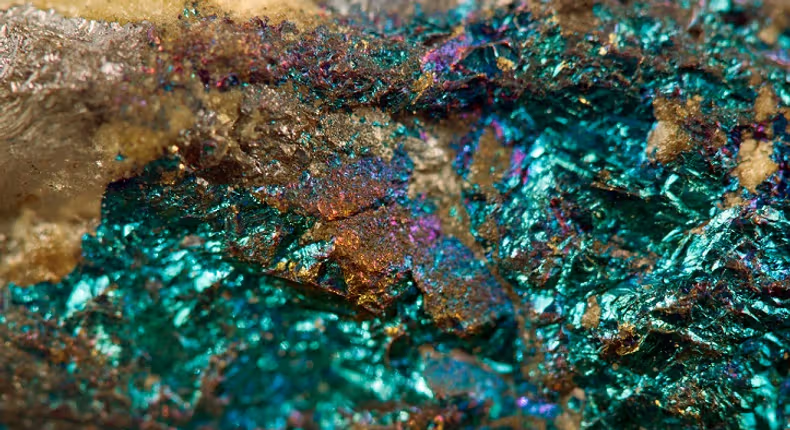

Australian mining company Aldoro Resources Ltd has reported a major find of high-grade niobium and strontium at its Kameelburg project in central Namibia, significantly boosting the estimated value and scale of the deposit. This discovery has led the company to raise N$39 million (about $2.1 million) in new funding to expand drilling. The minerals, found between Otjiwarongo and Omaruru in a geologically complex area, have important industrial uses—strontium is vital for high-performance magnets in wind turbines and electric vehicle motors, while niobium strengthens steel for pipelines, bridges, and advanced alloys. The find strengthens Namibia’s position as an emerging hub for rare earth and critical minerals, joining projects like the Lofdal rare earths development, and has caught the attention of global powers like Japan and the European Union, which are looking to diversify supply chains away from China. For a country whose economy has long relied on uranium, diamonds, and tourism, the Kameelburg find could mark a new chapter in resource-based growth—if exploration leads to production and Namibia secures value beyond just exporting raw concentrate.

Key Developments: The Discovery, the Minerals, and the Funding
Aldoro’s drilling program at Kameelburg, which is located in central Namibia’s Erongo region, has returned high-grade intersections of niobium and strontium that exceed the company’s initial expectations. While full assay results and resource estimates have not yet been published, Aldoro’s board disclosed that the deposit is of “substantial size and quantity,” and that the latest drilling shows the mineralized zone is larger and more valuable than previously modeled.
Niobium and strontium serve distinct but equally strategic functions. Niobium, a refractory metal, is primarily used as a microalloying element in high-strength low-alloy (HSLA) steels. Adding as little as 0.1% niobium can double the strength of steel while maintaining weldability and formability. This makes niobium critical for gas and oil pipelines, structural beams, shipbuilding, rail tracks, and automotive components. Global niobium production is heavily concentrated: Brazil’s CBMM controls approximately 75% of the market, with Canada’s Magris Resources and a few other producers accounting for most of the remainder. A significant new source in Namibia would diversify supply—an objective of Western governments concerned about concentration risk.
📢 GET A DETAILED ARTICLES + JOBS
Join ASJ's WhatsApp Channel and never miss a post or opportunity.
Strontium is less well-known but equally strategic. Its primary application is in strontium ferrite magnets, which are permanent magnets used in small motors for windshield wipers, power windows, speakers, and—critically—wind turbines and electric vehicle auxiliary systems. While neodymium-iron-boron (NdFeB) magnets get more attention for their superior strength, strontium ferrite magnets are cheaper, more corrosion-resistant, and remain essential for high-volume applications where cost is paramount. Global strontium supply is also concentrated, with China and Mexico as dominant producers.
The N$39 million funding agreement will finance expanded drilling to test the viability of a large-scale mining project. This is an exploration-stage funding round, not a construction budget. Aldoro must still delineate a JORC-compliant resource, conduct metallurgical test work, complete a scoping study, and then a pre-feasibility study before any mining decision. The path from discovery to production in mining typically takes 5 to 10 years. Kameelburg is promising, but it is not yet a mine.
The location—central Namibia, between Otjiwarongo and Omaruru—has existing infrastructure advantages. The area is accessible by road, has nearby rail links to Walvis Bay (Namibia’s main port), and has access to water and power. This reduces capital costs compared to remote discoveries in other African jurisdictions.
Analysis & Implications: Why Niobium and Strontium Matter for Global Green Tech
The timing of Aldoro’s announcement is not coincidental. Global demand for critical minerals is accelerating as governments implement climate policies that require massive deployment of wind, solar, battery storage, and electric vehicles. The International Energy Agency’s (IEA) 2025 Critical Minerals Review projected that demand for niobium could grow by 300% by 2040 under a net-zero scenario, driven by high-strength steel for wind turbine towers and lightweight vehicle bodies. Strontium demand could grow by 150%, driven by permanent magnet motors in EVs and industrial automation.
However, supply has not kept pace. New niobium mines are rare because the metal is often found in complex carbonatite deposits that require specialized processing. The last major niobium mine opened in 2017 (Magris’s Niobec mine expansion in Canada). Strontium is often produced as a byproduct of more valuable minerals, meaning its supply is inelastic—producers will not expand capacity unless primary mineral markets justify it.
Namibia’s geology is favorable. The Kameelburg carbonatite complex, similar in formation to Brazil’s CBMM deposit, contains the right mineralogy for potentially economic niobium extraction. The presence of strontium as a co-product improves the project’s economics because two revenue streams can share fixed costs.
For Namibia, the discovery reinforces its emerging status as a critical minerals hub. The country already hosts the Husab and Rössing uranium mines (supplying nuclear fuel), the Lofdal rare earth project (heavy rare earths), and significant lithium and tantalum potential. The government has signaled its intention to capture more value from these resources through local processing requirements, beneficiation, and industrial policy. Unlike some African countries that have imposed export bans or punitive taxes, Namibia has pursued a partnership model—offering stable fiscal terms in exchange for investment in local processing.
The international attention is real. Japan’s Japan Oil, Gas and Metals National Corporation (JOGMEC) has provided exploration funding to several Namibian projects. The European Union’s Critical Raw Materials Act identifies Namibia as a potential partner country for diversifying supply. The United States has not been as active in Namibia, though the Minerals Security Partnership (MSP)—a US-led initiative to secure critical mineral supply chains—has engaged with the Namibian government.
The win-win framing that Aldoro and its partners have adopted—investment in Namibian mining secures raw materials for Western industries while developing local processing infrastructure—is politically appealing. But the devil is in the details. Processing niobium and strontium to battery-grade or steel-grade specifications requires significant capital (a hydrometallurgical refinery for niobium could cost 500millionto1 billion). Namibia’s domestic market for these refined products is negligible; they would be exported. The question is whether the government can negotiate terms that capture value for Namibia without killing the investment.
What This Means for Namibia: Industrialization, Infrastructure, and Sovereignty
For Namibia, the Kameelburg discovery offers an opportunity to accelerate its industrialization agenda. The government has long aspired to process its minerals within its borders, not just export raw ore. Uranium is currently exported as yellowcake; diamonds are cut and polished locally to some extent, but most value addition occurs elsewhere. For niobium and strontium, the opportunity is to build a refining facility that converts ore into niobium pentoxide (Nb2O5) or ferroniobium, and strontium carbonate—products that command higher prices than unprocessed ore.
The funding for such a refinery would likely require a partnership between Aldoro, a strategic investor (perhaps a Chinese battery or steel company, a Japanese trading house, or a European specialty chemicals firm), and development finance institutions (AfDB, IFC, Proparco). Namibia’s sovereign wealth fund (the Welwitschia Fund) could also participate. The timeline for a refinery would follow mine development: a final investment decision by 2029, construction from 2030 to 2032, and commissioning by 2033.
Infrastructure will be a constraint. Namibia’s rail network, while functional, has limited capacity for bulk mineral transport. The Port of Walvis Bay has been expanded but will compete for capacity with uranium, copper, lithium, and other mineral exports. Power supply is also a concern; Namibia imports electricity from South Africa and the Southern African Power Pool. A niobium refinery would be energy-intensive. The government’s plans for solar and wind generation (Namibia has excellent solar resources) could align with green certification for refined products—a potential marketing advantage for environmentally conscious buyers.
The sovereignty question—who controls Namibia’s critical minerals and for whose benefit—will inevitably arise. The Kameelburg project is owned by Aldoro, an Australian company listed on the Australian Securities Exchange. Its shareholders are primarily Australian, UK, and North American institutional and retail investors. The government of Namibia receives taxes, royalties (the standard rate is 3% to 5% for most minerals, negotiable for strategic minerals), and potential equity (the state-owned Epangelo Mining Company has rights to participate in strategic mineral projects). But the strategic direction—how quickly to develop, with which partners, at what scale—is controlled by Aldoro’s board, not the Namibian government.
Accra Street Journal notes that this is not unique to Namibia. Every African resource economy faces the same tension: foreign capital and expertise are needed to develop resources, but foreign control means that strategic decisions are made in London, Perth, or Toronto, not in Windhoek. The solution is not to block foreign investment—that simply leaves resources in the ground—but to negotiate terms that align private incentives with national development objectives: local processing requirements, technology transfer, employment targets, and infrastructure co-investment.
Wider Context: Africa’s Critical Minerals Race and Global Supply Chains
The Kameelburg discovery is one of dozens of critical mineral projects across Africa that have attracted exploration interest in recent years. The continent is endowed with cobalt (DRC, Zambia), lithium (Zimbabwe, Ghana, Mali, Namibia), graphite (Mozambique, Tanzania, Madagascar), rare earths (Malawi, Namibia, South Africa, Angola), and nickel (Tanzania, Botswana). The global competition for these resources is intensifying as the United States, China, Europe, Japan, and South Korea all seek to secure supply chains for their green technology and defense industries.
China currently dominates processing: it refines approximately 60% of global cobalt, 70% of rare earths, and 90% of graphite. Western governments are seeking to reduce that dependency, but building alternative refining capacity takes years. Africa offers both resource potential and the opportunity to host processing facilities, provided that investment climate and infrastructure are conducive.
Namibia’s advantage is its reputation for stability, rule of law, and transparent governance. The country ranks consistently higher than most African peers on governance indices. Its mining code is well-regarded by investors. And its logistical infrastructure (Walvis Bay, rail network, road connections to landlocked neighbors) is superior to many competing jurisdictions. The Kameelburg project will test whether these advantages translate into rapid development.
The comparison with other African niobium projects is instructive. The Niobay project in Malawi (owned by Globe Metals & Mining) has been in development for over a decade without reaching production. The Mrima Hill project in Kenya (niobium and rare earths) has faced permitting delays and community opposition. The Lueshe niobium project in DRC is located in an unstable region. Kameelburg has the potential to move faster, but only if Aldoro executes effectively and the Namibian government supports the project through the permitting process.
Outlook / What Happens Next
Aldoro’s immediate priority is to complete the expanded drilling program funded by the N$39 million raise. This will define a JORC-compliant mineral resource estimate, expected in late 2026 or early 2027. Concurrently, metallurgical test work will determine the optimal processing route—whether to produce a bulk concentrate or separate niobium and strontium products.
If resource and metallurgy are favorable, a scoping study would follow in 2027, then a pre-feasibility study in 2028-2029. A final investment decision could come as early as 2029, with construction from 2030 to 2032, and first production in 2032-2033. This is a long-cycle project; patience is required.
The Namibian government should use this window to prepare. It should negotiate a clear fiscal framework for the project that incentivizes local processing. It should ensure that Epangelo Mining Company has the technical capacity to participate effectively if it exercises its equity option. And it should upgrade infrastructure (rail, power, port) in coordination with other mineral projects to achieve economies of scale.
For the Accra Street Journal‘s readers, the Kameelburg story is a reminder that Africa’s mineral wealth remains largely underexplored and underdeveloped. The discovery of high-grade niobium and strontium is good news for Namibia, for Aldoro’s shareholders, and for global supply chains seeking diversification. But the long journey from discovery to mine to refinery to export means that the benefits will be realized in the 2030s, not the 2020s. Africa is not just a source of raw materials; it is a continent of future industrial potential. Realizing that potential requires investment, policy stability, and patience. Kameelburg is a step in the right direction. The path ahead is still long.
Source: Accra Street Journal
Last Updated on May 10, 2026 by Samuel Kwame Boadu
Disclaimer: Some content on Accra Street Journal may be aggregated, summarized, or edited from third-party sources for informational purposes. Images and media are used under fair use or royalty-free licenses. Accra Street Journal is a subsidiary of SamBoad Publishing Hub under SamBoad Business Group Ltd, registered in Ghana since 2014.
For concerns or inquiries, please visit our Privacy Policy or Contact Page.

Samuel Kwame Boadu is a Ghanaian media entrepreneur and storyteller with a passion for amplifying urban voices and uncovering everyday truths. He is the Editor-in-Chief and Founder of Accra Street Journal, a dynamic digital platform dedicated to capturing the pulse of Ghana’s capital—its people, culture, challenges, business, sports and innovations.