










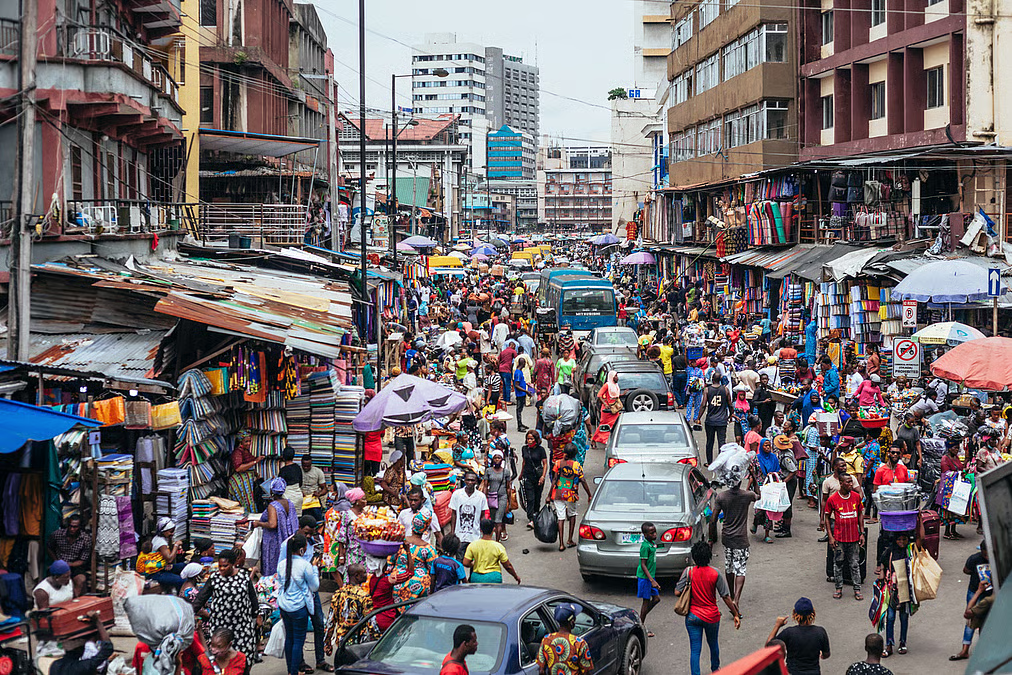
Accra’s population is growing faster than the city can prepare for it. With over 5.4 million residents already and projections of 7.5 million by 2050, the pressure on roads, drains, housing, and services is becoming unbearable. This ASJ article explains how population growth is reshaping the city’s infrastructure and what it means for ordinary residents.
The Numbers: A City Under Pressure
The scale of Accra’s growth is staggering. In 1985, the city’s built-up area was about 104 square kilometres. By 2021, it had expanded to 514 square kilometres—a nearly 400% increase . That is equivalent to converting an area the size of about 2,744 football fields from non-built to built-up land every year for 35 years .

According to projections from the Ghana Statistical Service, Greater Accra’s population stood at 5.46 million in 2021 and is expected to exceed 7.5 million by 2050 . By 2035, the region will have about 6.5 million residents—an increase of roughly 900,000 additional people within a decade .
📢 GET A DETAILED ARTICLES + JOBS
Join ASJ's WhatsApp Channel and never miss a post or opportunity.

Yet Greater Accra is Ghana’s smallest region in terms of land area, occupying only 1.4% of the country’s territory. Despite this, it is now the most populous region, with a population density of 1,680 people per square kilometre compared to about 300 in the Ashanti Region .
This is what Dr Nii Moi Thompson, Chairman of the National Development Planning Commission, calls a “perfect storm”: all the contradictions of rapid growth concentrated in a tiny geographical space .

Drainage: When Roads Become Rivers
The most visible effect of population growth is on drainage. Accra’s drains were never designed for the volume of water they now have to carry. As the Ghana Institution of Engineering (GhIE) has warned, conventional drainage infrastructure is “no longer fit for purpose” in the face of rapid urbanisation .
Why the drains are failing:
-
Loss of natural absorption: Rapid urban expansion has paved over vast areas. Impermeable surfaces mean water cannot soak into the ground. It runs off and overwhelms drains .
-
Solid waste in drains: Many of Accra’s drains have effectively become conduits for solid waste, sharply reducing their hydraulic capacity . As the population grows, waste generation rises—projected to reach 4,000 tonnes per day .
-
Loss of wetlands: Natural retention ponds and wetlands that historically absorbed stormwater have been filled in or built over. The water that used to take about 12 hours to travel from Aburi to Accra now arrives in about one hour .
Former DRIP Chief Executive Nii Lante Vanderpuye has noted that Accra’s “very critical and unprecedented growth” has not been matched by proportional investment in drainage systems . The result is that flooding is no longer a seasonal event—it is a structural challenge driven by urbanisation itself .
Housing: Too Many People, Too Few Homes
Ghana’s housing deficit stands at over 1.8 million units . This shortage has created a crisis for lower- and middle-income earners, who “struggle daily to find decent accommodation” .
The effects are visible across the city:
-
Slum growth: Slum dwellers make up 38.4% of Accra’s population and occupy about 15.7% of the city’s land area .
-
Flood-prone settlements: Inadequate housing supply has pushed people into unsafe areas, including along waterways and in wetlands. As one resident living along the Odaw River put it: “I migrated from my village for greener pastures in Accra, but I can’t afford rent. At least here, I don’t have to pay to stay” .
-
Skyrocketing rent: The housing shortage has driven rental prices beyond the reach of many, forcing families to move further from the city centre—where services are weaker and travel times longer .
The Ga Mantse, King Tackie Teiko Tsuru II, has warned that without decisive action on housing, “national productivity and social stability would remain at risk” .
Transport: The High Cost of Congestion
Traffic congestion has become one of Accra’s defining characteristics. The economic cost runs into millions of cedis annually through lost productivity, increased fuel consumption, and environmental pollution .
The scale of the problem:
-
Traffic across major highways in the Greater Accra Metropolitan Area has increased between 2.5% and 14.8% per annum .
-
A civil servant who should have a 45-minute commute spends nearly two hours in traffic each morning .
-
A student at Ghana Law School has sustained burns on her legs from using motorbikes to skip traffic .
The imbalance is stark. Cars, used by a minority, occupy a disproportionate share of road space. But investment in mass transit systems has been inadequate, leaving many residents with no choice but to rely on private vehicles due to issues of limited reach, reliability, and quality .

As the Ga Mantse noted, “Accra is choked with congestion on planned settlements, strained sanitation systems, inadequate drainage, and uncondemnated infrastructure” .
The Uneven Burden: Services Falling Behind
One of the most telling effects of population growth is the spatial mismatch between where people live and where services are located. New development has been predominantly residential, concentrated in peri-urban areas far from the city centre .
The result: Some peripheral communities are more than nine kilometres from essential services like healthcare facilities, primary schools, or markets . This makes it costly in time and money to use non-motorised modes, while increasing the appeal of the car.
Worse, districts with the greatest expansion in the built environment tend to have the least road infrastructure overall, making them “extremely disconnected” . This disconnection takes the form of unpaved roads, long street segments, and vulnerability to weather conditions—making mass transit systems financially unviable in those areas .
The Economic Concentration Problem
Greater Accra contributes about 38% of Ghana’s GDP and attracts approximately 86% of the country’s foreign direct investment, despite occupying only 1.4% of the land area . This massive concentration of economic activity, population, and investment in a single region has created what the NDPC Chairman calls “structural distortions that are actually getting worse” .
The “pull effect” draws people from across Ghana in search of better living conditions, employment, and education . But without corresponding investment in infrastructure, the result is: “the flooding, the collapsing buildings and everything” .
The NDPC is finalising a consolidated national development plan aimed at promoting more balanced regional growth and reducing the overconcentration of people and economic activities in the capital .
What This Means for Ordinary Ghanaians
For residents, the effects of population growth are immediate and personal:
-
Longer commutes: Hours lost in traffic mean less time with family and less productivity.
-
Higher living costs: Rent, transport, and food prices are driven up by demand.
-
Flood risk: Every rainy season brings the fear of displacement and loss.
-
Health risks: Poor sanitation, blocked drains, and flooding create conditions for disease.
-
Service gaps: Essential services are further away and harder to access.
The Way Forward
Experts agree that Accra’s infrastructure challenges require a fundamental shift in approach:
Long-term planning: The Ga Mantse has called for a new comprehensive master plan for Accra, arguing that “the modern capital is not inherited. It is designed. It is planned. It is deliberately built” .
Nature-based solutions: The GhIE is advocating decentralised, nature-based stormwater management systems, including permeable pavements, bioswales, rain gardens, green roofs, and rainwater harvesting .

Balanced regional development: The NDPC is prioritising measures to encourage investment and economic opportunities outside Greater Accra .
Stronger enforcement: Political interference and weak enforcement of planning regulations have been identified as key obstacles. As the GARID Project Coordinator has noted: “We should get away from this patronage system… thereby undermining the law” .
Public transport investment: Accra needs a coordinated, well-funded public transport system that serves everyone, not just car owners .
Quick Facts
| Topic | Details |
|---|---|
| Built-up Area (1985) | 104 km² |
| Built-up Area (2021) | 514 km² |
| Population (2021) | 5.46 million |
| Projected Population (2050) | 7.5 million |
| Population Density | 1,680 people/km² |
| Housing Deficit | 1.8 million units |
| Slum Dwellers | 38.4% of population |
| Greater Accra GDP Share | 38% of national GDP |
| Greater Accra FDI Share | 86% of national FDI |
| Traffic Increase (Annual) | 2.5% – 14.8% |
Frequently Asked Questions
1. How fast is Accra’s population growing?
Accra’s population stood at 5.46 million in 2021 and is expected to exceed 7.5 million by 2050. The city’s built-up area expanded by nearly 400% between 1985 and 2021 .
2. Why is Accra flooding so often?
Flooding is driven by rapid urbanisation, loss of natural wetlands, solid waste blocking drains, inadequate drainage infrastructure, and weak enforcement of planning regulations. The GhIE has warned that flooding is now a “structural challenge,” not just a seasonal event .
3. What is Accra’s housing situation?
Ghana faces a housing deficit of over 1.8 million units. Lower- and middle-income earners struggle to find decent accommodation, leading to slum growth, development in flood-prone areas, and rising rents .
4. How does population growth affect traffic?
Traffic across major highways in the Greater Accra Metropolitan Area has increased by 2.5% to 14.8% annually. Commuters spend hours in traffic, and the economic cost runs into millions of cedis annually .
5. What are the main challenges to fixing Accra’s infrastructure?
Key challenges include institutional fragmentation, weak enforcement of planning laws, political interference, and the massive concentration of population and economic activity in a tiny geographical area .
6. What solutions are being proposed?
Experts are calling for a new master plan for Accra, nature-based stormwater management, balanced regional development, stronger enforcement of planning laws, and investment in public transport
Source: Accra Street Journal
Last Updated on September 2, 2026 by Samuel Kwame Boadu
Disclaimer: Some content on Accra Street Journal may be aggregated, summarized, or edited from third-party sources for informational purposes. Images and media are used under fair use or royalty-free licenses. Accra Street Journal is a subsidiary of SamBoad Publishing Hub under SamBoad Business Group Ltd, registered in Ghana since 2014.
For concerns or inquiries, please visit our Privacy Policy or Contact Page.

Samuel Kwame Boadu is a Ghanaian media entrepreneur and storyteller with a passion for amplifying urban voices and uncovering everyday truths. He is the Editor-in-Chief and Founder of Accra Street Journal, a dynamic digital platform dedicated to capturing the pulse of Ghana’s capital—its people, culture, challenges, business, sports and innovations.





