


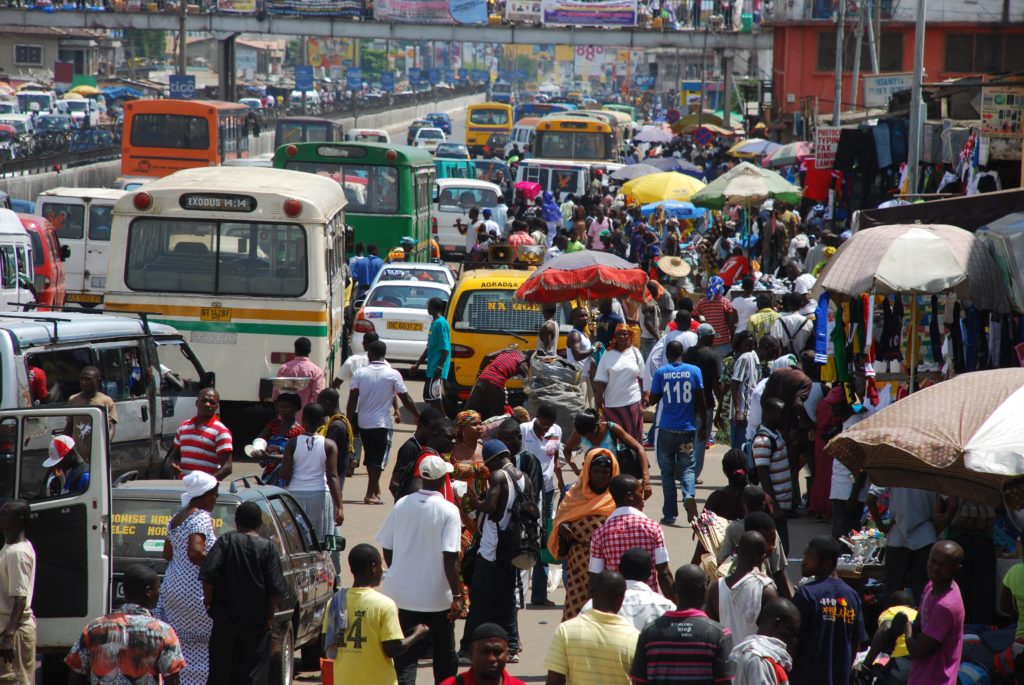
From waste collection and flooding to air quality and institutional failure, Accra’s environmental challenges are deeply interconnected. Understanding these realities is the first step toward solving them.
Introduction: A City Overwhelmed
Every rainy season, Accra receives the same warning, and many residents receive the same floodwaters . For over six decades, the city has flooded in the same places, for largely the same reasons, and the people paying the heaviest price are, as ever, the poor .

The problem is not simply the rain. It is a “dangerous interaction between inadequate infrastructure, poor urban governance, weak enforcement and irresponsible human behaviour” . This ASJ article examines the key realities behind Accra’s environmental challenges, from waste management and flooding to air quality and institutional failure.
📢 GET A DETAILED ARTICLES + JOBS
Join ASJ's WhatsApp Channel and never miss a post or opportunity.

The Waste Crisis: A System on the Brink
4,400 Tonnes of Waste Daily
Accra now generates an estimated 4,400 tonnes of waste daily—roughly the equivalent of 4,400 fully loaded aboboyaa tricycles . This places an enormous strain on an already overstretched waste management system.
The Landfill Crisis
Greater Accra faces an acute shortage of landfill sites. The city currently relies on only two major landfill facilities to dispose of the thousands of tonnes of waste generated daily . The Kpone landfill, which has served the region, is “full and exhausted” and expected to be shut down within six months . The only other major landfill is the 120-acre Adepa facility beyond Nsawam in the Eastern Region—a round trip of more than 40 kilometres that makes it difficult for waste collection trucks to make more than one trip per day .

The Transfer Station Collapse
The problem is compounded by the closure of most transfer stations. Accra previously operated about six transfer stations, but only two are currently functional because of inadequate funding . During his tenure as Mayor, Dr Alfred Okoe Vanderpuije explained, aboboyaa operators were required to take waste to designated transfer stations, where waste management companies would collect it and transport it to final disposal sites . The system worked until the transfer stations were closed, leading to indiscriminate dumping.
As the Borla Taxi and Tricycle Association has revealed, operators are now forced to queue for days at the only functioning dump site . “As we speak, only one dumping site is serving Accra, compared to the 17 operational sites the city had in 2023,” the General Secretary stated .
The Cost of Distance
Waste collection companies that previously made up to three trips daily are now able to complete only one, slowing waste evacuation and allowing refuse to pile up in communities . The delays mean many operators are unable to complete multiple collection trips daily, significantly affecting their income while slowing refuse collection .
Flooding: A 66-Year Crisis
The 2015 Turning Point
Eleven years after the 3 June 2015 flood and fire disaster that killed more than 150 people at a fuel station near Kwame Nkrumah Circle, Accra remains trapped in a cycle of disaster, outrage, and promises of reform .
The Five Root Causes
Every credible study points to the same five factors:
-
Low-lying geography: Accra sits on a coastal plain drained by a handful of rivers and lagoons, with the Odaw basin where the worst disasters concentrate—low-lying, densely populated, ringed by informal settlements .
-
Loss of natural water retention: Wetlands, ponds, and lagoons that once absorbed stormwater have been steadily diminished and encroached upon. Richard Kofi Amekor, Head of Drainage at the Ministry of Works, Housing and Water Resources, explained: “What happens is people have encroached on these wetlands within these ponds. Even the lagoons that we have in the outlets, they are all heavily encroached so they are diminished. They have reduced in capacity and even in size, so when it rains heavily you will think that the drains are inadequate” .
-
Solid waste in drains: Many of Accra’s drains have effectively become conduits for solid waste, sharply reducing their hydraulic capacity . It is a common practice for some residents to use heavy downpours as a free waste disposal service, emptying domestic bins directly into fast-flowing runoff . This plastic and solid waste travels downstream, rapidly coalescing at narrow culverts and major arteries like the Odaw River and Korle Lagoon, creating makeshift dams .
-
Inadequate drainage infrastructure: Drainage systems designed for a much smaller city are now overwhelmed . The Ghana Institution of Engineers has been blunt: “We have done things the wrong way for over 30–40 years . Natural water retention areas that once absorbed rainfall have been built over; drainage systems are often blocked or inadequate; rapid urbanisation has replaced permeable land with concrete, accelerating surface runoff .
-
Weak enforcement and institutional fragmentation: Planning regulations exist. Building codes exist. Restrictions on waterways exist. Yet enforcement often collapses under political pressure, bureaucratic inefficiency or corruption . The fragmentation of Greater Accra into numerous municipal assemblies has weakened coordination, and as Amekor noted, “you go to places where you are to enforce the law, the local authorities even don’t have the power to do that because everybody is afraid .
The 2026 Crisis
June 2026 became the wettest June since 1995, with 593.2mm recorded . Rain fell on about 22 of the 30 days, leaving very few dry days for drainage systems to recover . At least five people died, and roads, homes, and businesses were submerged .
Air Quality: An Invisible Threat
Beyond the visible crises of flooding and waste, Accra also faces a serious air quality challenge. Research on particulate matter (PM2.5, PM10) and black carbon in rapidly urbanizing cities highlights significant health risks associated with poor air quality. In Accra, concentrations of PM2.5 (38.6 μg/m³) and PM10 (80.3 μg/m³) exceed WHO guidelines, posing respiratory and cardiovascular health risks, particularly for vulnerable populations.
Institutional Failures: The Missing Link
A Governance Failure
The recurring official explanation—most recently President Mahama’s framing of the crisis as “indiscipline”—locates the cause primarily in citizen behaviour: dumping plastic, building illegally. That explanation is not wrong. But as the UNDP has noted, it is “incomplete in a way that shifts responsibility away from the state’s own failures to enforce, plan, resettle and build, and onto residents who have, in many cases, been offered no safe alternative” .
The GARID Question
Perhaps nowhere is the frustration more visible than in the World Bank-funded Greater Accra Resilient and Integrated Development (GARID) project. The World Bank has committed more than $300 million across multiple phases of the initiative, yet implementation has faced significant delays. A World Bank official expressed frustration: “The financing has been made available and significant resources have already been committed. From our perspective, some implementation delays have become unacceptable. Communities are waiting for critical flood infrastructure while contractual and operational issues remain unresolved .

Political Interference
Inspections have revealed extensive obstruction of natural drainage channels by private developments, with people “actually blocking them entirely and building over them” . The GARID Coordinator has argued that unless Ghana overcomes political interference and consistently applies planning laws, investments in drainage infrastructure alone will not significantly reduce flooding .
What This Means for Ordinary Ghanaians
For residents, the realities are immediate and personal:
-
Flood risk: Every rainy season brings the fear of displacement and loss. “I have replaced furniture three times in five years,” said Ama Adjei, a trader in Alajo whose home flooded . “Every year, politicians come here, but when the rain starts, we are left alone” .
-
Waste accumulation: Refuse piles up in communities as collection becomes less frequent . In Alogboshie, taxi driver Mohammed Sulemana says residents now fear both flooding and unfinished construction .
-
Health risks: Poor sanitation and blocked drains create conditions for disease. The Council of State has warned that continued encroachment on wetlands could trigger cholera outbreaks .
-
Economic costs: For traders and business owners, each flood means lost inventory, damaged goods, and lost income. The economic rhythm of the capital grinds to a halt .
The Way Forward
Engineering Meets Enforcement
Fixing this perennial menace requires moving away from the annual, reactive ritual of desilting gutters just as the rains begin . The ultimate solution demands a massive shift in civic discipline and rigid law enforcement .
As the UNDP noted: “We must foster a culture of shared environmental responsibility where indiscriminate dumping is socially unacceptable and logistically unnecessary through robust waste management systems. Simultaneously, local government authorities must strictly enforce municipal bylaws without fear or favour—penalizing polluters and aggressively halting unauthorized structures in low-lying zones” .
Sustainable Financing
Dr. Peter Kwei Dagadu has warned that “sustainable financing remains the biggest obstacle” to implementing waste projects . What households pay for waste collection is not enough to sustain downstream operations. Government support is required to keep these facilities operational .
Long-Term Planning
Former Mayor Vanderpuije has argued that governments have failed to adopt a comprehensive approach: drainage, refuse collection, waste disposal, and road infrastructure should be addressed together rather than separately . He called for stronger coordination among the assemblies, led by the Greater Accra Regional Coordinating Council, to develop and implement a unified strategy .
Nature-Based Solutions
The Ghana Institution of Engineering has advocated a shift toward decentralised, nature-based stormwater management systems—including permeable pavements, bioswales, rain gardens, green roofs, and rainwater harvesting—designed to mimic natural hydrological processes .
Quick Facts
| Topic | Details |
|---|---|
| Daily Waste Generated | 4,400 tonnes |
| Operational Dump Sites (2023) | 17 |
| Operational Dump Sites (2026) | 1 (plus distant Adepa) |
| Kpone Landfill Status | Nearing closure within 6 months |
| Functional Transfer Stations | 2 out of 6 |
| World Bank GARID Funding | $300 million+ |
| Rainfall (June 2026) | 593.2mm (wettest June since 1995) |
Frequently Asked Questions
1. How much waste does Accra generate daily?
Accra generates between 4,000 and 5,000 tonnes of waste daily, equivalent to about 4,400 fully loaded aboboyaa tricycles .
2. Why is Accra’s waste crisis so severe?
The crisis stems from the closure of most transfer stations, the Kpone landfill nearing capacity, the long distance to the only alternative landfill at Adepa (40+ km round trip), inadequate funding, and the suspension of public cleansing activities .
3. Why does Accra flood so often?
Flooding is caused by low-lying geography, loss of natural wetlands, solid waste in drains, inadequate drainage infrastructure, weak enforcement of planning laws, and institutional fragmentation .
4. What happened to Accra’s transfer stations?
Accra previously operated about six transfer stations, but only two are currently functional because of inadequate funding . Their closure has led to indiscriminate dumping by aboboyaa operators .

5. What is the GARID project?
The Greater Accra Resilient and Integrated Development (GARID) project is a $300 million+ World Bank-funded initiative to improve flood risk management, drainage, solid waste management, and infrastructure across the Odaw River Basin. Implementation has faced significant delays .
6. How does air quality affect Accra?
Research shows that concentrations of PM2.5 (38.6 μg/m³) and PM10 (80.3 μg/m³) in Accra exceed WHO guidelines, posing significant respiratory and cardiovascular health risks .
7. What is the solution to Accra’s environmental challenges?
Experts call for a combination of improved infrastructure, stronger enforcement of planning laws, sustainable financing, nature-based stormwater management, coordinated governance across assemblies, and a shift in civic discipline
Source: Accra Street Journal
Last Updated on September 2, 2026 by Samuel Kwame Boadu
Disclaimer: Some content on Accra Street Journal may be aggregated, summarized, or edited from third-party sources for informational purposes. Images and media are used under fair use or royalty-free licenses. Accra Street Journal is a subsidiary of SamBoad Publishing Hub under SamBoad Business Group Ltd, registered in Ghana since 2014.
For concerns or inquiries, please visit our Privacy Policy or Contact Page.

Samuel Kwame Boadu is a Ghanaian media entrepreneur and storyteller with a passion for amplifying urban voices and uncovering everyday truths. He is the Editor-in-Chief and Founder of Accra Street Journal, a dynamic digital platform dedicated to capturing the pulse of Ghana’s capital—its people, culture, challenges, business, sports and innovations.