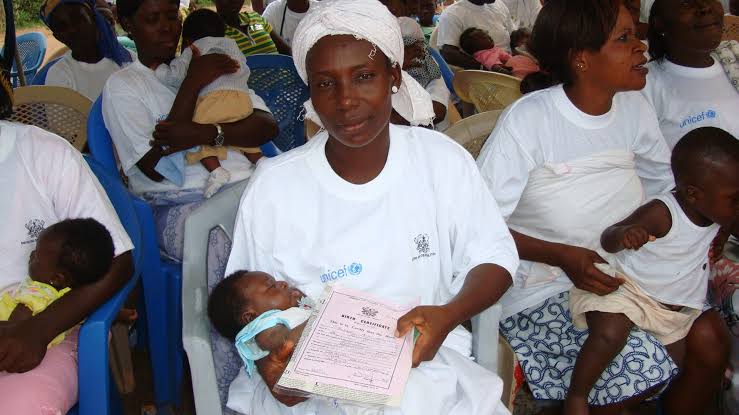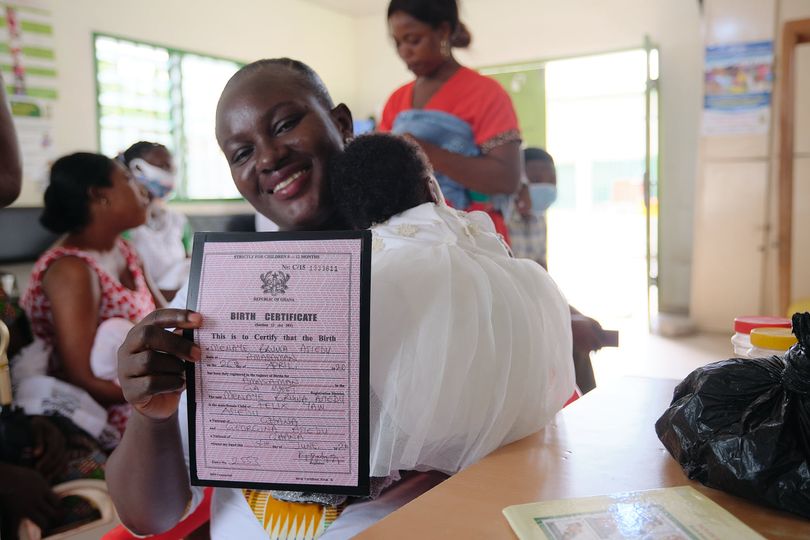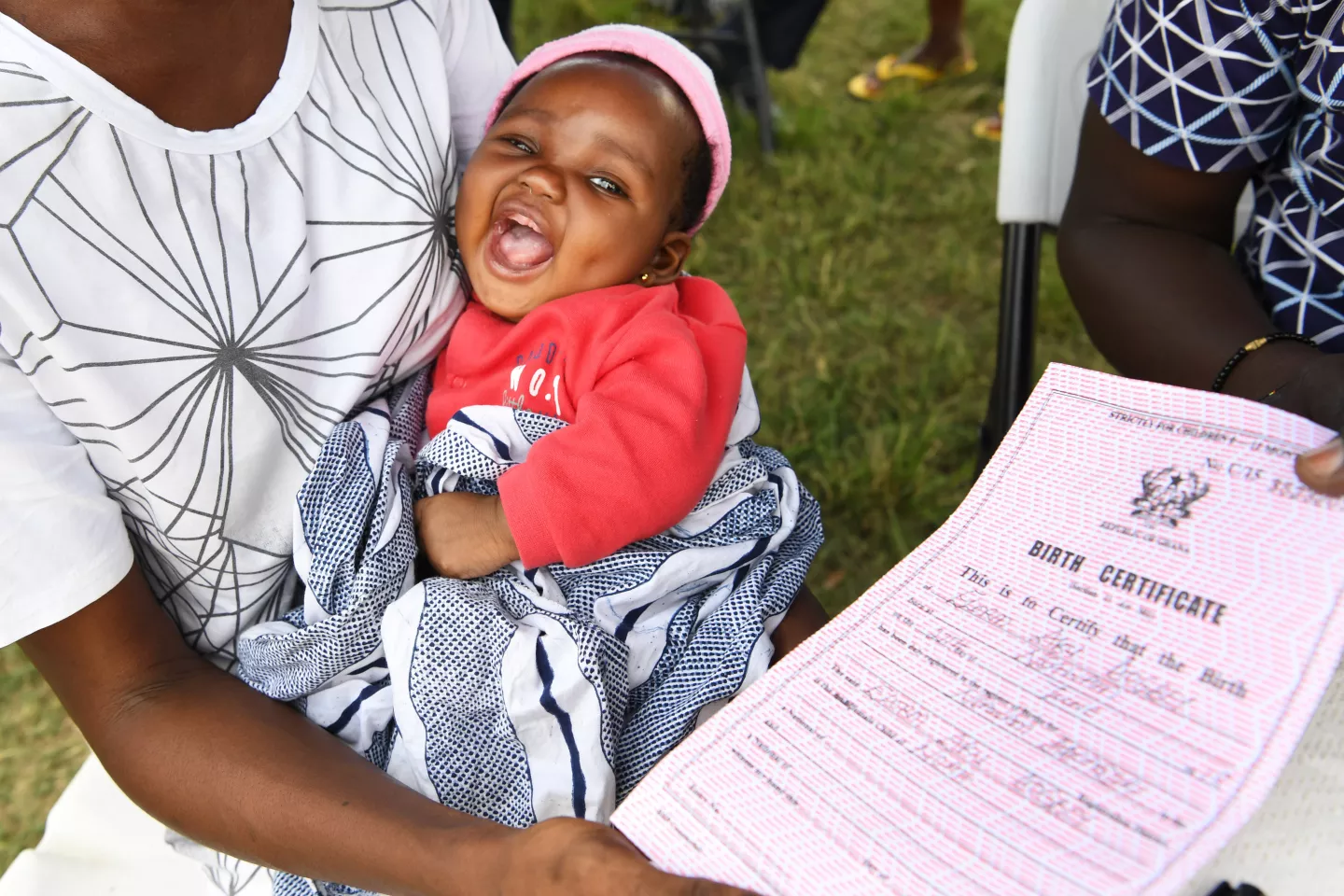
A birth certificate is the foundational document of a person’s legal identity in Ghana. It proves your name, your date of birth, your parentage, and your nationality. Without it, you cannot obtain a Ghana Card, apply for a passport, enrol in school, or access many government services. Yet many Ghanaians were never registered at birth—and the process for late registration is more complex than registering a newborn. Here is what you need to know.
The Two Tracks: Newborn vs Late Registration
The Births and Deaths Registry (BDR) operates under the Registration of Births and Deaths Act, 1965 (Act 301). The law distinguishes between births registered within the first year and those registered later.

Newborn Registration (Within 12 Months)
Registration is free for children within 12 months of birth . The parent must visit the nearest BDR office in the district where the birth occurred, present evidence of the birth—typically the maternal health record book or weighing card—and provide the required biodata .
📢 GET A DETAILED ARTICLES + JOBS
Join ASJ's WhatsApp Channel and never miss a post or opportunity.

The informant must provide the child’s full name, date and place of birth, and details of both parents, including name, age, occupation, religion, nationality, and educational background. Any nationality claimed must be supported with evidence, such as a national ID or passport .
Late Registration (After 12 Months)
If the birth was not registered within the first year, the process becomes more involved and attracts a fee .

The informant—the parent, or the adult applicant themselves—must visit the nearest BDR office in the district where the birth occurred. They must present evidence of birth, which can include a clinical weighing card, a baptismal certificate issued within five years of birth, an extract from a family records book, or an affidavit from one of the parents.
The Registration Assistant will partially complete Form A and a Declaration Form. The informant then pays the prescribed fee and declares the documents before a Commissioner of Oaths, Court Registrar, or Notary Public. The documents are forwarded through the District and Regional Registration Offices for approval, and the certificate is finalised at the Central Registry Office .
Important: A birth should not be reported for registration more than once .
Required Documents
The exact requirements vary depending on the BDR office and whether the registration is new or late, but the following are commonly requested:
-
Evidence of birth – Maternal health record book, weighing card, or baptismal certificate (issued within five years of birth)
-
Parents’ identification – Ghana Card, passport, or voter ID
-
Completed application form – Obtained at the BDR office
-
Passport-sized photographs – For older registrations
-
Proof of residential address – Some district assemblies require this
For late registration, a Declaration Form must be sworn before a Commissioner of Oaths, Court Registrar, or Notary Public .
A note on names: Only the full name of the child is accepted. Short forms and titles are not permitted. The mother’s name must be her full maiden name .
Fees
The fee structure has been a source of confusion, with different figures circulating. Here is what the available information shows:
Newborn registration (0–12 months): Free
Late registration: A prescribed fee applies. Reports from October 2026 indicate that birth certificates for children aged one to five years cost GH¢13, and for individuals aged five to 59 years, the fee is GH¢26 . Other sources cite figures ranging from GH¢20 to GH¢100 depending on the service and processing time, but these are less authoritative .

Certified copies: A small fee applies for certified copies of existing records .
Because fees can change and may vary by district, confirm the current rate at the BDR office before paying.
Where to Apply
You must apply at the BDR office in the district where the birth occurred . This is a legal requirement, not a matter of convenience. If you were born in Kumasi but live in Accra, you must register at the BDR office in Kumasi.
Some district assemblies also facilitate registration in collaboration with the BDR. The Ningo-Prampram District Assembly, for example, processes applications at its office in Prampram during working hours, with a processing time of 5–7 working days for standard cases.
The Recent Suspension of Instant Services
In October 2026, the Registrar-General announced the suspension of instant birth certificate services. The reason given was to allow for a review of the system. This means that applicants should not expect same-day issuance at this time. Processing times of several working days, or longer for late registrations, should be anticipated .
Why It Matters Beyond the Certificate
The birth certificate is not just a piece of paper. It is the gateway to the Ghana Card. The National Identification Authority uses birth records to establish citizenship and identity. Without a birth certificate, obtaining a Ghana Card becomes significantly more difficult—and without a Ghana Card, access to banking, formal employment, and government services is restricted.
For parents, registering a birth within the first year is free, straightforward, and saves the child from the complexity of late registration later in life. For adults who were never registered, the late registration process exists—but it requires patience, documentation, and a trip to the district of birth.
Quick Facts
| Topic | Details |
|---|---|
| Governing Law | Registration of Births and Deaths Act, 1965 (Act 301) |
| Newborn Registration Fee | Free (within 12 months) |
| Late Registration Fee | GH¢13 (1–5 years); GH¢26 (5–59 years) |
| Where to Apply | BDR office in district of birth |
| Key Document | Maternal health record book or weighing card |
| Late Registration Requirement | Declaration before Commissioner of Oaths |
| Instant Service | Suspended (October 2026) |
| Processing Time | 5–7 working days (standard) |

Last Updated on October 23, 2026 by Samuel Kwame Boadu
Disclaimer: Some content on Accra Street Journal may be aggregated, summarized, or edited from third-party sources for informational purposes. Images and media are used under fair use or royalty-free licenses. Accra Street Journal is a subsidiary of SamBoad Publishing Hub under SamBoad Business Group Ltd, registered in Ghana since 2014.
For concerns or inquiries, please visit our Privacy Policy or Contact Page.

Samuel Kwame Boadu is a Ghanaian media entrepreneur and storyteller with a passion for amplifying urban voices and uncovering everyday truths. He is the Editor-in-Chief and Founder of Accra Street Journal, a dynamic digital platform dedicated to capturing the pulse of Ghana’s capital—its people, culture, challenges, business, sports and innovations.