


4 min read
The African Development Bank Group has secured a JPY86.6 billion ($583.4 million) concessional loan from Japan to expand affordable development financing for Africa’s lowest-income countries under the African Development Fund’s 17th replenishment.
The African Development Bank (AfDB) Group has secured a JPY86.6 billion ($583.4 million) concessional loan from Japan to expand affordable development financing for Africa’s lowest-income countries under the African Development Fund’s 17th replenishment (ADF-17).
Key Takeaways
- The African Development Bank Group has secured a JPY86.6 billion ($583.4 million) concessional loan from Japan to expand affordable development financing for Africa's lowest-income countries under the African Development Fund's 17th replenishment.
- The agreement comes as African countries face growing development financing requirements and pressure to mobilise affordable, long-term capital for infrastructure expansion, economic diversification and job creation.
- Japan joined the African Development Fund in 1973 and the African Development Bank in 1982, with the partnership covering concessional financing, private sector investment, human capital development, technical assistance and knowledge exchange.
The financing, provided through the Japan International Cooperation Agency (JICA), is expected to strengthen the Fund’s capacity to support critical investments in infrastructure, energy access, food security and regional integration.
The agreement comes as African countries face growing development financing requirements and pressure to mobilise affordable, long-term capital for infrastructure expansion, economic diversification and job creation.
The Signing
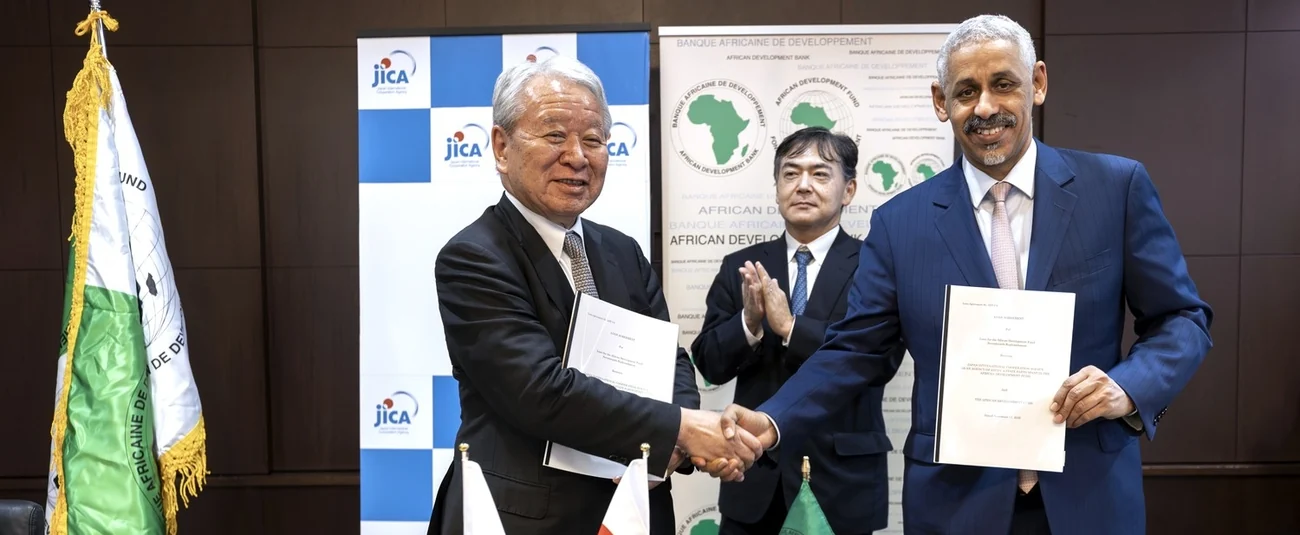
AfDB Group President Dr Sidi Ould Tah and JICA President Dr Akihiko Tanaka signed the loan agreement in Tokyo on November 13.
Dr Tanaka said the financing demonstrated Japan’s commitment to Africa’s development and confidence in the Fund’s ability to address interconnected development challenges.
He described it as JICA’s largest-ever Official Development Assistance (ODA) financing support to the African Development Fund, reflecting the importance Japan attached to resilient, inclusive and sustainable development across the continent.
A Record Replenishment
Dr Ould Tah said ADF-17 had mobilised a record $11 billion from 44 development partners, but added that the Bank’s ambition extended beyond raising additional resources to changing how development finance was mobilised and deployed.
Through the New African Financial Architecture for Development, we are transforming how Africa mobilises and deploys development finance,” he said.
The Japanese loan fulfils a commitment made by the country’s Ministry of Finance during the ADF-17 replenishment pledging session in December 2025.
It complements Japan’s other contributions to the Fund, including grants and compensation under the Multilateral Debt Relief Initiative, which together amount to approximately $600 million.

Japan’s Expectations
Japan’s Deputy Vice Minister for International Affairs at the Ministry of Finance, Mr Kazuki Watanabe, said the country expected ADF-17 to deliver tangible development outcomes through investments in quality infrastructure, stronger governance, institutional capacity and sustainable debt management.
The Tokyo agreement follows an earlier signing ceremony on November 5 at the AfDB Group’s headquarters in Abidjan, Côte d’Ivoire, where the Bank’s Vice-President for Finance and Chief Financial Officer, Ms Hassatou Diop N’Sele, and Japan’s Ambassador to Côte d’Ivoire, Mr Junji Gomakubo, exchanged official diplomatic notes to formalise Japan’s financing commitment.

Japan joined the African Development Fund in 1973 and the African Development Bank in 1982, with the partnership covering concessional financing, private sector investment, human capital development, technical assistance and knowledge exchange.
A New Financing Model
The ADF-17 replenishment also introduces a more investment-driven financing model intended to increase the Fund’s capacity to mobilise development capital.
Under the approach, the Fund will deploy innovative financing instruments, including concessional donor loans and a new market borrowing framework, to leverage existing resources and attract additional capital.
The strategy is expected to expand access to affordable, long-term financing for eligible African countries while enabling development partners to maximise the impact of their contributions.
That structural shift is the more consequential element. A concessional fund that borrows against its own balance sheet can multiply donor contributions, but it also assumes new financial obligations — a model that requires disciplined capital management and creditworthiness that the Fund has only recently begun to establish.
Quick Facts
The African Development Bank Group has secured a JPY86.6 billion ($583.4 million) concessional loan from Japan through JICA for the African Development Fund’s 17th replenishment, supporting infrastructure, energy access, food security and regional integration in Africa’s lowest-income countries.
The agreement was signed in Tokyo on November 13, 2026 by AfDB President Dr Sidi Ould Tah and JICA President Dr Akihiko Tanaka, following an exchange of diplomatic notes in Abidjan on November 5 by AfDB CFO Ms Hassatou Diop N’Sele and Japanese Ambassador Mr Junji Gomakubo.
It is JICA’s largest-ever ODA financing support to the African Development Fund and fulfils a pledge made at the December 2025 replenishment session, complementing Japan’s other contributions of approximately $600 million including grants and Multilateral Debt Relief Initiative compensation.
ADF-17 has mobilised a record $11 billion from 44 development partners, with the replenishment introducing a more investment-driven model using concessional donor loans and a new market borrowing framework to leverage resources.
Source: Accra Street Journal

Last Updated on November 17, 2026 by Samuel Kwame Boadu
Disclaimer: Some content on Accra Street Journal may be aggregated, summarized, or edited from third-party sources for informational purposes. Images and media are used under fair use or royalty-free licenses. Accra Street Journal is a subsidiary of SamBoad Publishing Hub under SamBoad Business Group Ltd, registered in Ghana since 2014.
For concerns or inquiries, please visit our Privacy Policy or Contact Page.

Samuel Kwame Boadu is a Ghanaian media entrepreneur and storyteller with a passion for amplifying urban voices and uncovering everyday truths. He is the Editor-in-Chief and Founder of Accra Street Journal, a dynamic digital platform dedicated to capturing the pulse of Ghana’s capital—its people, culture, challenges, business, sports and innovations.
Use the following reference when citing or referencing this article.
Your feedback helps us improve our journalism.
Report an Error
Help us maintain accuracy. Let our editorial team know if you spot an issue in this article.
Report a problem with this article