


15 min read
Introduction
Ghana is built on gold. Not metaphorically. Literally.
The country was once called the Gold Coast, and gold still drives a huge part of the economy. In 2025, Ghana produced about 186 tonnes of gold, making it Africa’s largest producer and the world’s sixth biggest . Gold exports brought in over $20 billion, more than double what the country earned in 2024 . The mining sector, dominated by gold, accounts for more than two-thirds of Ghana’s total exports and is the single largest source of tax revenue for the government .
Key Takeaways
- In 2025, all gold royalties came from large-scale producers, while small-scale miners exported $10.8 billion worth of gold and paid virtually nothing to the state .
- The government estimates that small-scale mining exports reached $10.8 billion in 2025, but royalties from the sector were essentially zero .
- Small-scale miners now produce most of Ghana's gold (52.4% in 2025) but pay almost no royalties.
But the business behind the minerals is changing fast. The government is no longer satisfied with just collecting royalties. It wants Ghanaians to own more of the mines, do more of the work, and keep more of the money. Foreign mining giants like Newmont, AngloGold Ashanti, and Zijin are being told to hand over mining operations to local contractors by the end of 2026. Royalty rates are being redesigned to capture more when gold prices are high. And a new state body is buying gold directly to formalise the trade and reduce smuggling.
This article explains how Ghana’s mining industry works, who the major players are, how the money flows, the reforms shaking up the sector, and why all of this matters to ordinary Ghanaians.
Background: From Gold Coast to Gold Powerhouse
Ghana’s relationship with mining goes back centuries, long before colonial rule. But the modern industry took shape in the 1980s when the government moved away from state ownership and opened the sector to foreign investment .
For decades, the model was simple. Foreign companies like Gold Fields, AngloGold Ashanti, and later Newmont and Zijin came in, built mines, dug up the gold, and paid taxes and royalties to the government. Ghana got revenue. The companies got profits. Ghanaians got jobs, mostly as labourers.
That model produced results. Ghana overtook South Africa as Africa’s top gold producer in 2018 . By 2025, the country’s gold output had surged. Large-scale mines produced about 90 tonnes, while small-scale mining exploded to account for 52.4 percent of national output for the first time in over a century .
But the model also created problems. Ghanaians worked in the mines but did not own them. The country exported raw gold but imported refined products. And small-scale mining, while producing huge volumes, generated very little tax revenue because much of it operated informally or smuggled gold out of the country.
By 2025 and 2026, the government decided to change the rules.
How the Mining Business Works
Mining in Ghana is not one business. It is a chain of activities, each with its own economics.

Exploration and licensing. Companies apply to the Minerals Commission for licences to explore and mine. The government grants mineral rights, but it is entitled to a 10 percent free carried interest in any mining operation, meaning it gets a share of the equity without putting in money . The small-scale mining sector is reserved exclusively for Ghanaians.
Large-scale mining. This is dominated by foreign companies. They build and operate huge mines, employ thousands of workers, and produce most of the gold. Newmont operates the Ahafo mines. AngloGold Ashanti runs Obuasi and Iduapriem. Gold Fields has Tarkwa and Damang. Zijin, a Chinese company, acquired the Akyem mine from Newmont in 2025 for $1 billion . These companies bring capital, technology, and expertise. In return, they pay corporate income tax, royalties, and other levies.

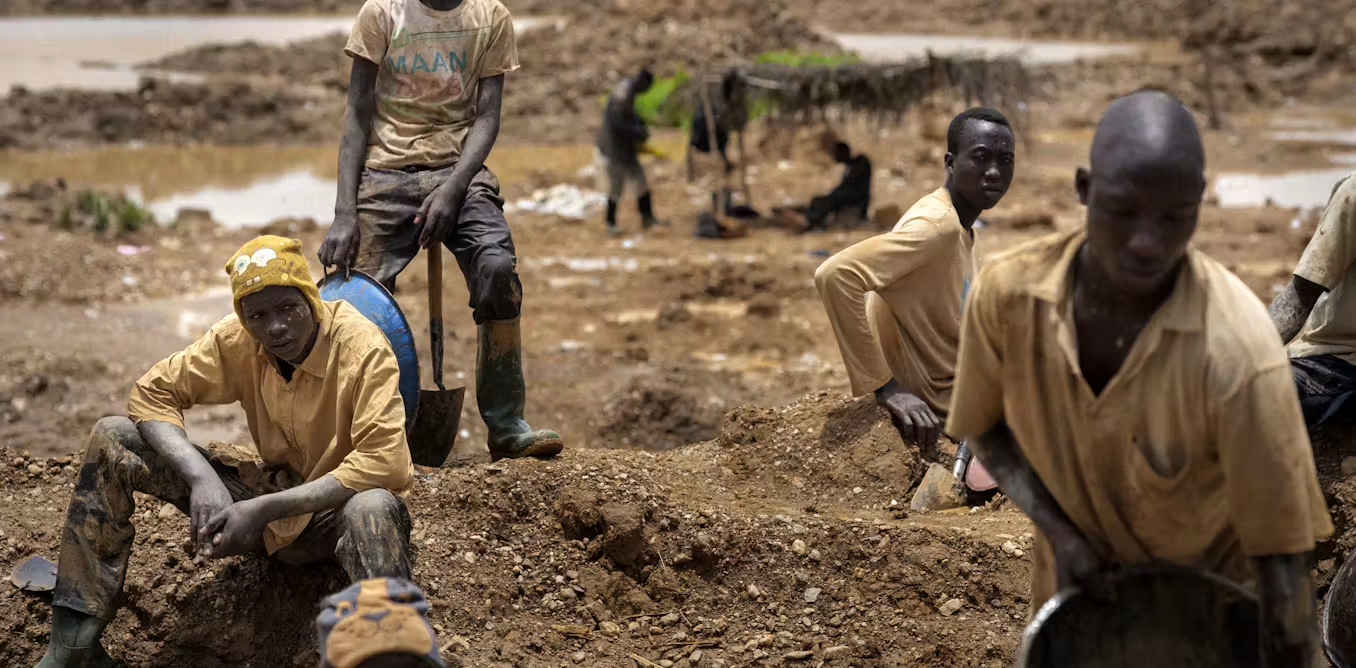
Small-scale mining. This is where the story gets complicated. Small-scale miners, often called galamsey when they operate illegally, now produce more gold than the big mines . But they contribute almost nothing in royalties. In 2025, all gold royalties came from large-scale producers, while small-scale miners exported $10.8 billion worth of gold and paid virtually nothing to the state . The government is trying to formalise this sector, but progress is slow.
Royalties and taxes. The government earns from mining in several ways. Royalties are paid on production. Corporate income tax is paid on profits. There are also levies and dividends from the state’s equity stakes. In 2026, the government changed the royalty system from a flat 5 percent to a sliding scale of 5 to 12 percent, depending on the gold price. When gold prices are high, the government takes more. When prices fall, it takes less. This is meant to share the risk and reward between the state and the companies.
The new player: GoldBod. The government created the Ghana Gold Board to buy gold directly from producers, including small-scale miners. In 2025, GoldBod exported 100 tonnes of gold independently, bringing in about $10 billion . The goal is to formalise the trade, improve traceability, and capture revenue that was previously lost to smuggling.
Market Position: Who Controls the Gold?
The large-scale mining sector is dominated by a handful of foreign companies.
Newmont is one of the biggest, operating the Ahafo North and South mines. AngloGold Ashanti, originally South African, runs the deep Obuasi mine and Iduapriem. Gold Fields, also South African, operates Tarkwa and Damang, though it recently lost the Damang lease after the government refused to renew it and handed the mine to a Ghanaian contractor . Zijin Mining, a Chinese company, is growing its presence, having acquired Akyem and operating it alongside other Chinese firms like Chifeng Gold and Shandong Gold .
The government itself is a significant player through its free carried interest and through the Minerals Income Investment Fund (MIIF), which manages the state’s mineral royalties and investments.
But the most important shift is the rise of small-scale mining. Small-scale miners now produce more gold than the large mines combined . This is a dramatic change from the historical pattern. The problem is that this production is largely informal. The government estimates that small-scale mining exports reached $10.8 billion in 2025, but royalties from the sector were essentially zero . The IMF has warned that this informal production generates little direct fiscal revenue due to smuggling and the removal of withholding tax on unprocessed minerals .
This is the central tension in Ghana’s mining industry today: the gold is flowing, but the state is not capturing its fair share from the fastest-growing part of the sector.
The Reforms: Ownership, Royalties, and Local Content
The government has launched a series of reforms that are reshaping the industry. These are not minor adjustments. They change who owns, who works, and who earns.
Local ownership of mining operations. The Minerals Commission has ruled that surface mining must be done by companies that are 100 percent Ghanaian-owned. Underground mining must be done by companies with at least 50 percent Ghanaian ownership . Newmont, AngloGold Ashanti, and Zijin were given until December 2026 to comply. Newmont asked for an extension to 2027, but the regulator rejected it, noting that other companies like Gold Fields had already transitioned . The message is clear: foreign companies can still own the mines, but Ghanaians must do the digging.

The royalty overhaul. In March 2026, Ghana replaced its flat 5 percent royalty with a sliding scale of 5 to 12 percent, linked to the gold price . When gold is above $4,500 an ounce, the rate hits 12 percent. This is designed to let the state capture more value during booms. The results were immediate. Mineral royalty collections surged 106 percent to GHS 7.82 billion ($673 million) in the first nine months of 2026, compared to the same period the year before .
The Growth and Sustainability Levy debate. The government also imposed a Growth and Sustainability Levy on mining companies. Originally set at 3 percent of gross production, it was later reduced to 1 percent after industry pushback . The Ghana Extractive Industries Transparency Initiative (GHEITI) warned that combining the new royalty scale with the levy could push the total tax burden above 16 percent of gross production, a level it described as unprecedented in global mining . The Ghana Chamber of Mines has argued that the combined burden, including corporate tax and other imposts, could reach 54 to 58 percent, placing Ghana among the highest-taxed mining jurisdictions in the world .
Cracking down on “fronting.” The Minerals Commission has revoked over 300 small-scale mining licences acquired through irregular means and is targeting “fronting,” where foreign entities use Ghanaian nominees to acquire mineral rights . The Commission’s CEO, Isaac Tandoh, put it bluntly: “Employment is not the same as ownership. Labour is not the same as control” .
The GoldBod and domestic refining. The government wants to build a gold refinery that meets London Bullion Market Association standards by 2030. As part of this, the Gold Board is buying 30 percent of large-scale production and settling in cedis. The goal is to move Ghana up the value chain, from exporting raw gold to exporting refined gold . But analysts note that 30 percent of large-scale production may not be enough to feed a refinery economically, and the challenges of power, skills, and international certification are significant .
Challenges
The reforms are ambitious, and they face real obstacles.
The small-scale mining paradox. Small-scale miners produce most of the gold but pay almost none of the taxes. The government wants to formalise the sector, but decades of informality, smuggling, and weak enforcement cannot be fixed overnight. The IMF has warned that without better capture of small-scale revenue, Ghana is losing billions .
Investment uncertainty. Mining companies are nervous. The Ghana Chamber of Mines has warned that higher royalties and levies could “dry up new projects and output” . GHEITI has cautioned that the sudden introduction of the levy without consultation disrupted long-term planning, and that fiscal predictability is now the biggest threat to Ghana’s investment attractiveness . The government reduced the levy from 3 percent to 1 percent, but the industry says that is not enough.
Galamsey and environmental damage. Illegal mining, known locally as galamsey, has devastated forests and polluted rivers. The government is trying to crack down, but enforcement is difficult and politically sensitive. The environmental damage also affects farming communities and water supplies.
The local content transition. Forcing foreign miners to hand over operations to local contractors by a fixed deadline is a bold move. Local firms like Rocksure and Engineers & Planners have the capacity, but scaling up to take over entire mining operations is a huge task . If local contractors cannot deliver, production could suffer.
Commodity price risk. Ghana’s fiscal position is now more dependent on gold than ever. The IMF has estimated that a 45 percent fall in gold prices could reduce annual fiscal revenue by about 1.5 percent of GDP . The sliding royalty scale helps when prices are high, but it does not protect the budget when prices crash.
Why It Matters to Ordinary Ghanaians
Mining is not just about big companies and government revenue. It touches everyday life.
Jobs and local business. The mining sector directly employs thousands of Ghanaians. But the bigger impact is through local procurement. When mines buy goods and services from Ghanaian suppliers, they support jobs in transport, catering, engineering, and security. The local content reforms are meant to increase this multiplier effect by keeping more of the mining spend in Ghana.
Government revenue. Mining is the largest source of direct domestic revenue. In 2025, taxes from the sector rose to GH¢23.11 billion . This money funds roads, schools, hospitals, and salaries. When the government captures more from mining, it has more to spend on public services. When it captures less, everyone feels the shortfall.
The cedi and the economy. Gold exports bring dollars into Ghana. In 2025, gold exports of over $20 billion helped stabilise the cedi and build foreign reserves . A strong gold sector supports the currency, which in turn keeps import prices lower. But if gold production falls or prices crash, the cedi comes under pressure.
The environment. Galamsey has poisoned rivers and destroyed farmland. Ordinary Ghanaians who depend on water and land for their livelihoods suffer directly. The mining reforms are partly about controlling this damage, but enforcement remains weak.
Community benefits. Mining companies are expected to invest in the communities where they operate. The new Minerals and Mining Act amendments require miners to negotiate directly with communities on benefit sharing . If implemented well, this could mean better roads, schools, and health facilities in mining areas. If not, tensions between communities and mining companies will continue.
Future Outlook
The direction is clear: Ghana wants more from its gold. The question is whether the reforms will deliver without scaring away the investment needed to keep the mines running.
If the reforms succeed, Ghana could capture significantly more revenue from mining, build a domestic refining industry, and create a class of Ghanaian mining contractors and service companies. The GoldBod could formalise small-scale mining and reduce smuggling. Local content rules could build skills and businesses that extend beyond mining.
The risks are equally real. If the tax burden becomes too heavy, new exploration and mine development could slow. If local contractors cannot meet the December 2026 deadline, production could be disrupted. If gold prices fall, the revenue gains from the sliding royalty scale will shrink. And if small-scale mining remains informal, the state will continue to lose billions.
The most likely scenario is a messy but gradual transition. Some foreign miners will comply with local content rules. Others will push back or divest. Royalty revenues will rise when prices are high, but the government will still struggle to tax small-scale miners. The refinery project will face delays and technical hurdles. Ghana will remain a major gold producer, but the dream of a fully transformed mining economy will take years to realise.
The wild card is gold prices. At current high prices, the government has room to push for more. If prices fall sharply, the politics of mining reform will become much harder.
ASJ Conclusion
Ghana’s mining industry is in the middle of a major shake-up. The government is no longer content to be a passive recipient of royalties. It wants ownership. It wants local content. It wants a refinery. It wants a bigger share of the value chain.
The reforms are bold, and some are already producing results. Royalty revenues have doubled. Local contractors are taking over operations. A state gold buyer is formalising trade. But the challenges are just as real. Small-scale mining remains largely untaxed. Investors are wary. The tax burden is among the highest in the world. And the environmental damage from galamsey continues.
For ordinary Ghanaians, the stakes are high. Mining is the backbone of the export economy and a major source of government revenue. When it works, it supports jobs, services, and the currency. When it does not, the whole country feels it.
Ghana’s gold is not running out. The question is who benefits from it, and on what terms. The answer to that question is being rewritten right now.
Quick Facts
Topic: Ghana’s Mining Industry
2025 Gold Production: ~186 tonnes (6 million ounces)
Africa Ranking: Largest gold producer
Global Ranking: 6th largest producer
Gold Export Revenue (2025): ~$20 billion
Mining Share of Total Exports: ~68%
Mining Share of GDP: ~10%
Small-Scale Share of Output (2025): 52.4%
Royalty Regime (from March 2026): Sliding scale, 5%–12% based on gold price
Local Content Deadline: December 2026 for foreign miners to shift to local contractors
Key Regulator: Minerals Commission
Major Companies: Newmont, AngloGold Ashanti, Gold Fields, Zijin
Key Challenge: Taxing small-scale mining, investment uncertainty
FAQ Section
1. How much gold does Ghana produce?
Ghana produced about 186 tonnes (roughly 6 million ounces) of gold in 2025, making it Africa’s largest producer and the world’s sixth largest .
2. Who are the biggest mining companies in Ghana?
Major foreign companies include Newmont, AngloGold Ashanti, Gold Fields, and Zijin Mining. The government also holds a 10% free carried interest in mining operations .
3. How does Ghana earn from mining?
Through royalties on production, corporate income tax on profits, dividends from state equity, and various levies. Mining is the largest source of direct domestic tax revenue .
4. What is the new royalty system?
Since March 2026, Ghana uses a sliding scale of 5% to 12%, linked to the gold price. When gold prices are high, the government takes a larger share .
5. What is the local content rule for mining?
Surface mining must be done by 100% Ghanaian-owned companies. Underground mining must have at least 50% Ghanaian ownership. Foreign miners like Newmont and Zijin have until December 2026 to comply .
6. Why is small-scale mining a problem?
Small-scale miners now produce most of Ghana’s gold (52.4% in 2025) but pay almost no royalties. Much of the gold is smuggled or traded informally, meaning the state loses billions in potential revenue .
7. What is galamsey?
Galamsey is illegal small-scale mining. It has caused severe environmental damage, polluting rivers and destroying farmland. The government is trying to crack down, but enforcement is difficult .
8. What is the GoldBod?
The Ghana Gold Board is a state body that buys gold directly from producers, including small-scale miners. It exported 100 tonnes in 2025 and aims to formalise the trade and reduce smuggling .
9. Is Ghana building a gold refinery?
Yes, the government wants to build a refinery certified by the London Bullion Market Association by 2030. However, analysts question whether there is enough feedstock and whether the technical challenges can be overcome .
10. How does mining affect ordinary Ghanaians?
Mining provides jobs, supports local businesses through procurement, and generates government revenue for public services. But galamsey damages the environment, and the benefits of mining are not always shared fairly .
11. Will the mining reforms scare away investors?
There is a risk. The Ghana Chamber of Mines has warned that higher taxes and local content rules could discourage new investment. The government says it wants partnership, not punishment, but the industry is watching closely .
12. What happens if gold prices fall?
Ghana’s fiscal position is now more exposed to gold prices. The IMF estimates a 45% price drop could reduce annual revenue by about 1.5% of GDP. The sliding royalty scale helps when prices are high but does not protect the budget when they fall
Source: Accra Street Journal
Last Updated on November 20, 2026 by Samuel Kwame Boadu
Disclaimer: Some content on Accra Street Journal may be aggregated, summarized, or edited from third-party sources for informational purposes. Images and media are used under fair use or royalty-free licenses. Accra Street Journal is a subsidiary of SamBoad Publishing Hub under SamBoad Business Group Ltd, registered in Ghana since 2014.
For concerns or inquiries, please visit our Privacy Policy or Contact Page.

Samuel Kwame Boadu is a Ghanaian media entrepreneur and storyteller with a passion for amplifying urban voices and uncovering everyday truths. He is the Editor-in-Chief and Founder of Accra Street Journal, a dynamic digital platform dedicated to capturing the pulse of Ghana’s capital—its people, culture, challenges, business, sports and innovations.
Use the following reference when citing or referencing this article.
Your feedback helps us improve our journalism.
Report an Error
Help us maintain accuracy. Let our editorial team know if you spot an issue in this article.
Report a problem with this article