



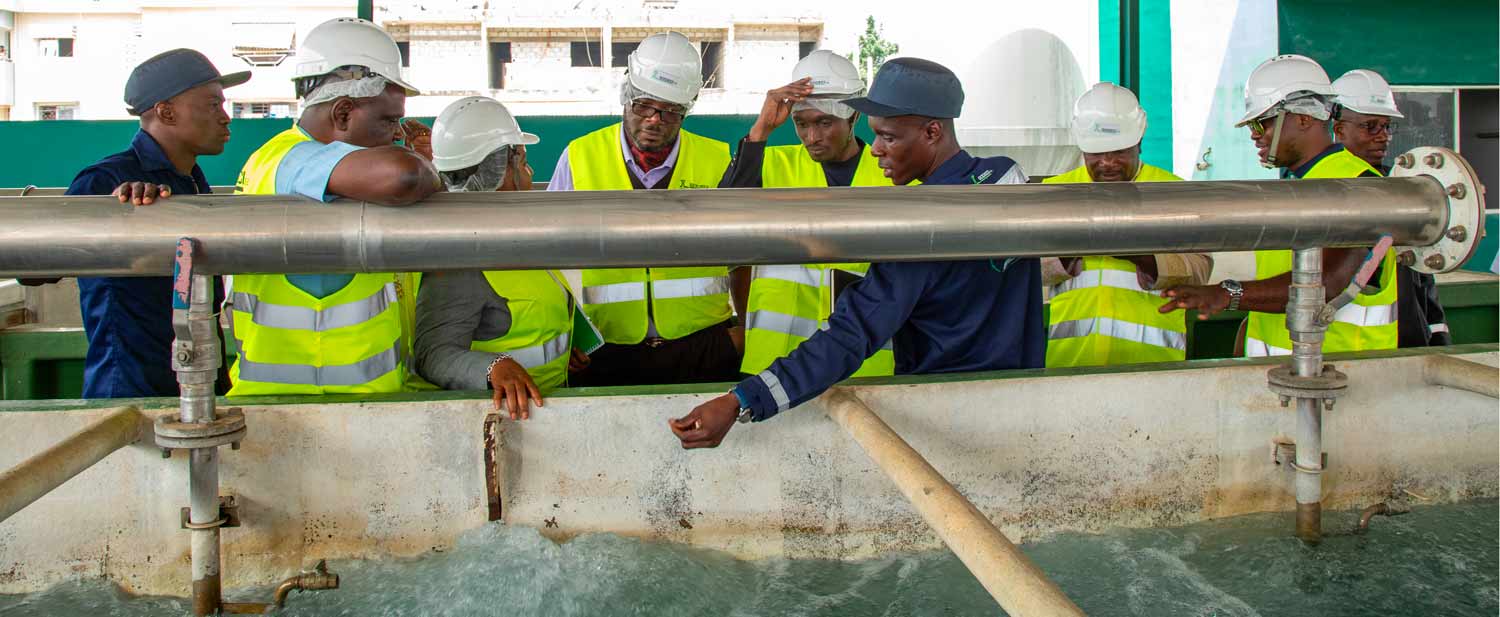
The water utility is the most essential business in any African city. It is also, in most cases, a business that loses money on every unit it sells. The pipes are old, the customers are poor, the tariffs are political, and the private vendors who fill the gap charge the poorest households the most. Understanding how the water business actually works is the first step to understanding why the taps run dry.
The Arithmetic of Loss
Ghana Water Limited offers a stark illustration. As of June 2026, the utility was losing 47.6% of its treated water to illegal connections and decaying infrastructure . The Managing Director, Adam Mutawakilu, was blunt about the cause: “The water is not lost. It is consumed by Ghanaians, but illegally” . Illegal connections accounted for roughly 78% of the unaccounted-for supply, with physical bursts and pipe degradation making up the rest. Sections of the distribution network date back to the 1960s .

The utility pumps about 219 million gallons a day against a national requirement of 350 million gallons . It is not just losing water. It is losing revenue on nearly half of what it produces, while operating below the demand it is meant to serve.
📢 GET A DETAILED ARTICLES + JOBS
Join ASJ's WhatsApp Channel and never miss a post or opportunity.

This is not a Ghanaian anomaly. It is the structural condition of urban water supply across much of the continent.
The Tariff Problem: Selling Below Cost
The Teshie-Nungua desalination plant in Accra tells the story in a single contract.

The plant, built to ease water scarcity in the coastal communities, sits idle. The reason is arithmetic. The private operator charges Ghana Water about GH₵6.75 to produce one unit of water. The national regulator mandates that Ghana Water can only sell that same unit to the public for GH₵1.47 . Ghana Water loses GH₵5.28 on every unit the plant produces. Once the government stopped covering the difference, the plant shut down.
Residents of Teshie now spend over GH₵300 a week buying water from private tankers because the taps are dry . The poorest households pay the highest price for water because the formal system cannot deliver it at a price that covers its costs.
The Public Utilities Regulatory Commission approved a 15.92% water tariff increase for 2026, citing the cedi-dollar exchange rate, domestic inflation, and fuel prices . Ghana Water’s Public Relations Officer, Stanley Martey, said the increase was inadequate. “Let’s admit that we can only keep the taps on 24/7 when we have built new treatment plants, when we have extended pipelines and all that. This tariff cannot do that” .
The gap between cost and tariff is the defining constraint. A utility cannot invest in new infrastructure if it cannot recover the cost of the water it already sells.
The Investment Gap: Infrastructure Without Maintenance
The World Bank has documented what happens when infrastructure investment is not matched by operational capacity. In a review of urban piped water projects across Africa, the bank found that increases in access were “not always accompanied by improvements in service quality.” Only one-quarter of the studies observed that service improvements resulted from expanded access. A substantial number reported deterioration .
The diagnosis was consistent: “poor operational management, suggesting a failure to invest in training and staff development when making large infrastructure investments.” Increases in non-revenue water, limited production capacity, and equipment failures pointed to “a mix of poor design and, as importantly, poor operation and management” .
The World Bank’s assessment of Ghana Water’s non-revenue water in 2023 put it at 45%, noting that while there had been a reduction, it “remains high” and “substantially affects its operational efficiency and financial standing” .
The pattern is not unique to Ghana. In Accra, 92% of the fecal sludge that reaches treatment plants is released back into the environment, with only 18% of treatment capacity operational. In Kenya, only 60% of wastewater entering sewers reaches treatment plants, which operate at 16% of design capacity.
The infrastructure is built. The systems to operate it are not.

The Poor Pay More
The consequence of a formal system that cannot recover its costs is a parallel system that can.
Private water vendors fill the gap left by piped networks that do not reach low-income areas or do not function reliably. And they charge accordingly. The World Bank’s research on water vendors in African cities found that vendors offer flexible payment terms—daily or weekly—and home delivery, but at “high profit margin per unit” . Households pay for the convenience and the reliability because the formal network cannot provide either.
This is the inverse of the intended subsidy. The poorest households, who cannot afford the upfront connection costs or the monthly bills of the formal network, end up paying more per litre to vendors. The formal network, designed to serve them, loses money on the water it does sell to those who can afford connections.
Ghana Water’s Social Connection Fund, presented at a UN-Habitat session, is an attempt to address this. The fund pools resources to subsidise low-income connections, with the aim of scaling through tariff-based surcharges. The model is utility-led, designed to operationalise water rights without external funding dependence .
Whether it works at scale is the test.
The Institutional Reform Pathway
The World Bank’s review of utility turnarounds in African cities identified a sequence that successful utilities follow. They start with concessional loans and some grants. They then “quickly worked to improve operating efficiency—by reducing NRW, improving staff productivity, and increasing collection rates—and then to expand access (thus also increasing revenue).” The increased operating cash allows them to service the loans and finance additional capital investment .
The key insight is that the sequence matters. Expansion without efficiency does not work. Building new treatment plants while losing half the water through leaks and theft is pouring money into a leaking bucket.
The Bank also noted how good utilities manage the trade-off between cost recovery and affordability. They “minimize up-front connection charges, and provide a basic needs quantity of water at a low tariff.” They use prepaid and limited-flow meters to help poor households manage payments. And they “delegate service provision to small entrepreneurs in informal areas where they lack a formal mandate” .
The utilities that succeed are not the ones that charge the most. They are the ones that operate most efficiently.
The Climate Layer
The infrastructure deficit is now compounded by climate shocks. Utility leaders at the African Water and Sanitation Association Congress in February 2026 warned that short funding cycles and weak cost recovery are slowing investment in resilience .
The mismatch is structural. Utilities often require over a decade to plan and finance major infrastructure, while many financing windows operate on two- to four-year cycles. “This mismatch frequently prevents successful pilots from scaling into sustained programmes” .

Ghana Water has begun using drone-enabled meter reading in flood-prone areas and systematic evidence gathering to unlock climate finance and build investment pipelines for low-income communities . But the gap between pilot and programme remains.
ASJ Bottom Line
The water business in African cities is not failing because there is no demand. Demand is growing, and the utilities cannot keep up. It is failing because the price of water is set below the cost of producing it, the infrastructure is ageing faster than it is being replaced, and the households least able to pay are the ones paying the most.
The solutions are known. Reduce non-revenue water. Price water at a level that allows cost recovery, with targeted subsidies for the poor. Invest in maintenance alongside new construction. Bring informal vendors into the system rather than pretending they do not exist. Plan for climate resilience on a timescale that matches the infrastructure.
What is missing is not the blueprint. It is the political will to charge what water costs, and the institutional capacity to spend that revenue well.
Until that changes, the taps will continue to run dry in Teshie, and the tankers will continue to charge GH₵300 a week to the families who can least afford it.
Quick Facts
| Topic | Details |
|---|---|
| Ghana Water Non-Revenue Water (June 2026) | 47.6% |
| Illegal Connections Share | ~78% of unaccounted supply |
| Daily Production vs Demand | 219m gallons vs 350m required |
| Teshie Desalination Cost Gap | GH₵6.75 production vs GH₵1.47 retail |
| 2026 Water Tariff Increase | 15.92% |
| Ghana NRW (World Bank 2023) | 45% |
| Vendor Water Cost (Teshie) | GH₵300+/week |
Frequently Asked Questions
1. Why does Ghana Water lose so much water?
Non-revenue water stood at 47.6% as of June 2026. About 78% of the loss is from illegal connections, with physical bursts and ageing pipes (some dating to the 1960s) making up the rest .
2. Why is the Teshie desalination plant idle?
The private operator charges Ghana Water GH₵6.75 per unit of water, but the regulator caps the retail price at GH₵1.47. Ghana Water lost GH₵5.28 per unit, and once government subsidies stopped, the plant shut down .
3. Why do the poor pay more for water?
Because the formal network cannot reach them or deliver reliably. Private vendors fill the gap and charge high per-unit prices with flexible payment terms. Households in Teshie spend over GH₵300 a week on tanker water .
4. How much did water tariffs increase in 2026?
The PURC approved a 15.92% increase for 2026, citing the exchange rate, inflation, and fuel costs. Ghana Water said the increase was inadequate to fund new infrastructure .
5. What is Ghana Water doing to reduce losses?
The utility has ramped up mains replacement projects and a nationwide crackdown on illegal connections. It has also introduced a Social Connection Fund to subsidise low-income connections .
6. How does the World Bank suggest utilities improve?
By following a sequence: use concessional loans to improve operating efficiency (reduce NRW, improve staff productivity, increase collection), then expand access. Increased cash flow then services the loans and funds capital investment.
7. What is non-revenue water?
Water that is produced and treated but generates no income—lost through leaks, theft, or metering failures. Ghana’s rate of 47.6% means nearly half of all treated water is not paid for .
8. How does climate change affect water utilities?
Utilities need over a decade to plan and finance major resilience infrastructure, but many financing windows operate on 2–4 year cycles. This mismatch prevents pilots from scaling. Climate pressures are also shaping tariff discussions .
9. Why did the World Bank find that new infrastructure didn’t always improve service?
Because investment in pipes and plants was not matched by investment in operations and maintenance. Poor management led to increased non-revenue water, equipment failures, and service deterioration .
10. What is the Social Connection Fund?
A Ghana Water initiative that pools funding to subsidise water connections for low-income households, with the aim of scaling through tariff-based surcharges. It is designed to be utility-led and not dependent on external funding
Source: Accra Street Journal
Last Updated on November 3, 2026 by Samuel Kwame Boadu
Disclaimer: Some content on Accra Street Journal may be aggregated, summarized, or edited from third-party sources for informational purposes. Images and media are used under fair use or royalty-free licenses. Accra Street Journal is a subsidiary of SamBoad Publishing Hub under SamBoad Business Group Ltd, registered in Ghana since 2014.
For concerns or inquiries, please visit our Privacy Policy or Contact Page.

Samuel Kwame Boadu is a Ghanaian media entrepreneur and storyteller with a passion for amplifying urban voices and uncovering everyday truths. He is the Editor-in-Chief and Founder of Accra Street Journal, a dynamic digital platform dedicated to capturing the pulse of Ghana’s capital—its people, culture, challenges, business, sports and innovations.