










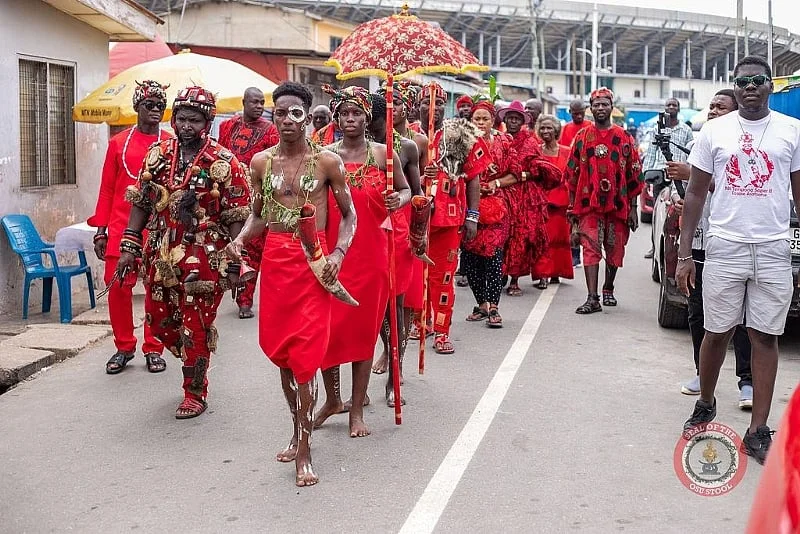
Introduction: A Community at the Crossroads
La is one of the oldest Ga settlements on the Accra plains, a community whose history stretches back centuries before the glass towers of Airport City or the diplomatic enclaves of Cantonments. Yet today, La finds itself at the intersection of tradition and modernity—grappling with chieftaincy succession crises, disputes over stool lands, military encroachment, and the pressures of rapid urban development.
For the people of La, the struggle is not merely about land. It is about legacy—the right to control their heritage, to determine who speaks for the community, and to ensure that development does not come at the cost of identity.

This article examines the multiple crises facing La: the indefinite suspension of the La Traditional Council over corruption allegations, the long-running dispute with the Ghana Armed Forces over military lands, the demolition and rezoning of the Kpeshi Lagoon enclave, and the broader chieftaincy tensions that have made La a microcosm of the challenges facing traditional governance in modern Accra.
📢 GET A DETAILED ARTICLES + JOBS
Join ASJ's WhatsApp Channel and never miss a post or opportunity.

Part 1: The Suspension of the La Traditional Council
A Stunning Directive
In September 2024, the Ministry of Religious and Chieftaincy Affairs, in collaboration with the Greater Accra Regional House of Chiefs, issued a stunning directive: the indefinite suspension of the La Traditional Council .
The suspension, which took effect on September 26, 2024, was accompanied by a clear instruction: all government agencies and institutions were directed not to engage with any persons who might carry themselves as La Traditional Council representatives in any capacity .

The Allegations
The suspension followed a series of serious allegations against the Council, including corruption, illegal land dealing, and extortion . The Ministry, invoking Section 45 of the Chieftaincy Act, determined that the Council could not continue to operate while these allegations were being investigated.
The Registrar of the La Traditional Council was ordered to hand over all Council property to the Regional House of Chiefs pending further directives .
What This Means for La
The suspension has far-reaching implications. Paramount stool land issues have been put on hold until the suspension is revoked or a new La Paramount Chief is enstooled . This means that land transactions, development approvals, and customary dispute resolution mechanisms are effectively frozen.
For a community where stool land represents both heritage and economic asset, this suspension is not merely administrative—it is a crisis of governance. The Ministry’s directive effectively declared that the current leadership of La could not be trusted to manage its own affairs, a rare and significant intervention in traditional governance.
The indefinite nature of the suspension—without a clear timeline for resolution—has left the people of La in a state of uncertainty. Who speaks for La? Who has the authority to allocate land? Who represents the community in negotiations with the state?
These questions remain unanswered.
Part 2: The Military Land Dispute – A Longstanding Wound
The Protest
On July 30, 2024, the youth of La took to the streets to protest what they described as the “unethical seizure of lands by political entities” in the Greater Accra Region . At the heart of their grievance was a long-running dispute with the Ghana Armed Forces over military lands.
The La Coalition demonstration was intended to draw attention to the military’s occupation of lands that the community considers its rightful heritage. The protest, however, became a point of tension when disagreement arose between police and organisers over the demonstration route .
The Government’s Response
The Minister of Lands and Natural Resources, Samuel Abu Jinapor, appealed to the youth of La to exercise patience as the government worked towards resolving the issue .

Speaking at a press briefing on August 14, 2024, Jinapor disclosed that a five-member committee had been constituted to address the matter and that a lease had been granted to the La Traditional Council .
“We’ve since granted a lease to the La Traditional Council, but the Ministry of Defence is engaging the La Traditional Council and the Ministry of Lands and Natural Resources for an arrangement which would ensure that the taking or possession of the land does not result in unnecessary controversy,” Jinapor explained .
The Armed Forces’ Concerns
The Minister acknowledged that the Ghana Armed Forces had legitimate concerns that needed to be addressed. “They need to deal with it, and rightly so, because it’s a very important, sensitive institution,” he said .
The government’s position was clear: it remained committed to returning the lands to the La Traditional Council, as evidenced by the granting of a lease. However, the Ministry of Defence required time to work out arrangements that would satisfy both military operational needs and the community’s legitimate claims.
Jinapor appealed for patience: “I’ll use this medium to crave the indulgence of the La youth to continue to exercise restraint and patience while we go through this complex process to find a resolution to this longstanding matter” .
The Unresolved Question
The military land dispute is emblematic of a broader pattern across Ghana, where state institutions—particularly the security services—occupy lands that were historically stool lands. For La, the presence of military installations on what the community considers its territory is a daily reminder of power imbalances and unresolved historical grievances.
The government’s commitment to granting a lease was a significant step, but the suspension of the La Traditional Council in September 2024—just weeks after these assurances—has complicated the path forward. With the Council suspended and paramount stool land issues on hold, the resolution of the military land dispute remains in limbo .
Part 3: The Kpeshi Lagoon – Demolition, Rezoning, and Regularisation
The Demolition Exercise
In January 2026, the National Disaster Management Organisation (NADMO) undertook a three-day demolition exercise along the Kpeshi Lagoon buffer zone . Several structures were pulled down to reduce flooding risks ahead of the rainy season.
The lagoon enclave, which had become an ecological site, had never been designated for residential occupation. The La Dade-Kotopon Municipal Assembly had, over the years, not granted permits to anyone to build in the area .
Rezoning and Regularisation
Speaking to Citi News, the Municipal Chief Executive for La Dade-Kotopon, Alfredos Nii Anyetei, outlined the Assembly’s post-demolition plans: the area would be rezoned for residential use, and buildings not affected by the demolition would be regularised to allow for property rate collection .
“Those who were not affected by the demolition will have their presence regularised within the demarcated area, after which we will collect their property rates and building permits,” Anyetei explained .
The Controversy
The demolition and rezoning highlight the tension between environmental protection, urban development, and community rights. The Kpeshi Lagoon is an ecological site, yet it had been encroached upon by residential structures. The Assembly’s decision to rezone the area for residential use—rather than restoring it as a protected ecological zone—reflects the immense pressure on land in Accra.
For the residents whose structures were demolished, the exercise was devastating. For those whose buildings survived, regularisation offers a path to legal recognition—but at the cost of accepting that an ecological site will now be formally designated for housing.
The long-term implications for flooding and environmental sustainability remain concerning. The Kpeshi Lagoon once served as a natural buffer against flooding; its gradual conversion to residential use may exacerbate the very risks that the demolition was intended to mitigate.
Part 4: The Chieftaincy Crisis – Who Speaks for La?
The Succession Question
At the heart of La’s struggles is a fundamental question: who is the legitimate La Mantse?
La is one of the six independent Ga towns that constitute the Ga paramountcy, alongside Teshi, Nungua, Tema, Osu, and Ga Mashi . The pre-colonial political system of the Ga-Dangbe people was initially theocratic, with political power reposed in the Wulomo (Chief Priest). Later, political and religious power were separated, with the Paramount Chief (Ga Mantse) wielding political authority while the Wulomo retained religious functions .
This dual system of authority has, at various points in La’s history, created ambiguity about who holds ultimate authority. The suspension of the La Traditional Council in 2024 has exacerbated this ambiguity, leaving the community without a recognised governing body.
The Wider Ga Mantse Dispute
The chieftaincy crisis in La cannot be understood in isolation from the broader Ga Mantse succession dispute, which has roiled the Ga State for years.
In June 2025, the Court of Appeal in Kumasi ordered the National House of Chiefs to re-enter Boni Tackie Adama Latse II into the National Register of Chiefs as Ga Mantse . However, the Office of the Ga Mantse, under the leadership of King Tackie Teiko Tsuru II, vehemently refuted claims that the ruling conferred chieftaincy legitimacy on Nii Adama Latse II .
The Office clarified that the court’s ruling was procedural, not substantive: “The Court of Appeal did not and could not declare Nii Adama Latse II as Ga Mantse. The court merely upheld an administrative order—specifically, an order of mandamus compelling the National House of Chiefs to follow due legal process” .
Just one month later, in July 2025, the Supreme Court quashed the Court of Appeal’s ruling, reaffirming King Tackie Teiko Tsuru II as the recognized Ga Mantse .
Implications for La
For La, these national-level chieftaincy disputes have direct consequences. The La Mantse owes allegiance to the Ga Mantse, and the legitimacy of the La chieftaincy is intertwined with the legitimacy of the Ga paramountcy .
The suspension of the La Traditional Council—combined with the ongoing legal battles over the Ga Mantse stool—has created a governance vacuum. Without a recognised council, without clarity on who holds legitimate authority, the community’s ability to advocate for its interests in land disputes, development negotiations, and cultural preservation is severely constrained.
Part 5: The Traditional Structure of La – How Governance Worked
The Six Towns of the Ga Paramountcy
The pre-colonial political system of the Ga-Dangbe people consisted of six independent towns: Teshi, Nungua, Tema, La, Osu, and Ga Mashi . Each town had its own chief, called a Mantse, responsible for the administration of his town. These six towns were organised into a paramountcy headed by the Ga Mantse, who was responsible for civil and administrative matters across the entire paramountcy .
The Quarters (Akutsei)
Each independent town was further divided into quarters, called Akutso (plural: Akutsei), administered by a chief. All heads of the quarters were chiefs (Mantse) with the same rank as the Mantse of the towns .
The Families (Wei)
The family (We) was the fundamental level of Ga political structure. The families, which were patrilineal, were headed by elders responsible for the affairs of the family .
The Theocratic Origins
Before the adoption of the chieftaincy system, the Ga people did not have chiefs. Political power was reposed in the Wulomo (Chief Priest), who held authority in both civil and religious matters. Later, political and religious power were separated: the Paramount Chief wielded political authority, while the Wulomo continued to wield religious authority, though he still retained influence in administrative matters .
This dual system—the Wulomo as spiritual leader, the Mantse as political leader—has created points of tension throughout Ga history. The 2008 controversy over the installation of Dr. Joe Blankson as King Tackie Tawiah III, for example, pitted the Nai Wulomo and Gbobu Wulomo (who had performed the rituals) against the Sakumo Wulomo (who claimed that he was the supreme high priest with authority to bless any new Ga Mantse) .
Summary Table: La’s Challenges at a Glance
| Challenge | Description | Status |
|---|---|---|
| Traditional Council Suspension | Indefinite suspension over corruption, illegal land dealing, extortion | Ongoing (as of September 2024) |
| Military Land Dispute | Long-running dispute with Ghana Armed Forces over occupied lands | Lease granted to La Traditional Council; implementation pending |
| Kpeshi Lagoon Demolition | NADMO demolition of structures in ecological buffer zone | Completed January 2026; rezoning underway |
| Chieftaincy Succession | Ambiguity over legitimate La Mantse; broader Ga Mantse dispute | Supreme Court reaffirmed King Tackie Teiko Tsuru II as Ga Mantse (July 2025) |
| Development Pressures | Rapid urbanisation, encroachment on ecological sites, property regularisation | Ongoing |
Frequently Asked Questions (FAQs)
1. Why was the La Traditional Council suspended?
The Council was suspended indefinitely in September 2024 following allegations of corruption, illegal land dealing, and extortion. The Ministry of Religious and Chieftaincy Affairs and the Greater Accra Regional House of Chiefs issued the directive under Section 45 of the Chieftaincy Act .
2. Who is the legitimate Ga Mantse?
As of July 2025, the Supreme Court reaffirmed King Tackie Teiko Tsuru II as the recognized Ga Mantse, quashing a Court of Appeal ruling that had ordered the restoration of Nii Adama Latse II .
3. What is the status of the military land dispute in La?
The government has granted a lease to the La Traditional Council, but the Ministry of Defence is engaging with the Council to work out arrangements that address the Armed Forces’ operational concerns. The process remains ongoing .
4. What happened at the Kpeshi Lagoon?
In January 2026, NADMO demolished structures along the Kpeshi Lagoon buffer zone to reduce flooding risks. The La Dade-Kotopon Municipal Assembly plans to rezone the area for residential use and regularise surviving buildings for property rate collection .
5. Can the La Traditional Council conduct business during its suspension?
No. The suspension has frozen all Council activities. Paramount stool land issues have been put on hold, and government agencies have been directed not to engage with anyone claiming to represent the Council .
6. What is the pre-colonial political structure of the Ga people?
Initially, the Ga people were ruled by a theocracy led by the Wulomo (Chief Priest). Later, political and religious power were separated: the Paramount Chief (Ga Mantse) assumed political authority, while the Wulomo retained religious functions. The six independent towns—Teshi, Nungua, Tema, La, Osu, and Ga Mashi—were organised into a paramountcy .
7. What is the significance of the Wulomo in Ga chieftaincy?
The Wulomo is the spiritual head of the Ga people, responsible for officiating public worship, calculating the dates for Homowo, offering libation, and performing purification ceremonies. No chief can be properly enstooled without the Wulomo’s rituals .
8. Why was the Kpeshi Lagoon enclave demolished?
The structures were built without permits in an ecological buffer zone. The area was never designated for residential occupation, and the demolition was intended to reduce flooding risks during the rainy season .
9. What does “regularisation” mean in the context of the Kpeshi Lagoon?
Regularisation means that the Assembly will formally recognise the surviving buildings, collect property rates and building permit fees, and rezone the area for residential use—transforming an ecological site into a designated residential zone .
10. How does the Ga Mantse dispute affect La?
La is one of the six independent towns in the Ga paramountcy, and the La Mantse owes allegiance to the Ga Mantse. Disputes over the Ga Mantse stool have direct implications for the legitimacy and authority of the La chieftaincy .
Conclusion: The Struggle for La’s Future
La’s struggle in modern Accra is not a single crisis but a convergence of crises: chieftaincy succession, land disputes, military encroachment, environmental degradation, and the suspension of traditional governance.
The indefinite suspension of the La Traditional Council has left the community without a recognised voice . The military land dispute remains unresolved despite government assurances . The Kpeshi Lagoon demolition has raised questions about the balance between environmental protection and development . And the broader Ga Mantse succession dispute continues to cast a shadow over the legitimacy of La’s traditional leadership .
Yet La endures. The community’s history stretches back centuries, through pre-colonial theocracy, colonial rule, and Ghanaian independence. The people of La have navigated change before.
The question now is whether the state, the traditional authorities, and the community can find a path forward that respects La’s heritage while addressing the legitimate needs of a modern Accra. The lease granted to the La Traditional Council for the military lands is a step in the right direction . The regularisation of the Kpeshi Lagoon buildings offers a model for addressing unplanned development .
But the suspension of the Council remains unresolved. The chieftaincy disputes continue. And the people of La wait—for clarity, for resolution, for the restoration of their voice.
The struggle for La is not merely about land. It is about legacy. And that struggle is far from over.
Frequently Asked Questions (FAQs)
1. Why was the La Traditional Council suspended?
Over corruption, illegal land dealing, and extortion allegations in September 2024 .
2. Who is the legitimate Ga Mantse?
King Tackie Teiko Tsuru II, reaffirmed by the Supreme Court in July 2025 .
3. What is the status of the military land dispute in La?
A lease has been granted to the La Traditional Council, but negotiations with the Ministry of Defence continue .
4. What happened at the Kpeshi Lagoon?
NADMO demolished unpermitted structures in the ecological buffer zone in January 2026 to reduce flooding risks. The area will be rezoned for residential use .
5. Can the La Traditional Council conduct business during its suspension?
No. All Council activities are frozen, and government agencies cannot engage with anyone claiming to represent the Council .
6. What is the pre-colonial political structure of the Ga people?
A theocracy led by the Wulomo (Chief Priest), later separated into political authority (Ga Mantse) and religious authority (Wulomo) .
7. What is the significance of the Wulomo in Ga chieftaincy?
The Wulomo performs purification rituals essential for the enstoolment of any Ga chief .
8. Why was the Kpeshi Lagoon enclave demolished?
Structures were built without permits in an ecological buffer zone not designated for residential occupation .
9. What does “regularisation” mean?
Formal recognition of surviving buildings, collection of property rates, and rezoning the area for residential use .
10. How does the Ga Mantse dispute affect La?
La is one of six independent towns in the Ga paramountcy, and the La Mantse owes allegiance to the Ga Mantse. Disputes at the paramount level affect legitimacy at the town level
Source: Accra Street Journal
Last Updated on April 11, 2026 by Samuel Kwame Boadu
Disclaimer: Some content on Accra Street Journal may be aggregated, summarized, or edited from third-party sources for informational purposes. Images and media are used under fair use or royalty-free licenses. Accra Street Journal is a subsidiary of SamBoad Publishing Hub under SamBoad Business Group Ltd, registered in Ghana since 2014.
For concerns or inquiries, please visit our Privacy Policy or Contact Page.

Samuel Kwame Boadu is a Ghanaian media entrepreneur and storyteller with a passion for amplifying urban voices and uncovering everyday truths. He is the Editor-in-Chief and Founder of Accra Street Journal, a dynamic digital platform dedicated to capturing the pulse of Ghana’s capital—its people, culture, challenges, business, sports and innovations.





