





Introduction: The Child Who Teaches the Parent
There is a scene playing out in homes across Accra that would have been unthinkable a decade ago.
A mother finishes her bottled water, tosses the plastic bottle into the general waste bin, and her twelve-year-old—still in school uniform—retrieves it. “Mummy,” she says, with the weary authority of someone who knows better, “this goes in the recycling sack. I told you yesterday.”

It is a small moment. But it is revolutionary.
📢 GET A DETAILED ARTICLES + JOBS
Join ASJ's WhatsApp Channel and never miss a post or opportunity.

For generations, environmental education in Ghana meant one thing: a single period a week, taught from a dog-eared textbook, with no practical connection to the child’s life. The student learned that “pollution is bad” and that “trees are good,” but the lesson ended at the classroom door.
That era is ending.
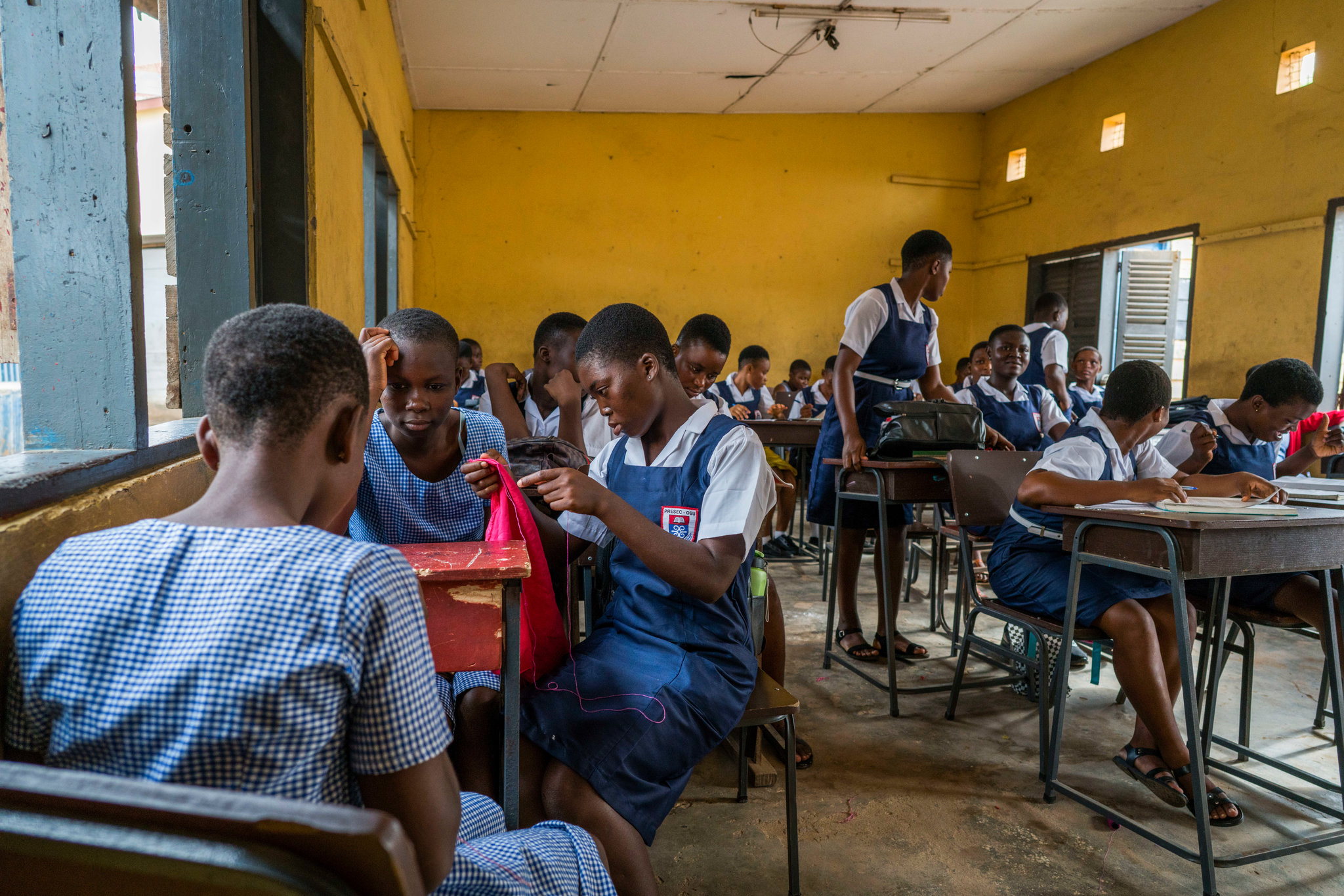
Across Accra, from the basic schools of Nungua to the senior high campuses of Labone and Achimota, a different kind of education is taking root. It is messy, competitive, and surprisingly effective. Students are collecting millions of plastic wrappers. They are building gardens. They are sorting waste into categories their parents never learned. And in some cases, they are winning ICT laboratories for their efforts.
This ASJ feature investigates how Accra’s schools—through government policy, NGO intervention, and corporate partnerships—are transforming environmental awareness from a theoretical subject into a lived practice. We will name the schools leading the charge, explain what actually works, and ask the uncomfortable question: Is this enough, given the scale of the climate crisis?
The Curriculum Shift: Climate Change Enters the Classroom
Let us start with the policy reality, because everything else builds on it.
For a long time, environmental topics in Ghanaian schools were scattered—a mention of erosion in Geography, a paragraph on pollution in Social Studies. There was no systematic effort to build climate literacy.
That changed in 2019.
Working with the Environmental Protection Agency (EPA), the Ghana Education Service (GES) formally integrated climate change studies into the primary school curriculum . Two years later, in 2021, the same integration was completed for junior high schools .
Dr Emmanuel Takyi Obeng, Acting Director of the Climate Change Department at the EPA, confirmed that teaching and learning materials have been developed, and teachers have been trained to deliver the new content . The current goal? To extend the same integration to the senior high school syllabus.
What this means for parents: Your child in basic school is now learning about climate change as a formal, assessed subject—not an afterthought. The curriculum covers the mechanisms of global warming, the local impacts (erratic rainfall, rising temperatures, coastal erosion), and, crucially, the actions individuals and communities can take.
But here is the gap that no policy document admits: curriculum integration does not guarantee effective teaching. A teacher who has never sorted waste or planted a tree cannot inspire a child to do so. The formal curriculum is the skeleton. What gives it life is the programmes, competitions, and extracurricular activities that turn theory into habit.
That is where the real action is happening.
The Eco-Schools Movement: Ten Years of Transformation
If there is a single umbrella initiative that captures the green shift in Ghanaian education, it is the Eco-Schools Programme.
Launched in Ghana approximately a decade ago, Eco-Schools is an international framework for Education for Sustainable Development (ESD). It aims to integrate sustainability into every aspect of school life—curricular, operational, and cultural .
In January 2025, the Centre for Sustainable Transformation (CeST), in collaboration with the Ministry of Environment, Science and Technology and the Ministry of Education, held a major conference in Accra to mark the programme’s 10th anniversary .
The results presented at that conference were striking.
According to Mrs Sarah Freda Adei, Acting Headmistress of Akosombo International School, the Eco-Schools initiative has achieved measurable outcomes across participating institutions:
-
Reduction of waste in schools
-
Conservation of energy
-
Promotion of biodiversity
-
Advocacy for sustainable practices within surrounding communities
Speaking at the anniversary conference, Professor Benedicta Fosu Mensah of the University of Ghana’s Institute for Sanitation and Environment argued that sustainability must be “woven into the fabric of our curriculum at all levels” . She was blunt about the stakes: “Education should not only impart knowledge, but also inspire action.”
The journalist’s observation: The Eco-Schools programme’s longevity matters. Ten years is long enough to graduate a cohort of students who experienced sustainability education from primary through JHS. Those students are now entering SHS or the workforce. We are beginning to see the first generation of Ghanaian youth for whom environmental consciousness is not an add-on but a baseline. That is significant.
Which schools are participating? At the 2025 anniversary conference, participating schools included Accra Technical Training Centre, Saint John Bosco, and Akosombo International School . However, the programme extends far beyond these names. Parents should ask their child’s school directly: Are you an Eco-School? What sustainability projects have you implemented this year?
When Competition Drives Change: The FanMilk School Caravan
Not every child is inspired by lectures on the carbon cycle. But nearly every child is motivated by competition.
The FanMilk School Caravan is proof of this simple psychological truth. Launched in 2018, this annual programme challenges schools to collect plastic wrappers for recycling. The school that collects the most wins a major infrastructure prize—an ICT laboratory, a renovated playground, or a refurbished classroom block .
The 2025 numbers are staggering:
-
Over 1,000 schools participated across Greater Accra, Ashanti, and Western Regions
-
More than 507,000 students were reached
-
Over 11.2 million wrappers were collected and sent for recycling through MiniPlast Ghana Limited
The top-performing school in Accra—and the overall national champion—was Quaye Nungua R/C Basic School, which collected an astonishing 10,989 wrappers .
Their prize? A fully refurbished ICT laboratory, commissioned in April 2026 .
Speaking at the commissioning ceremony, the Managing Director of FanMilk Ghana, Mr Lionel Parent, put it memorably: “We believe that a snack is only truly enjoyed when its wrapper is safely disposed of in a recycling bin” .
The Ministry of Education’s Technical Advisor for Pre-Tertiary Education, Stephen Kwaku Owusu, added a broader frame: “What we are witnessing goes beyond a school competition. These students are learning values that will shape their contributions to Ghana’s development. Protecting the environment is a patriotic responsibility” .
The deeper lesson: The FanMilk Caravan works because it ties environmental action to tangible reward. Students are not just “being good.” They are competing for a computer lab. This is not pure altruism—it is smart incentive design. And it is producing measurable results: 11.2 million wrappers diverted from landfills and water bodies.
Other top Accra schools in the 2025 competition:
-
Association Community Model Basic School (2nd place, Greater Accra): 9,485 wrappers, won a KG playground refurbishment
-
Ashma Tsui-Bleoo No. 2 Basic School (3rd place, Greater Accra): 8,905 wrappers, won a new ICT laboratory
Parents, take note: your child’s school does not need to be rich to win these competitions. Quaye Nungua R/C is a public basic school. What they had was organisation, teamwork, and a headteacher who believed in the programme.
The Mohinani “Charley, Sort It Out” Challenge: Waste Segregation as a Life Skill
If the FanMilk Caravan is about collection volume, the Mohinani Group’s “Charley, Sort It Out” campaign is about precision.
Launched in late 2025, this initiative is currently running in 42 selected schools across the Greater Accra Region . Its focus is on a skill that most Ghanaian adults have never formally learned: waste sorting.
Over three months, students in participating schools attend interactive sessions on four waste categories: plastic, paper, organic, and mixed waste . They learn what goes where, why segregation matters for recycling, and how improper disposal harms the environment.
Then comes the innovation challenge. Students are encouraged to collect, segregate, and repurpose post-consumer waste into new products. The campaign culminates in an Innovation Fair, where student teams showcase their recycled artifacts before a panel of judges .
The prizes are substantial:
-
Cash prizes for winning students
-
A seed fund to establish a Sustainability Centre in their schools
-
Laptops and educational materials
Ashok Mohinani, Chairman of the Mohinani Group, framed the initiative in intergenerational terms: “Sustainability is not just a policy at Mohinani but a personal commitment to the communities we serve. Our goal with this campaign is to shape the mindset of tomorrow’s leaders to become sustainability-conscious and eco-heroes who will champion the sustainability agenda in their communities” .
What makes this different: The programme has trained 60 teachers and deployed over 60 trained volunteers (mostly from Academic City University) to facilitate the sessions . They are not just dropping off materials and leaving. They are embedding knowledge. The goal is for the schools to sustain the practice after the campaign ends.
The ambition is national expansion. Mohinani has stated that this competition “is not a short-term project but one that will be expanded to cover other regions and eventually the entire country” .
Editorial observation: The private sector is filling a gap here that the state cannot. Between FanMilk and Mohinani, corporate Ghana has recognised that environmental education is good for business—not just in a PR sense, but because a generation that understands recycling will be a generation that values the formal waste management systems these companies are building. Mohinani’s recent establishment of Ghana’s “first-ever bottle-to-bottle recycling plant” is the industrial logic behind the school campaign .
NGOs and the Creative Classroom: Games, Stories, and Peer Education
Not every environmental initiative is a competition. Some are slower, quieter, and focused on changing hearts before habits.
In April 2026, the Africa Centre for Nature-Based Climate Action (AC4NCA) , in partnership with the Eco Games Foundation, launched a nature-education campaign with a pilot event at Labone Senior High School .
The approach was deliberately unlike traditional teaching. Instead of lectures, the programme used games, discussions, and visual storytelling to make climate issues relatable. The goal was to move students from passive awareness to active engagement.
Students who participated were trained to become peer-to-peer educators—taking the knowledge they gained and sharing it within their own communities .
The Project Lead of Eco Games Foundation, Eugenia Narh, explained the philosophy: “Young people learn best when they are actively involved. By integrating environmental themes into games and group activities, we are not only educating them but also making the learning process enjoyable and memorable. This helps deepen their understanding and encourages them to take action” .
A tutor at Labone SHS, Gideon Andorful, confirmed the impact: “This programme has brought environmental education to life for our students. It goes beyond theory and allows them to see how climate issues affect their daily lives, while also empowering them to be part of the solution” .
Why this matters: Teenagers are notoriously resistant to top-down instruction. But they listen to their peers. The peer-to-peer model—where trained students become the teachers—has been shown to produce longer-lasting behaviour change than adult-led instruction. It is also scalable. One trained student can influence a whole dormitory, a whole family, a whole street.
Infrastructure with a Green Conscience: Rainwater Harvesting and School Gardens
Beyond competitions and curricula, some schools are receiving physical infrastructure that embeds sustainability into the built environment.
Fidelity Bank’s Orange Impact Initiative, launched in 2022, has pledged to support 15 marginalised schools over five years. As of April 2026, 13 schools have been completed .
Two recent projects are particularly relevant to our theme:
-
Tema Community 1 Day Care Centre (Site 10): Refurbishment of the day care block, washroom facilities, a new water tank, and a rainwater harvesting system .
-
Assin Wurakese School (Central Region): A new six-unit classroom block, alongside a rainwater harvesting system and a school garden designed to support both learning and sustainability .
Nana Yaa Afriyie Ofori-Koree, Head of Partnerships, Sustainability and CSR at Fidelity Bank, explained the thinking: “The Orange Impact Initiative is about responding to those realities by improving the spaces where teaching and learning happen, while also supporting schools with resources that enhance the overall learning experience. The rainwater harvesting system and school garden introduce students to sustainable practices that connect education with everyday life” .
What this teaches students: A school garden is not just a source of vegetables. It is a living laboratory for biology, agriculture, and nutrition. A rainwater harvesting system is not just a utility solution. It is a daily demonstration of water conservation. Children who drink rainwater collected from their own school roof internalise a lesson that no textbook can match.
The challenge, as always, is maintenance. A rainwater system with a broken pump is just a roof decoration. Parents considering schools with such features should ask about the maintenance schedule and who is responsible for repairs.
The Green Tales Competition: Storytelling as Activism
At Achimota Senior High School in October 2025, the EPA’s Dr Emmanuel Takyi Obeng praised the GES for curriculum integration while also calling for the next step: the senior high school syllabus to follow the lead of basic schools .
He was speaking at the Green Tales Competition, organised by The Climate Sociologist under the theme “Sankofa: Learning from the Past, Acting for the Future” .
Storytelling competitions like Green Tales serve a different function than wrapper-collection drives. They ask students to imagine a different future and articulate why it matters. In a culture that sometimes views environmentalism as a foreign import, the “Sankofa” framing is crucial—it roots environmental stewardship in Ghanaian tradition, not Western activism.
The editorial take: The most effective environmental education does not feel like education at all. It feels like play, or art, or competition. The Green Tales model—asking students to write and tell stories about climate action—taps into Ghana’s deep oral tradition. It is culturally appropriate and pedagogically sound.
The Gaps: Where Environmental Education Is Falling Short
For all the impressive initiatives, an honest assessment must name the gaps.
Gap One: Not Every School Is Included.
The FanMilk Caravan reached 1,000 schools. Mohinani reached 42. The Eco-Schools programme is not universal. Most public schools in Accra—and the vast majority outside the capital—have no structured environmental programme beyond the textbook. The child who attends a school without an engaged headteacher or a corporate partner learns that environmental action is something other schools do.
Gap Two: Teacher Training Is Inconsistent.
The EPA has trained teachers on the new climate curriculum . But “trained” can mean a one-day workshop. Transforming a teacher’s practice requires ongoing support, modelling, and accountability. A teacher who is anxious about their own environmental ignorance cannot teach confidently.
Gap Three: The Call for a Standalone Subject.
At the Eco-Schools 10th anniversary, Hilde Opoku, Co-Founder of CeST, made a pointed recommendation: the GES should reintroduce Environmental Studies as a stand-alone subject rather than integrating topics into ‘Our World, Our People’ .
Her argument is compelling: “While the current integration of environmental topics in ‘Our World, Our People’ is commendable, a dedicated subject would allow for focused learning on essential topics such as ecosystems, waste management and renewable energy” .
Integration sounds efficient, but it often means environmental topics are squeezed out when time is short. A stand-alone subject sends a signal: this matters enough to have its own period, its own exam, its own budget.
Gap Four: The Green Economy Skills Mismatch.
Ghana is pursuing a green transition—solar energy, waste recycling, sustainable agriculture. But are schools preparing students for the jobs in that transition? Rarely. Environmental education is currently about awareness, not vocational training. The child who learns to sort waste is not necessarily learning to design a recycling plant or install a solar panel. That gap will need to be filled by technical and vocational education.
A Parental Guide to Environmental Education
You do not need to wait for the school to lead. Here is how to assess and supplement your child’s green education.
What to ask during school tours:
-
“Do you participate in the FanMilk School Caravan or any wrapper-collection competition?”
-
“Is your school registered with the Eco-Schools programme?”
-
“Do you have a school garden? Who maintains it?”
-
“How do you teach waste sorting? Do you have separate bins on campus?”
-
“Have your teachers received EPA training on the climate curriculum?”
What to look for:
-
Visible recycling bins in the school compound
-
Student-led environmental clubs
-
Evidence of tree-planting or clean-up events
-
A school garden that looks used, not decorative
What to do at home:
-
Set up waste segregation bins and explain the categories
-
Involve your child in decisions about energy and water use
-
Support their participation in school environmental competitions—collecting wrappers may seem small, but it builds the habit of action
The most important question: Is your child’s school teaching them that environmental problems are someone else’s responsibility, or that they personally have agency? The latter is the mark of genuine education.
FAQ Section: Parents’ Top Questions Answered
1. Which schools in Accra are best for environmental education?
Based on current data, Quaye Nungua R/C Basic School has demonstrated exceptional commitment through their FanMilk Caravan performance . Labone Senior High School has hosted major NGO-led environmental programmes . Akosombo International School is a leading Eco-School with a decade of sustainability integration . However, the landscape changes rapidly. Ask any prospective school directly about their environmental programmes.
2. Is climate change actually taught in Ghanaian schools?
Yes, formally. Since 2019, climate change studies have been integrated into the primary school curriculum. Since 2021, the same has applied to junior high schools. The EPA and GES have developed teaching materials and trained teachers . Senior high school integration is currently underway.
3. What is the FanMilk School Caravan?
An annual competition where schools collect plastic wrappers for recycling. The school that collects the most wins infrastructure prizes like ICT labs or playground renovations. In 2025, over 1,000 schools participated and more than 11.2 million wrappers were collected .
4. How can my child’s school join the Eco-Schools programme?
The Eco-Schools programme in Ghana is coordinated by the Centre for Sustainable Transformation (CeST). Schools interested in joining should contact CeST directly or inquire through their local Ghana Education Service office. The programme involves a seven-step framework and is open to both public and private schools .
5. Are private schools doing better than public schools on environmental education?
Not necessarily. Quaye Nungua R/C, a public basic school, won the national FanMilk competition . However, private schools often have more flexibility to introduce extracurricular environmental programmes. The real difference is not public vs. private—it is leadership. A committed headteacher, regardless of sector, drives environmental action.
6. What is the “Charley, Sort It Out” campaign?
A waste management and recycling programme run by the Mohinani Group in 42 Greater Accra schools. Students learn waste sorting and compete to create innovative products from recycled materials. Winners receive cash prizes and seed funding for school Sustainability Centres .
7. Does environmental education affect WASSCE performance?
Not directly—environmental topics are not heavily examined in WASSCE sciences except where they intersect with biology or geography. However, the skills developed through environmental programmes (critical thinking, project management, teamwork) transfer broadly. Also, some schools have won ICT labs through environmental competitions, which directly improves learning conditions .
8. What should I do if my child’s school has no environmental programmes?
Advocate. Approach the Parent-Teacher Association (PTA) and request that the school join the FanMilk Caravan or contact CeST about Eco-Schools registration. These programmes are free to join. You can also start small: volunteer to help establish a school garden or waste segregation system. Often, schools lack programmes not because they oppose them, but because no parent has asked.
9. How is plastic waste from schools actually recycled?
In the FanMilk programme, collected wrappers are sent to MiniPlast Ghana Limited, which processes them into bin liners and other products . Mohinani has invested in Ghana’s “first-ever bottle-to-bottle recycling plant,” which processes PET plastic into new food-grade packaging . The recycling ecosystem in Ghana is still developing, but school programmes are helping build the supply of clean, segregated waste that recyclers need.
10. Is there a national policy requiring environmental education?
Yes. The National Pre-Tertiary Education Curriculum Framework includes environmental sustainability as a cross-cutting theme. The specific integration of climate change into basic school curricula was formalised in 2019 (primary) and 2021 (JHS) through collaboration between the EPA and GES . However, implementation remains uneven across schools and regions.
Conclusion: The Seed and the Soil
There is a temptation, when writing about environmental education, to focus on the dramatic—the million-wrapper collection, the new ICT lab, the corporate sponsorship. These are the headlines.
But environmental awareness is not built in grand gestures. It is built in the small, repetitive actions that become invisible habits. The student who rinses a yogurt container before dropping it in the recycling bin. The teenager who picks up a piece of plastic on the street without being asked. The young adult who chooses a reusable water bottle because the alternative feels wrong.
These habits are not born. They are taught. And they are being taught, right now, in Accra’s classrooms.
The formal curriculum provides the soil. The Eco-Schools framework provides the seeds. The corporate competitions provide the sunlight of incentive and reward. And the NGOs provide the water of creativity and engagement.
But the harvest—a generation of Ghanaian citizens who treat the environment as something to protect, not something to use—will take years to mature.
The schools named in this feature are not perfect. They struggle with maintenance, funding, and the relentless pressure of exam preparation. But they are trying. And in a country where waste chokes the lagoons and the dry season arrives earlier each year, trying is not optional.
The child who corrects her mother about the recycling bin is not being difficult. She is being educated. And if enough of those children grow into adults who insist on a cleaner, greener Ghana, then the quiet revolution happening in Accra’s schools will have been worth every collected wrapper, every sorted waste bin, and every awkward family conversation.
That is the future worth building.
Source: Accra Street Journal
Last Updated on May 21, 2026 by Samuel Kwame Boadu
Disclaimer: Some content on Accra Street Journal may be aggregated, summarized, or edited from third-party sources for informational purposes. Images and media are used under fair use or royalty-free licenses. Accra Street Journal is a subsidiary of SamBoad Publishing Hub under SamBoad Business Group Ltd, registered in Ghana since 2014.
For concerns or inquiries, please visit our Privacy Policy or Contact Page.

Samuel Kwame Boadu is a Ghanaian media entrepreneur and storyteller with a passion for amplifying urban voices and uncovering everyday truths. He is the Editor-in-Chief and Founder of Accra Street Journal, a dynamic digital platform dedicated to capturing the pulse of Ghana’s capital—its people, culture, challenges, business, sports and innovations.