A 2026 Intelligence Brief from Accra Street Journal
Executive Summary
The conventional narrative about solar energy in Ghana focuses on utility-scale plants feeding the national grid—the 50 MW Galgu facility in Yendi, the planned 200 MW Norbert Anku Solar Park, Bui Power Authority’s floating solar installations. But the most transformative opportunities in Ghana’s solar future lie not in what connects to the grid, but in what operates beyond it.
Across Ghana, approximately five million people still lack access to electricity, concentrated in remote, island, and lakeside communities where grid extension is prohibitively expensive . A techno-economic study of Nkoranza South in the Bono East Region found that constructing a solar photovoltaic microgrid was significantly more lucrative than extending the national grid—with a positive net present value of $431,882 compared to a negative $383,017 for grid extension . The internal rate of return for the solar microgrid option was 24%, with a payback period of just seven years .

This report examines the future of solar energy in Ghana beyond the national grid, structured around four opportunity frontiers:
📢 GET A DETAILED ARTICLES + JOBS
Join ASJ's WhatsApp Channel and never miss a post or opportunity.

-
Mini-grids and off-grid systems — The SREP programme (35 mini-grids, 1,450 solar home systems, 12,000 net-metered rooftop systems) represents the government’s flagship off-grid initiative . But the government has already completed feasibility studies for 150 island and lakeside communities, with plans to construct 150 new mini-grids as part of future development, targeting 200 operational mini-grids by 2030 .
-
Solar for productive use — The AfricaEnergyParks project, funded by the European Union, is deploying a plug-and-play microgrid using solar PV and battery storage, integrated with productive energy use technologies including improved cookstoves, at a site fringing the Mole National Park .
-
Solar irrigation and agriculture — The government has announced plans to scale up the Water-Energy-Nexus Project to cover all irrigation schemes in Ghana, with a 1 MW solar pilot at Dawhenya funded by the Korean Government . The International Water Management Institute (IWMI) has launched IRRILINE, an advisory service connecting smallholder farmers to solar-powered irrigation systems and financing .
-
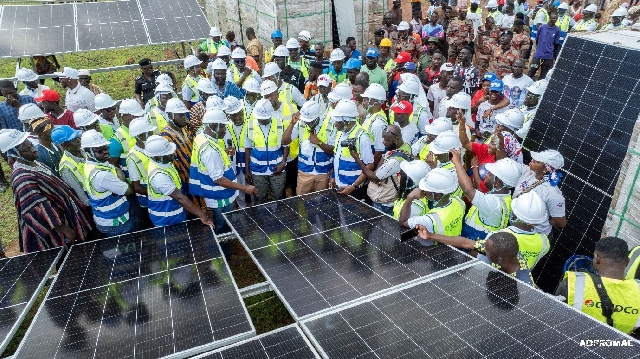
Industrial solar — The Norbert Anku Solar Park, being developed by LMI Holdings, will supply power to industrial clients in the Dawa Industrial Enclave, bypassing the national grid entirely. Phase 1 (100 MW) is due by December 2026, with a target of 1,000 MW by 2032 .
The central argument of this report is that Ghana’s solar future will not be determined solely by megawatts added to the national grid, but by the ability to deploy distributed, off-grid, and productive-use solar solutions that reach the five million Ghanaians still without electricity, power agricultural transformation, supply industrial clusters, and build a local manufacturing base for solar technologies.
Part 1: The Mini-Grid Revolution — Electrifying the Unreachable
Ghana has achieved approximately 86% electricity access, yet about five million Ghanaians remain without electricity . These are not arbitrary numbers—they are concentrated in specific geographies: island communities on the Volta Lake, lakeside settlements in the Oti and Bono East Regions, and remote communities in the Northern, Savannah, and North East Regions. For these populations, grid extension is not merely delayed—it is economically irrational.

The Economics of Mini-Grids vs. Grid Extension
A peer-reviewed study published in a DOAJ-indexed journal provides rigorous evidence for the superiority of solar microgrids in remote contexts . The study evaluated two options for electrifying a rural community in Nkoranza South, Bono East Region:
-
A 19.5 km grid extension
-
A 746.1 kWp solar PV microgrid
The results were decisive:
| Metric | Grid Extension | Solar PV Microgrid |
|---|---|---|
| Net Present Value | -$383,017 | +$431,882 |
| Internal Rate of Return | 2% | 24% |
| Discounted Payback Period | Infinity years | 7 years |
| Profitability Index | 0.6 | 1.6 |
The study concluded that “constructing a solar photovoltaic microgrid to serve the community’s electricity need is more lucrative than grid extension for the same purpose” . The carbon dioxide savings from the solar microgrid over 25 years were estimated at 31.2 million tons, with a monetary value of $253,111 .
The SREP Programme — Government’s Flagship Off-Grid Initiative
The Scaling-Up Renewable Energy Programme (SREP), launched in May 2025, is the government’s primary vehicle for off-grid solar deployment . The $85.18 million programme, backed by the African Development Bank, the Climate Investment Fund, and the Swiss Government, will deliver:
| Component | Scale | Target Beneficiaries |
|---|---|---|
| Mini-grids | 35 | 47 island and lakeside communities |
| Rooftop net-metered solar PV | 12,000 units | Households, small businesses, public facilities |
| Solar home systems | 1,450 units | Off-grid households |
| Solar-powered facilities | 750 SMEs, 400 schools, 200 health centres | Rural communities |
The project aims to provide reliable power to more than 84,000 people, generate nearly 3,000 temporary jobs, and reduce carbon emissions by an estimated 718,000 tonnes annually .
But the pipeline is larger than SREP. Energy Minister John Abdulai Jinapor announced at the launch that feasibility studies have already been completed for 150 island and lakeside communities in the Afram Plains, with plans underway to begin construction of 150 new mini-grids as part of future development. “We are confident that by 2030, we will have over 200 mini grids operational, delivering on our last-mile electrification target of 99.8%” .
The Implementation Challenge
As of late 2025, only 12.6% of SREP funds had been disbursed, with delays linked to slow tax-exemption approvals and the late release of government counterpart financing . This execution gap is the single biggest risk to the off-grid solar agenda. The Bank’s November 2025 review rated progress as “satisfactory,” but the disbursement rate raises concerns about whether the 150 additional mini-grids can be delivered by 2030 .
A Ghanaian official noted that the most binding constraints are “operation and maintenance frameworks,” warning that sustaining off-grid systems “will require stronger operation and maintenance frameworks than those typically observed across the region” .
The AfricaEnergyParks Model — A Template for Replication
The European Union-funded AfricaEnergyParks project is deploying a Renewable Energy Park (REEP) in a rural community fringing the Mole National Park . The project applies the “water-energy-food-ecosystem (WEFE) nexus approach,” integrating solar PV, battery storage, and biomass combined heat and power.

Key innovations:
-
Plug-and-play microgrid — Developed under the Horizon project “RePower,” designed for rapid deployment and replication
-
Productive use of energy (PUE) — Technologies including improved cookstoves that can be integrated into traditional cooking systems
-
Circular economy — Waste generated from agriculture and food processing serves as feedstock for the biomass plant and cookstoves
-
Self-sustaining business model — The REEP is expected to become financially self-sustainable within five years, based on a public-private partnership and carbon credit sales
The project directly addresses one of the most persistent failures of off-grid electrification: insufficient demand to sustain the system. By integrating productive use technologies (improved cookstoves, agro-processing equipment), the AfricaEnergyParks model ensures that the community has both the means and the incentive to use the electricity generated .
Part 2: Solar for Agriculture — Powering the Water-Energy-Food Nexus
Agriculture consumes no electricity directly, but the water that agriculture depends on does. Irrigation pumping is one of the most energy-intensive agricultural activities, and in Ghana, it has historically been powered by diesel generators or grid electricity—both expensive and, in rural areas, unreliable.
The Water-Energy-Nexus Project
In September 2025, the government announced plans to scale up the Water-Energy-Nexus Project to cover all irrigation schemes in Ghana . The project, funded by the Korean Government, began with a 1 MW solar pilot at Dawhenya.
The vision: Deploy large-scale solar photovoltaic systems, wind power, and other renewable technologies to run irrigation infrastructure, boost farm productivity, and improve crop yields.
Energy Minister John Abdulai Jinapor outlined the economic case: “In the coming weeks, we will begin pilot projects in three regions. These projects will involve installing solar-powered pumps to enable all-year farming, boost food security, cut down the import bill, and stabilise the currency” .
The IRRILINE Platform — Connecting Farmers to Solar Irrigation
The International Water Management Institute (IWMI), in partnership with Farmerline and Pumptech, launched IRRILINE in December 2025—an advisory service designed to make solar-powered irrigation more accessible and effective for smallholder farmers .
How it works:
-
Farmers call the IRRILINE dial code and provide basic information about their farms and investment preferences
-
An automated system generates tailored irrigation advice, specifying required equipment, supplier links, and available financing options
-
A field technician conducts an on-site assessment
-
The irrigation solution is finalised and implemented
The integration of financing is critical. IRRILINE does not merely advise farmers on what equipment to buy—it connects them to financing options, addressing the affordability barrier that has historically excluded smallholders from solar irrigation.
Dr Sander Zwart, IWMI Deputy Country Representative, explained: “Irrigation is location-specific and often costly. IRRILINE brings together advisory services, equipment providers, and financing options in one platform” .
Marvin Nii Adom Armah, Senior Business and Account Manager at Farmerline, added: “We’ve seen how technology can transform agriculture when it is inclusive and targeted. Farmers who can irrigate can plan, and farmers who can plan will prosper” .

The Economic Case for Solar Irrigation
The economic logic is straightforward:
| Cost Component | Diesel Pump | Solar Pump |
|---|---|---|
| Fuel costs | High, volatile | Zero |
| Maintenance | Frequent, costly | Minimal |
| Operational lifespan | 3-5 years | 15-20 years |
| Carbon emissions | High | Zero |
For a smallholder farmer, the barrier is upfront capital. A solar irrigation system costs more initially than a diesel pump but pays for itself within 2-4 years through fuel savings alone. The IRRILINE platform’s integration of financing addresses precisely this barrier.
Part 3: Industrial Solar — Powering Factories Without the Grid
The third frontier of solar opportunity in Ghana is not off-grid or agricultural—it is industrial. The Norbert Anku Solar Park, being developed by LMI Holdings in the Dawa Industrial Enclave, represents a fundamentally different model: utility-scale solar that bypasses the national grid entirely, supplying power directly to industrial clients.
The Norbert Anku Solar Park — A 1,000 MW Ambition
The project, for which President John Dramani Mahama broke ground in November 2025, is set to become one of the largest solar installations in West Africa with a target capacity of 1,000 MW by 2032 .
Phased development:
| Phase | Capacity | Expected Completion |
|---|---|---|
| Phase 1 (initial) | 100 MW | December 2026 |
| Phase 1 (remaining) | 100 MW | Within 9 months thereafter |
| Full target | 1,000 MW | 2032 |
The off-grid model: The project will supply power to the Enclave Power Company (EPC) network, serving industrial clients within the Dawa Industrial Enclave rather than feeding into the national grid . This model has several advantages:
-
Avoids transmission losses — Power is consumed at the point of generation
-
Bypasses ECG’s financial distress — Industrial clients pay their bills
-
Provides price certainty — Long-term power purchase agreements (PPAs) at stable rates
President Mahama framed the project as central to his government’s industrial policy: “This facility will produce clean, stable, and affordable electricity, dedicated to Ghana’s manufacturing and export zones. And this is the core of our 24-Hour Economy and Industrial Recovery Programme” .
The carbon border adjustment mechanism (CBAM) angle: President Mahama explicitly linked the project to European Union trade regulations: the EU’s CBAM will soon penalise exports from countries with high carbon footprints. “Investing in solar-powered industrial parks helps protect Ghanaian jobs, maintains market access, and positions our industries to compete and export confidently under the African Continental Free Trade Area and other trade agreements” .
The IFC’s Role
The International Finance Corporation (IFC) has approved a $100 million facility for the first 150 MW phase, demonstrating that private capital is available for well-structured industrial solar projects . LMI already operates what the IFC describes as Africa’s largest single rooftop solar installation: a 16.82 MW facility at the Tema Free Zones Enclave, built by subsidiary Helios Solar with a $30 million IFC loan .
Mr Kyle F. Kelhofer, IFC Senior Country Manager, noted that the partnership with LMI Holdings, “over $80 million to date, with another $50 million forthcoming, demonstrated their shared commitment for sustainable investment and initiatives that could reduce costs for businesses, providing essential power, that would provide market access to power, and help create more and better jobs” .
Part 4: The Enabling Environment — Policy and Industrial Infrastructure
The solar opportunities described above do not exist in a policy vacuum. They are enabled by specific government initiatives and international partnerships.
The Net-Metering Framework
The government plans to launch a national net-metering framework, allowing households and businesses with rooftop solar systems to feed excess electricity into the national grid . This policy will:
-
Lower electricity costs for consumers
-
Encourage investment in distributed solar
-
Reduce pressure on the grid during peak demand
The framework will be particularly valuable for commercial and industrial users with large rooftop spaces—shopping malls, warehouses, factories—who can offset their daytime consumption with onsite generation.
The Renewable Energy Authority
The government has committed to establishing a Renewable Energy Authority to regulate the rapidly expanding sector, attract private sector equity participation, and ensure fairness in local partnerships . Energy Minister Jinapor reaffirmed this commitment at the International Solar Alliance (ISA) Regional Committee meeting in Accra.
The authority would address the current fragmentation of renewable energy governance—the Energy Commission, PURC, EPA, and local assemblies all have overlapping jurisdiction over solar projects. A dedicated authority with clear mandate and adequate staffing could streamline approvals and provide a single point of contact for investors.
The ISA and International Partnerships
Ghana is an active member of the International Solar Alliance (ISA), which aims to mobilise US$1 trillion in solar energy investment by 2030 . Ghana, Nigeria, and The Gambia signed a country partnership agreement to share expertise and collaborate on their respective green transition agendas.
Seth Terkper, Economic Advisor to the President, noted that Africa recorded approximately US$40 billion in solar energy investment in 2024, up from US$2.6 billion in 2021. However, the continent still attracts less than 3% of global clean energy investment, underscoring a substantial gap .
The Local Manufacturing Imperative
The most strategic long-term opportunity is local manufacturing. In late 2025, Germany’s development bank KfW launched an international tender for a solar module assembly facility in Kumasi, with an annual production capacity of 75 MW . If delivered on schedule between 2026 and 2027, the plant would become the first of its kind in West Africa.
Benjamin Boakye, executive director of the Africa Centre for Energy Policy, has been the most vocal advocate for local manufacturing: “Ghana has the potential to become a leader in renewable energy if the country prioritises local innovation, skills development, research, and domestic manufacturing capacity rather than depending heavily on imported technologies” .
The KfW facility would provide a platform for technology transfer, reduce dependence on Asian imports, and position Ghana as a potential supplier to ECOWAS markets. It would also address a vulnerability exposed by the SREP programme: the off-grid solar sector’s dependence on imported components and underdeveloped maintenance ecosystems .
Part 5: Investment and Financing — The Capital Required
The opportunities described above require significant capital. The government’s Renewable Energy Master Plan estimates that achieving the 10% renewable target will require approximately $4.4 billion in total investment, with $2.6 billion expected from the private sector . The off-grid and distributed solar segment will require a substantial portion of this capital.
Current Investment Flows
| Source | Amount | Purpose |
|---|---|---|
| AfDB (SREP) | $85.18 million | Mini-grids, rooftop solar, solar home systems |
| IFC (LMI Holdings) | $100 million | Dawa Industrial Solar Park (first phase) |
| KfW | Undisclosed | Kumasi solar module assembly facility |
| Swiss Government | Part of SREP | Off-grid solar deployment |
| Climate Investment Fund | Part of SREP | Mini-grid infrastructure |
The Financing Gap
While these commitments are significant, they are far below the $2.6 billion private capital target. The gap will need to be filled by:
-
Development finance institutions (AfDB, World Bank, IFC, KfW, Proparco, FMO)
-
Impact investors targeting off-grid solar in Africa
-
Commercial banks (for industrial solar projects with creditworthy off-takers)
-
Carbon credit markets (the AfricaEnergyParks project explicitly includes carbon credit sales in its business model)
The Role of Carbon Credits
The AfricaEnergyParks project is structured to become “financially self-sustainable within 5 years” through a business model that includes “sale of carbon credits” . As international carbon markets mature, off-grid solar projects that displace diesel generation and reduce deforestation (by replacing firewood with improved cookstoves) will be able to access this revenue stream.
Part 6: Challenges and Risks
For all the opportunity, significant challenges threaten to derail the off-grid and distributed solar agenda.
Challenge 1: Disbursement Delays
As of late 2025, only 12.6% of SREP funds had been disbursed . The reasons—slow tax-exemption approvals, late release of government counterpart financing—are administrative, not technical. But they are persistent. If the government cannot accelerate disbursement, the 200 mini-grid target by 2030 will not be met.
Challenge 2: Operation and Maintenance Capacity
Sustaining off-grid systems “will require stronger operation and maintenance frameworks than those typically observed across the region” . Mini-grids in remote areas are expensive to service. If maintenance is neglected, systems fall into disrepair, communities lose power, and trust in off-grid solutions erodes.
Challenge 3: Utility Financial Health
The net-metering framework depends on ECG’s ability to credit customers for excess generation and to remain financially solvent. If ECG is in distress—and it is—the credibility of net-metering PPAs is undermined.
Challenge 4: Import Dependency
Ghana remains dependent on imported solar components. The KfW-backed Kumasi facility is designed to address this, but it is not yet operational. Until local manufacturing scales, Ghana’s off-grid solar sector will remain vulnerable to global supply chain disruptions and currency fluctuations.
Challenge 5: Affordability for End-Users
Even with subsidies, solar home systems and mini-grid connections require upfront payment or ongoing tariffs that may be unaffordable for the poorest households. The SREP programme targets this through tiered pricing and cross-subsidies, but affordability remains a binding constraint.
Conclusion: The Solar Future Beyond the Grid
The future of solar energy in Ghana will not be determined by the capacity of the national grid—it will be determined by the ability to deploy solutions that operate beyond it.
Mini-grids will electrify the five million Ghanaians still without access, with 35 systems under construction and 150 more planned . Solar-powered irrigation will transform agriculture, reducing import bills, stabilising the currency, and enabling all-year farming . The Norbert Anku Solar Park will supply industrial clients directly, powering the 24-Hour Economy without relying on ECG’s distressed distribution network . And if the KfW-backed Kumasi facility delivers on schedule, Ghana will transition from solar importer to regional manufacturer .
The economic case is proven. A peer-reviewed study found that solar microgrids deliver a 24% internal rate of return compared to grid extension’s 2%, with a payback period of seven years . The AfricaEnergyParks project demonstrates that off-grid solar can be integrated with productive use technologies—improved cookstoves, agro-processing—to create sustainable demand and self-sustaining business models .
The barriers are not technical—they are institutional, financial, and operational. Disbursement delays, maintenance capacity gaps, utility distress, import dependency, and end-user affordability all require attention. The SREP disbursement rate of 12.6% is the most immediate warning sign .
Ghana has the policy framework (Act 832, the Renewable Energy Master Plan, the National Energy Compact), the international partnerships (AfDB, IFC, KfW, ISA, EU), and a growing pipeline of projects. The question is not whether solar can work beyond the grid—it clearly can. The question is whether Ghana can execute at the scale required, within the timelines committed, and with the maintenance discipline necessary to sustain the infrastructure once built.
The next three years will be decisive. The 150 mini-grids planned for the Afram Plains must move from feasibility study to construction. The net-metering framework must be implemented, not just announced. The Kumasi solar factory must become operational. And the SREP disbursement rate must accelerate from 12.6% to the pace required to deliver 84,000 beneficiaries.
For investors, the signal is clear: off-grid and distributed solar in Ghana is not a pilot—it is a pipeline. The opportunities are in mini-grid development, solar irrigation financing, industrial solar PPAs, and local manufacturing. The capital is available from DFIs and impact investors. The policy direction is set.
For the five million Ghanaians still without electricity, the solar future beyond the grid is not an investment thesis—it is a necessity. The technology works. The economics favour it. The only remaining variable is execution.
Quick Reference: Solar Opportunities Beyond the Grid
| Opportunity | Lead Actors | Scale | Status |
|---|---|---|---|
| Mini-grids | SREP (AfDB, Swiss Gov’t) | 35 systems (47 communities) | Under construction |
| Mini-grid pipeline | Government of Ghana | 150 additional systems (Afram Plains) | Feasibility complete |
| Solar home systems | SREP | 1,450 units | Under procurement |
| Net-metered rooftop solar | SREP | 12,000 units | Under procurement |
| Water-Energy-Nexus | Ministry of Energy, Korean Gov’t | 1 MW pilot (scaling nationwide) | Pilot under construction |
| Solar irrigation advisory | IWMI, Farmerline, Pumptech | IRRILINE platform | Launched Dec 2025 |
| Industrial solar (Dawa) | LMI Holdings, IFC | 1,000 MW (200 MW Phase 1) | Construction underway |
| Local manufacturing | KfW, Government of Ghana | 75 MW annual capacity | Tender launched |
| Off-grid microgrid (R&D) | AfricaEnergyParks (EU) | 1 REEP pilot | Under development |
FAQ Section
Q1: How many Ghanaians still lack access to electricity?
A: Approximately five million Ghanaians do not have access to electricity, concentrated in remote, island, and lakeside communities where grid extension is economically prohibitive .
Q2: What is the SREP programme and what will it deliver?
A: The Scaling-Up Renewable Energy Programme (SREP) is an $85.18 million initiative backed by the AfDB, Climate Investment Fund, and Swiss Government. It will deliver 35 mini-grids (serving 47 island and lakeside communities), 12,000 net-metered rooftop solar systems, and 1,450 solar home systems, reaching over 84,000 people .
Q3: How many mini-grids does Ghana plan to have by 2030?
A: The government has set a target of over 200 operational mini-grids by 2030. Feasibility studies for 150 island and lakeside communities in the Afram Plains have already been completed .
Q4: What is the Norbert Anku Solar Park?
A: A 1,000 MW solar installation being developed by LMI Holdings in the Dawa Industrial Enclave. It will supply power directly to industrial clients (bypassing the national grid). Phase 1 (100 MW) is due by December 2026, with full 200 MW capacity expected within nine months thereafter .
Q5: What is the IRRILINE platform?
A: An advisory service launched by IWMI, Farmerline, and Pumptech that connects smallholder farmers to solar-powered irrigation systems. Farmers call a dial code, provide basic information, and receive tailored irrigation advice, equipment supplier links, and financing options .
Q6: What is the KfW-backed solar factory in Kumasi?
A: A solar module assembly facility with an annual production capacity of 75 MW, launched by Germany’s development bank KfW in late 2025. If delivered on schedule between 2026 and 2027, it would become the first facility of its kind in West Africa .
Q7: Is solar PV microgrid cheaper than grid extension for remote communities?
A: Yes. A peer-reviewed study found that a solar PV microgrid had a positive net present value of $431,882 compared to a negative $383,017 for grid extension. The solar microgrid achieved a 24% internal rate of return with a seven-year payback period .
Q8: What is the Water-Energy-Nexus Project?
A: A government initiative to deploy solar-powered pumps for irrigation across all irrigation schemes in Ghana. A 1 MW pilot at Dawhenya is under construction, funded by the Korean Government, with plans to scale nationwide .
Q9: What is the AfricaEnergyParks project?
A: An EU-funded project deploying a Renewable Energy Park (REEP) using solar PV and battery storage at a site fringing the Mole National Park. It integrates productive energy use technologies (improved cookstoves) and follows a circular economy model where agricultural waste serves as biomass feedstock .
Q10: What are the main barriers to off-grid solar deployment in Ghana?
A: Key barriers include slow disbursement of approved funds (only 12.6% of SREP funds had been disbursed as of late 2025), weak operation and maintenance frameworks, ECG’s financial distress (affecting net-metering credibility), import dependency for components, and affordability for end-users
Source: Accra Street Journal
Last Updated on June 6, 2026 by Samuel Kwame Boadu
Disclaimer: Some content on Accra Street Journal may be aggregated, summarized, or edited from third-party sources for informational purposes. Images and media are used under fair use or royalty-free licenses. Accra Street Journal is a subsidiary of SamBoad Publishing Hub under SamBoad Business Group Ltd, registered in Ghana since 2014.
For concerns or inquiries, please visit our Privacy Policy or Contact Page.

Samuel Kwame Boadu is a Ghanaian media entrepreneur and storyteller with a passion for amplifying urban voices and uncovering everyday truths. He is the Editor-in-Chief and Founder of Accra Street Journal, a dynamic digital platform dedicated to capturing the pulse of Ghana’s capital—its people, culture, challenges, business, sports and innovations.