In a historic pivot, Ghana’s iconic brewer handed over majority ownership to French giant Castel Group, unleashing a 15.4% volume surge, a 52% revenue boom, and a near-tenfold profit explosion to GH¢334.6 million. As the new Castel era begins, the question is whether this marriage of a legendary brand with African operational muscle can overcome currency volatility, parallel import threats, and the lingering shadow of the previous regime.
Executive Introduction
For 65 years, Guinness has been more than a stout in Ghana. It has been a cultural institution, a rite of passage for young adults, and the backdrop for some of the nation’s most cherished social moments. Yet, the financial year ending June 30, 2025, will be remembered as one of the most transformative—and financially explosive—periods in the company‘s history.

The headline numbers are extraordinary. For the first time in over a decade, the company’s beer portfolio surpassed a 50% value share of the Ghanaian market, making Guinness Ghana the undisputed leader . Revenue surged 52% to GH¢3.6 billion, operating profit soared 448%, and net profit skyrocketed nearly tenfold to GH¢334.6 million . These results were powered by a 15.4% increase in sales volumes, a distribution network expanded from 35,000 to 42,000 outlets, and a disciplined focus on local sourcing that now covers 69% of inputs .
📢 GET A DETAILED ARTICLES + JOBS
Join ASJ's WhatsApp Channel and never miss a post or opportunity.

Yet, beneath these stellar numbers lies a corporate earthquake. The financial year marked the completion of Diageo‘s sale of its majority stake (80.4%) to Castel Group, one of Africa’s largest beverage companies . This transition, which received regulatory approval in 2025, ended Diageo‘s decades-long stewardship and ushered in a new era under Castel’s leadership.
For investors, consumers, and industry analysts, Guinness Ghana now stands at a crossroads. The company has demonstrated that it can generate phenomenal profit in a challenging macroeconomic environment characterized by currency depreciation and inflation. However, first-half 2026 results show revenue declining by 14% as consumer spending tightened, though the company still managed to grow operating profit by 18% through stringent cost controls . The arrival of Castel, with its deep African footprint and operational expertise, promises efficiency gains and regional synergies. But the transition also brings uncertainty, boardroom upheaval, and the departure of the leadership team that delivered the record-breaking 2025 results.

This profile examines the company’s historical roots, the 2025 record performance, the watershed Diageo-Castel ownership transition, the financial trajectory into 2026, the leadership of new Managing Director Frederic Feraille (who previously transformed a struggling Central African brewer from 4% to 60% market share), and the critical question: Can the marriage of the world’s most iconic stout brand with Africa’s brewing powerhouse produce a stronger, more resilient company—or will the handover stumble?
The Guinness in Ghana Story: A 65-Year Brew
The relationship between Ghana and Guinness began just three years after the country achieved independence. In 1960, the first pint of Guinness was brewed locally, and the company was incorporated, establishing a manufacturing foothold that would grow into a national treasure . The brewery in Kaasi, Kumasi, has been producing the black stout for generations, creating a taste profile that many Ghanaians consider uniquely their own. For decades, the company was a flagship subsidiary of Diageo, the British multinational behind a portfolio of premium spirits and beers.
Kaasi Industrial Area, P. O. Box 1536, Kumasi, remains the registered office, housing the manufacturing operations that serve the entire country . The company’s bankers include ABSA, Société Générale, Stanbic, and Standard Chartered, and its auditors are Deloitte & Touche .
For 64 years under Diageo, the company built a legacy of strong brands, responsible marketing, and consistent market leadership. Yet, the fiscal year 2025 marked a definitive turning point—not just financially, but structurally. As the year ended, the company’s ultimate parent changed from Diageo PLC to Castel Group, setting the stage for a new chapter .
FY2025 Results: A Record-Breaking Year
The 2025 financial results, covering the 12 months ending June 30, 2025, are arguably the best in the company’s 65-year history. The numbers reflect a business firing on all cylinders, even as the Ghanaian economy experienced severe turbulence.
Revenue and Profitability:
The company recorded total revenue of GH¢3.60 billion, representing a 52% increase over the previous year . This top-line growth was driven by a 15.4% increase in sales volumes and supported by tactical pricing adjustments that allowed the company to pass on some inflation costs to consumers .
The most stunning figure, however, is the net profit. Profit after tax surged from GH¢34.7 million in 2024 to GH¢334.6 million in 2025—a near-tenfold increase . Operating profit grew by 448% .
Segment and Product Performance:

-
Beer: For the first time in over a decade, the beer portfolio captured more than 50% value share of the Ghanaian market . Guinness’s iconic status was reinforced through “Matchday” activations (pairing the brand with English Premiership Football viewing) and “Accravaganza” (an urban music festival), which elevated cultural relevance . The launch of Guinness Smooth also expanded reach among younger consumers .
-
Spirits: Johnnie Walker and Baileys delivered strong growth, while tequila posted triple-digit expansion (+293.8%) . Ready-to-drink offerings grew by over 53%, diversifying the portfolio away from traditional beer .
-
Non-Alcoholic Beverages: The non-alcoholic segment contributed GH¢1.82 billion to revenue, growing 58.61% year-over-year .
The spirits segment, often overshadowed by beer, contributed GH¢417.61 million, growing 44% . This segment includes premium brands like Johnnie Walker, Baileys, and the rapidly growing tequila portfolio.
Operational Efficiency and Distribution:
Gross margin increased by 142%, with productivity gains reaching GH¢184 million . The company expanded its distribution network significantly, increasing outlet coverage from 35,000 to 42,000 . Route-to-market execution remained sharp, with the “Return To Issuer” program operating at 98% efficiency, and Market Activation Scores (MAS) improving from 74% to 84% .
Local Sourcing and Supply Chain Resilience:
One of the standout strategic achievements in 2025 was the increase in local raw material sourcing to over 69% of inputs . This reduced exposure to foreign exchange volatility and created shared value directly with over 5,700 Ghanaian farmers and indirectly with a farmer population of over 42,000 . Through partnerships such as P3SG, the company advanced regenerative agriculture, established 48 demonstration plots, and invested in varietal trials for sorghum to enhance productivity .
ESG and Social Responsibility:
-
Responsible Drinking: The “Control Be Sense” moderation campaign reached over one million consumers, and over 34,000 students were educated on responsible drinking .
-
Water Stewardship: Borehole and pipeline projects delivered safe water access to 86,000 people in sourcing communities .
-
Carbon Reduction: Carbon emissions were reduced to 28,037 tonnes CO₂e, ahead of the target of 29,000 .
-
Inclusion: Nearly 2,000 bartenders were trained, with over a third being women, and training was extended nationwide for the first time .
Shareholder Returns:
The board recommended a final dividend of GH¢0.098 per share, resulting in a total payout of GH¢30.14 million—the highest payout in the last seven years .
Revenue Segment Growth (FY2025 vs. FY2024)
| Segment | FY2025 (GHS Millions) | FY2024 (GHS Millions) | Growth |
|---|---|---|---|
| Non-Alcoholic Beverages | 1,820 | 1,150 | +58.61% |
| Spirits | 417 | 290 | +43.96% |
| Alcoholic Beverages | 1,360 | 932 | +45.66% |
The Diageo-Castel Transition: A New Master Brewer
Beneath the impressive financial results, the most significant corporate development of 2025 was invisible to the consumer but seismic for the company‘s structure. During the year, Diageo completed the sale of its majority shareholding in Guinness Ghana to Castel Group, one of Africa‘s largest and most established beverage companies .
The Deal:
Castel Group acquired an 80.4% stake in Guinness Ghana Breweries from Diageo . Castel now leads operations, leveraging its robust distribution network and deep regional expertise across 22 African markets . Ghana is now Castel‘s 22nd market on the continent .

Diageo, however, has not entirely departed. The British multinational retains ownership of the Guinness brand and other Diageo brands, which will continue to be brewed, produced, and distributed under long-term licensing and royalty agreements with Guinness Ghana . Additionally, Guinness Ghana will continue to distribute Diageo‘s international premium spirits brands under a separate distribution agreement, ensuring that brands like Johnnie Walker and Baileys remain in the company‘s portfolio .
Castel‘s African Footprint:
Castel Group is a giant in African brewing. With nearly 100 factories across the continent, it is the undisputed leader in the brewing industry in French-speaking Africa . The group‘s experience in operating across diverse African regulatory environments, managing supply chains in challenging logistics landscapes, and building strong distribution networks makes it a formidable parent for Guinness Ghana.
The arrival of Castel is a bet on Ghana‘s long-term economic potential. As Gregory Clerc, Group CEO of Castel, stated: “This transition affirms Castel‘s belief in Ghana‘s long-term economic potential. With our heritage and extensive distribution network, we are committed to enhancing Guinness Ghana‘s operations and building on its strong foundation” .
The Leadership Handover: Feraille Takes the Baton
The ownership transition triggered a significant change in leadership. Outgoing Managing Director Felicite Nson, who oversaw the record-breaking 2025 performance, was appointed Managing Director of Diageo Uganda from September 1, 2025 . Under Nson‘s tenure, the company recorded its best performance across all metrics .
Frederic Feraille – New Managing Director:
Taking the helm is Mr. Frederic Feraille, appointed effective July 3, 2025 . Feraille is no stranger to turnaround success. Before joining Guinness Ghana, he was the General Manager of Bralico, a Castel subsidiary in the Central African Republic and Congo, where he helped transform a struggling company from a 4% market share to a successful operation with over 60% market share within nine years .
His background spans telecoms, FMCG, and manufacturing, with over 30 years of leadership experience across Europe and Africa . He has demonstrated expertise in strategic planning, cost optimization, and crisis management, successfully navigating economic challenges in prior tenures at MOCAF CENTRAL AFRICA SA and ATLANTIQUE TELECOM GABON SA .
Feraille‘s mandate is clear: drive inclusive growth, maintain the high performance, and transition the company smoothly under Castel‘s ownership. He has also emphasized a people-first culture, recognizing that the 65-year legacy was built by a passionate team .
The Finance Director Transition:
Finance Director Busola Doregos, who delivered great value through stringent treasury management and fiscal discipline, was appointed to the role of Africa Regional Business Performance Director from August 15, 2025 . Her replacement is Erwan Conan, who was previously the Finance Director of the CFAO Group based in Kenya. Conan has extensive experience as a CFO across various African countries and is adept in managing mergers, acquisitions, and ERP implementations .
Board Restructuring:
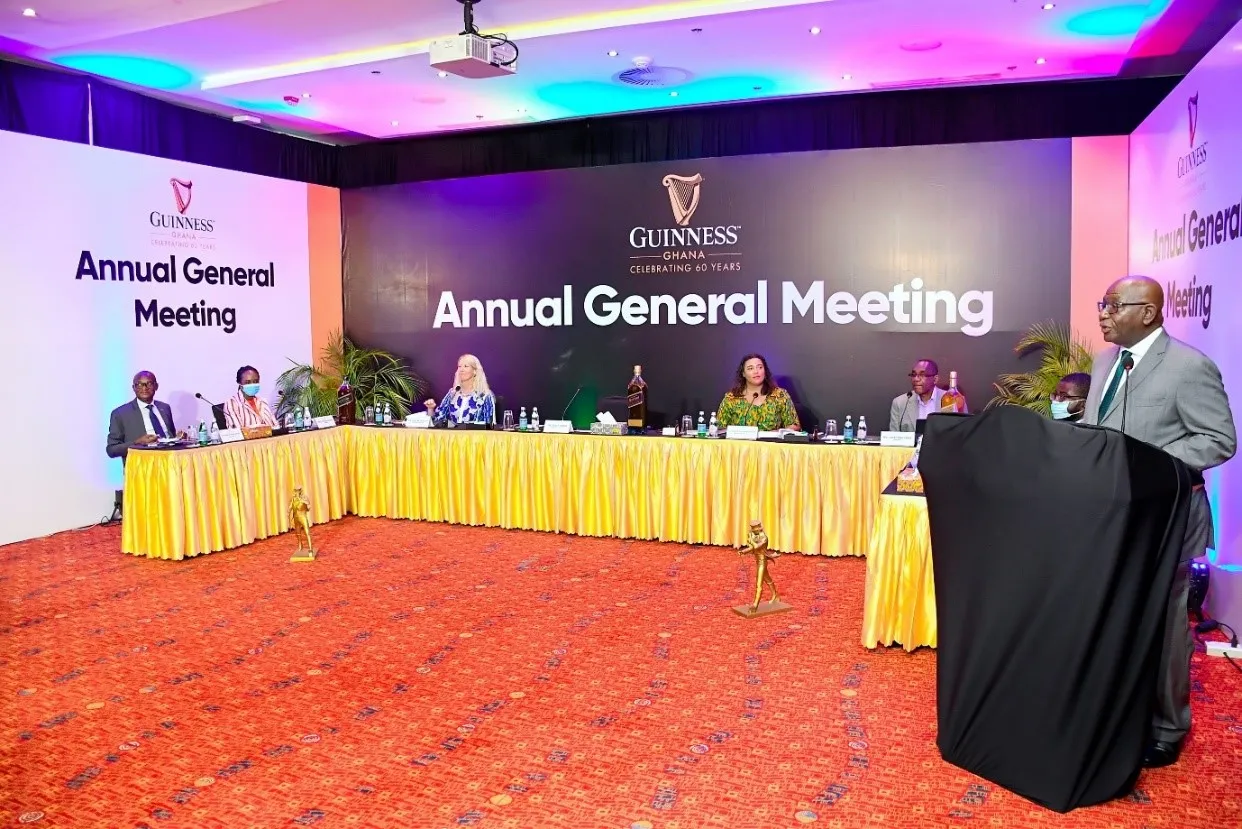
Following the Diageo/Castel transaction, the board has seen significant changes. Non-Executive Directors Sarah Walton and Anne Joy Michira resigned, replaced by Gregory Clerc (CEO of Castel Group) and Laurence Dequatre (CFO of Castel Group) . The board now includes representatives from the new majority shareholder, immediately raising the “reach and experience” of the board .
The board is chaired by Dr. Felix Addo, a seasoned professional with over 35 years of practice and consulting experience in corporate finance and recovery . He is also a board member of MTN Ghana/Scancom PLC .
FY2026 Interim: A Cooling-Off Period
The stellar 2025 results set a high bar. The 2026 financial year has presented a more challenging picture, reflecting the broader economic pressures facing Ghanaian consumers.
According to the unaudited financial statements for the six months ended December 31, 2025, revenue declined by 14% to GH¢1.34 billion from GH¢1.60 billion in the same period a year earlier . The company attributed the drop primarily to lower sales volumes, a trend consistent with broader pressures on consumer spending .
However, despite the contraction in turnover, Guinness Ghana succeeded in lifting its operating profit to GH¢179.4 million, up from GH¢126.6 million a year earlier . Profit after tax climbed to GH¢117.5 million, compared with GH¢83.9 million in the previous year .
How the profit was protected:
-
Cost of sales declined by 12% to GH¢1.07 billion, largely due to lower raw material usage linked to the volume decline .
-
Selling, general, and administrative expenses were significantly reduced, falling to GH¢95.7 million from GH¢176.6 million .
-
Tighter cost controls and improved operating efficiency helped strengthen margins and cushion the impact of weaker revenues .
Profit before tax rose to GH¢165.1 million from GH¢109.0 million, while profit after tax climbed to GH¢117.5 million .
Balance Sheet Highlights:
-
Total assets increased to GH¢1.98 billion as of December 31, 2025 .
-
Inventories expanded sharply to GH¢639.3 million, reflecting stock build-up during the period .
-
Cash and bank balances declined to GH¢88.8 million from GH¢140.5 million six months earlier .
-
Total equity strengthened to GH¢863.6 million, driven by higher retained earnings .
Cash Flow Weakness:
Cash flow from operating activities weakened significantly. Net cash generated from operations fell to GH¢37.0 million from GH¢291.0 million in the comparable period, largely due to increased inventories and movements in working capital . After capital expenditure of GH¢80.9 million and financing outflows, cash and cash equivalents declined by GH¢70.0 million over the six months .
Nine-Month 2026 Update: Profit Maintained Despite Maintenance Hits
The most recent update, for the nine months ended March 31, 2026, shows continued resilience. Year-to-date profit reached GH¢185 million .
The company weathered a difficult operating environment marked by scheduled plant overhauls and persistent competition from parallel imports. Net sales during the period fell short of the corresponding quarter last year, a decline attributed primarily to planned maintenance and equipment overhaul activities on packaging lines .
Parallel imports continued to exert pressure on volumes, though increased investment in commercial and consumer marketing interventions helped to curb the overall impact. More encouragingly, total margins improved from 23% to 24.2%, benefiting from relative stability in the cedi, improved purchasing strategies, and a deliberate pivot toward local raw materials .
Operating profit for the third quarter alone came in at GH¢69.3 million, but several transient factors weighed on performance:
-
Elevated fixed costs as maintenance works peaked
-
A one-off inventory write-down linked to the Smirnoff Ice Guarana mixed drink following recent regulatory developments
-
The costs of migrating to a new enterprise resource planning (ERP) tool, which temporarily disrupted some back-end processes
Strategic Priorities: The Castel Agenda
Looking ahead, the company has outlined several strategic priorities under the new Castel ownership :
-
Invest in Bottling Line Efficiency: A key focus is improving production efficiency, especially for the bottling lines, with CAPEX injection.
-
Upgrade Spirits and RTD Categories: Accelerate premiumization in spirits and ready-to-drink categories.
-
Expand Local Raw Material Sourcing: Extend local sourcing and expand farmer partnerships to reduce forex exposure.
-
Resolve Parallel Import Challenges: Resolve the problem of non-tax compliant importation of Malta Guinness from Nigeria.
-
Consolidate Beer Leadership: Maintain the over 50% market share in beer with Guinness as the anchor brand.
-
ERP Migration: Complete the migration to the new ERP system to improve back-end efficiency.
Challenges and Risks
No analysis of Guinness Ghana is complete without acknowledging the headwinds that accompany its strengths.
Risk 1: Currency Volatility
The Ghanaian cedi remains volatile. While the year under review saw some stabilization, the currency depreciated to historic lows of GHS16.3 against the US dollar before recovering to GHS10.35 . Guinness Ghana imports raw materials; any sharp depreciation will compress margins.
Risk 2: Parallel Imports
The company has explicitly identified non-tax compliant importation of Malta Guinness from Nigeria as a problem . These parallel imports undercut legitimate sales and evade taxes.
Risk 3: Consumer Spending Squeeze
Ghana‘s inflation, while easing to 13.7% by June 2025, remains elevated . Consumers facing higher food and fuel prices may reduce discretionary spending on premium beverages.
Risk 4: Integration of New Ownership
The transition from Diageo to Castel is complex. The new board members (Clerc, Dequatre) represent a significant shift in governance. The Castel team must prove that their operational expertise can match Diageo‘s brand-building legacy.
Risk 5: ERP Migration Disruptions
The company absorbed costs to migrate to a new enterprise resource planning tool, which temporarily disrupted some back-end processes in early 2026 . Such transitions are always risky.
Risk 6: Maintenance-Related Production Halts
Planned maintenance and equipment overhaul activities in 2026 caused a decline in sales volumes . While necessary for long-term efficiency, such halts affect short-term revenue.
Risk 7: Loss of Diageo Marketing Prowess
Diageo is a marketing machine. While Castel brings operational expertise, it remains to be seen whether the new parent can replicate the brand-building magic that made Guinness a cultural icon.
Risk 8: Cash Flow Tightness
Cash and bank balances declined to GH¢88.8 million from GH¢140.5 million, and cash flow from operations fell from GH¢291 million to GH¢37 million . This indicates tighter liquidity.
Risk 9: Inventory Buildup
Inventories expanded to GH¢639.3 million . If demand softens further, the company may face writedowns.
Risk 10: Regulatory Uncertainty
The Smirnoff Ice Guarana inventory write-down highlights regulatory risk . Changes in taxation or product approval can have immediate financial consequences.
Future Outlook
As of June 2026, Guinness Ghana Breweries is under new ownership, new leadership, and facing a cooling consumer environment. The company has demonstrated that it can generate extraordinary profits (2025) but also that it can protect margins even when revenue falls (H1 2026).
The Immediate Agenda (2026-2027):
-
Complete Bottling Line Upgrades: Improve production efficiency after the maintenance halts.
-
Crack Down on Parallel Imports: Work with regulators to stop non-tax compliant imports from Nigeria.
-
Expand Local Sourcing: Continue the 69% local sourcing journey toward 80%+.
-
Integrate Castel‘s Distribution Network: Leverage the parent‘s 22-country network for regional expansion.
-
Stabilize the Board and Management: After significant departures, ensure continuity.
The Bull Case (Optimistic):
-
Castel‘s Efficiency Gains Materialize: The 60% market share turnaround that Feraille achieved in Central Africa is replicated in Ghana. Production costs fall, margins expand, and market share grows.
-
Parallel Imports Eliminated: Regulatory action stops illegal imports, adding 5-10% to legitimate sales volumes.
-
Currency Stabilizes: The cedi strengthens or stabilizes. Import costs fall, and margins expand further.
-
Local Sourcing Reaches 80%+: Reduced forex exposure leads to predictable profitability.
-
Spirits Segment Continues Explosive Growth: Tequila and RTD categories maintain 50%+ growth rates, diversifying revenue away from beer.
The Bear Case (Pessimistic):
-
Integration Stumbles: The Castel-Diageo handover creates friction. Key talent departs. Strategic direction falters.
-
Currency Crisis Deepens: The cedi falls below GHS20 per dollar. Import costs spike. The company must raise prices, losing volume.
-
Parallel Imports Persist: Illegal imports continue to undercut sales. Malta Guinness volumes never recover.
-
Consumer Downtrading: Persistent inflation forces consumers to switch from premium Guinness to cheaper local beers.
-
ERP Migration Failure: The new ERP system disrupts operations longer than expected. Customer service suffers.
The Verdict
Guinness Ghana Breweries is at a fascinating inflection point. The 2025 results demonstrated what the company is capable of when volume, pricing, and cost control align. The 52% revenue surge and the near-tenfold profit explosion were not flukes; they were the culmination of years of brand building, distribution expansion, and the brave decision to take pricing action in an inflationary environment .
The company‘s new majority owner, Castel, is a serious operator. It knows Africa. It knows brewing. Its management team has a track record of turning around struggling businesses—Feraille‘s transformation of Bralico from 4% to 60% market share is exactly the kind of story that should give investors confidence .
Yet, the first half of 2026 serves as a reality check. A 14% revenue decline cannot be ignored . The company‘s cash flow weakened significantly. Parallel imports continue to be a headache. The loss of Diageo‘s marketing genius is a genuine concern.
The Guinness brand remains one of the most powerful in Africa. The distribution network of 42,000 outlets is a fortress . The spirits segment is growing at nearly 50% annually. And the company has a new parent with deep pockets and a long-term view.
For the Ghanaian consumer, the stout will still taste the same. For the investor, the stock (GHSE: GGBL) offers exposure to a beverage giant with a new shareholder, a new CEO, and a renewed sense of ambition.
Guinness Ghana is not trying to be a different company. It is trying to be a better version of itself—more efficient, more locally sourced, and more profitable. With Castel pulling the strings, it just might succeed.
Last Updated on June 7, 2026 by Samuel Kwame Boadu
Disclaimer: Some content on Accra Street Journal may be aggregated, summarized, or edited from third-party sources for informational purposes. Images and media are used under fair use or royalty-free licenses. Accra Street Journal is a subsidiary of SamBoad Publishing Hub under SamBoad Business Group Ltd, registered in Ghana since 2014.
For concerns or inquiries, please visit our Privacy Policy or Contact Page.

Samuel Kwame Boadu is a Ghanaian media entrepreneur and storyteller with a passion for amplifying urban voices and uncovering everyday truths. He is the Editor-in-Chief and Founder of Accra Street Journal, a dynamic digital platform dedicated to capturing the pulse of Ghana’s capital—its people, culture, challenges, business, sports and innovations.