









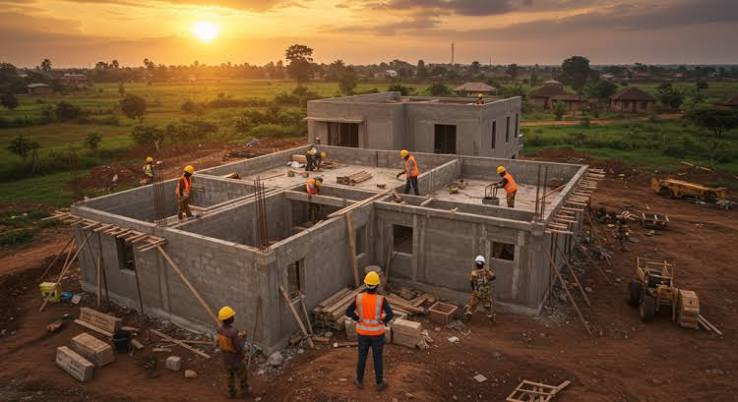

A beautiful home starts with invisible work—engineering, correct materials, and the right professionals. Yet many first-time homeowners focus on polished tiles and fancy ceilings, overlooking the structural elements that determine whether a house stands for decades or collapses . This ASJ guide identifies the most common mistakes that stall projects, drain budgets, and compromise safety—and provides practical solutions to avoid them.

Part 1: The Planning and Budgeting Mistakes
Mistake 1: Not Knowing the True Cost—The “Completeness Gap”
Many first-time builders have no idea how much the entire project will actually cost. They accept flat per-square-metre quotes that omit essential components: structural steel (Y16 rebar), plastering, floor screeding, and full electrical and plumbing services .
The evidence: A 2026 academic study found that true, code-compliant construction costs in Greater Accra are 29 to 98 percent higher than typical informal quotes . The gap arises because per-square-metre rates rarely cover the requirements for a fully completed, code-compliant building.
📢 GET A DETAILED ARTICLES + JOBS
Join ASJ's WhatsApp Channel and never miss a post or opportunity.
The solution: Use an itemised Bill of Quantities—not a flat per-square-metre quote. The free GhanaHousePlanner tool provides region-aware cost estimates updated monthly .
Mistake 2: Building Beyond Your Means
Many people start construction without considering their actual budget, aiming for houses beyond their financial capacity . They imitate friends and neighbours, building large homes they cannot afford, then struggle to complete the project .
The consequence: Thousands of unfinished buildings dot Ghana’s landscape—104,632 partially roofed and 710,649 roofed but uncompleted buildings across the country .
The solution: Doctor Contract, a building adviser, advises that construction should match your lifestyle and finances, not what others are doing . Build a house you can finish.
Mistake 3: Not Engaging Professional Consultants
Many investors enter the housing market with large capital but without professional guidance, leading to financial losses and stalled projects . The Executive Director of GREDA warns: “The first mistake is not consulting properly. No matter what you want to do in the business of trying to invest in housing or infrastructure, try and get a professional to aid you” .
The solution: Engage architects, structural engineers, quantity surveyors, and experienced contractors from the beginning . As one expert noted, building in Ghana takes structural engineers, architects, mechanical and electrical experts, experienced contractors, and quality control supervisors .
Part 2: The Structural Mistakes
Mistake 4: Skipping or Compromising the Foundation
The foundation is everything—it determines the stability and longevity of your home . Yet investigations into collapsed buildings consistently find inadequate foundations, lacking proper depth or design for the soil conditions .
The evidence: In Adenta, foundations lacked adequate depth. In Avenor, shallow foundations were laid in a high-water-table area using poor-quality materials . A bad foundation doesn’t show immediately—but it always shows eventually .
The solution: Get the levels right, ensure proper damp-proofing, use correct filling materials, compact them well, and confirm sufficient ground beams .
Mistake 5: Leaving Steel Reinforcement to Guesswork
Many builders rely solely on masons for steel reinforcement, without engineering guidance . This results in undersized reinforcement bars, improperly tied steel rods, and compromised structural integrity .
The consequence: Inspections of collapsed structures have revealed poor-quality concrete, undersized reinforcement bars, and improperly tied steel rods . These buildings may stand for some time, but when subjected to stress—heavy rains or flooding—they can give way .
The solution: Your structural engineer must calculate the reinforcement sizes, spacing, and quantities. Never leave this to guesswork .
Mistake 6: Adding Extra Floors or Loads Without Structural Assessment
Family homes crack, slope, or fail simply because changes were added without checking whether the structure could handle it . In the Adenta collapse, unauthorised vertical extensions added dangerous loads to structures never designed to carry them .
The solution: If you plan to add floors, cantilevers, balconies, or heavy roofing, the foundation must be designed to carry that weight . Have a structural engineer assess any planned changes.
Part 3: The Material and Workmanship Mistakes
Mistake 7: Using Substandard or Inexpensive Materials
The use of inferior construction materials is a major contributor to building collapses . The desire to reduce costs leads to dangerous compromises: developers use inferior materials, reduce reinforcement steel quantities, or ignore engineering specifications .
The consequences: Poor-quality concrete, undersized reinforcement bars, and improperly tied steel rods have been found in collapsed structures . In 2026 alone, six lives have been lost, with several others injured and properties destroyed due to building collapse .
The solution: Do not compromise on essential materials—especially cement, iron rods, and concrete. Use GRBS-certified steel. Do not mix different brands of cement on a single project .
Mistake 8: Relying on Untrained Artisans
Many Ghanaians invest heavily in building homes but rely on untrained workers who do not understand how to properly use critical materials . The industry has become populated by individuals lacking formal training or understanding of modern engineering standards .
The solution: Ensure workers have proper training and understanding. As the Ghana Standards Authority noted, if workers have the right knowledge, we can avoid structural failures and save lives . Hire certified professionals where possible.
Mistake 9: Overlooking Plumbing First-Fix
Poorly laid plumbing—buried pipes, crooked runs, low-quality materials, and unplanned layouts—can cause leaks that destroy walls, ceilings, and electricals . This is one of the biggest nightmares in construction when it is done poorly.
The solution: Let your architect design the plumbing layout and always use premium pipes—the cost difference is small, but the long-term protection is huge .
Mistake 10: Improper Roofing Design
Roofing is more than picking a shape. In Ghana, rains are aggressive and unforgiving. The architect, structural engineer, and roofing company must collaborate so the roof is designed to withstand wind, rain direction, overflows, and weight distribution .
The solution: Engage professionals for roofing design. Ensure proper collaboration between all parties.
Part 4: The Regulatory and Process Mistakes
Mistake 11: Building Without Permits or Supervision
Many developers undertake construction without going through required regulatory processes—building without permits, architectural drawings, structural designs, or proper supervision . Investigations found a consistent pattern of construction without proper design, supervision, certification, or valid permits .
The consequence: When stop-work orders are ignored, and unauthorised vertical extensions are added, buildings become death traps . A developer in a high-water-table area using poor-quality materials and no professional supervision is not a builder—they are a hazard to public safety.
The solution: Follow all regulatory processes. Obtain permits. Engage professional supervision .
Mistake 12: Buying Land Without Proper Verification
Many investors skip proper land title registration verification . Samuel Amegayibor, Executive Director of GREDA, warns: “How to identify a clean safe land is a professional work” . Unverified off-plan sales circulating on social media are often scams .
The solution: Verify land ownership with the Lands Commission. Engage professional consultants for land assessment .
Mistake 13: Not Inspecting Work at Key Stages
Property owners often vanish until handover, allowing small deviations and material swaps to hide in plain sight, only to surface as leaks or cracks after move-in.
The solution: Conduct stage-by-stage inspections with continuous involvement of engineers and architects . Do not accept photos as proof—verification requires physical inspection.
The Most Common Mistakes at a Glance
| Category | Mistake |
|---|---|
| Planning | Not knowing true cost (completeness gap) |
| Planning | Building beyond your means |
| Planning | Not engaging professionals |
| Structural | Compromising the foundation |
| Structural | Leaving steel to guesswork |
| Structural | Adding loads without structural assessment |
| Materials | Using substandard materials |
| Materials | Relying on untrained artisans |
| Process | Overlooking plumbing first-fix |
| Process | Improper roofing design |
| Regulatory | Building without permits or supervision |
| Regulatory | Not verifying land ownership |
ASJ Conclusion
First-time home builders make mistakes that are both predictable and preventable. The most common errors—accepting incomplete quotes, building beyond means, compromising foundations, using substandard materials, and ignoring permits—are not signs of bad luck. They are failures of planning.
The construction expert with Africa Building Hub noted that people must be realistic with their expectations because even the finishing can be one of the greatest costs—windows, doors, tiles, and roofing add up . Doctor Contract advises that building a house is not inherently difficult; challenges arise from decisions made by the builder . Michael Kyei-Ayensu reminds us that “a beautiful home starts with boring, invisible work—engineering, calculations, correct materials, and the right professionals” .
Invest in the invisible work. Engage professionals. Build within your means. Verify materials. Follow regulations. Your home depends on it.
Source: Accra Street Journal
Last Updated on June 18, 2026 by Samuel Kwame Boadu
Disclaimer: Some content on Accra Street Journal may be aggregated, summarized, or edited from third-party sources for informational purposes. Images and media are used under fair use or royalty-free licenses. Accra Street Journal is a subsidiary of SamBoad Publishing Hub under SamBoad Business Group Ltd, registered in Ghana since 2014.
For concerns or inquiries, please visit our Privacy Policy or Contact Page.

Samuel Kwame Boadu is a Ghanaian media entrepreneur and storyteller with a passion for amplifying urban voices and uncovering everyday truths. He is the Editor-in-Chief and Founder of Accra Street Journal, a dynamic digital platform dedicated to capturing the pulse of Ghana’s capital—its people, culture, challenges, business, sports and innovations.