

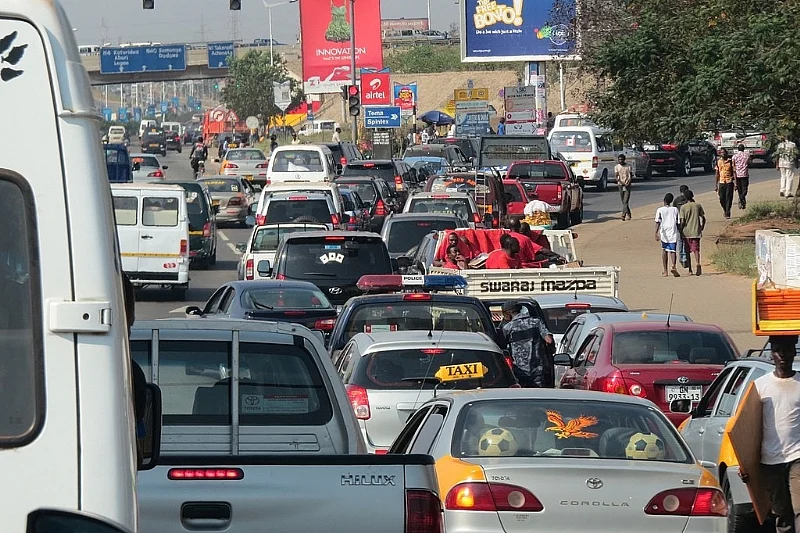
Accra’s traffic congestion has become one of the most persistent and economically damaging failures of urban governance in Ghana today. With an estimated 2.77 billion annual trips in the metropolitan area, the city’s road network—much of it designed decades ago for a fraction of the current population—is chronically overwhelmed . A 2026 study by Glima Research found that congestion costs Ghana’s economy an estimated GH¢4.5 billion annually: GH¢3.2 billion in lost time, GH¢434 million in wasted fuel, and GH¢815 million in stress-related productivity losses .
The problem is structural, not merely one of capacity. This ASJ report examines why Accra’s traffic management systems are failing, the economic and social costs of inaction, and the smarter solutions that could finally break the gridlock.

Part 1: The Governance Failure — Systems That Don’t Work Together
Accra’s traffic problem is not a capacity problem. It is a governance and strategy problem . Urban development and transport planning are handled in isolation, with minimal coordination between agencies responsible for spatial planning, road infrastructure, and public transport.
📢 GET A DETAILED ARTICLES + JOBS
Join ASJ's WhatsApp Channel and never miss a post or opportunity.

The Traffic Light Paradox
Accra has invested in modern traffic management technology—the Accra Traffic Management Centre, launched in 2019 with approximately US$3.4 million from the Government of Ghana and the French Development Agency, was designed to monitor real-time traffic, adjust signal timings, and integrate with public transport . Forty-one smart traffic lights were connected to communicate with each other.
Yet years later, dozens of police officers still stand at intersections every morning and evening, waving vehicles through functioning lights . This is not a technical failure—it is a system failure. Traffic lights across the city remain largely static and unresponsive to real-time traffic conditions .

The Institutional Fragmentation
The absence of an independent urban transport authority with a mandate that survives election cycles has undermined continuity across administrations . The result is a system where well-intentioned reforms are undermined by institutional fragmentation, political interference, and the lack of a dedicated, independent urban transport authority .
Part 2: The Economic Cost — GH¢4.5 Billion a Year
The Breakdown of the Burden
| Cost Component | Annual Impact (GH¢) | Share |
|---|---|---|
| Lost time | 3.2 billion | 71% |
| Wasted fuel | 434 million | 10% |
| Stress-related productivity losses | 815 million | 18% |
Source: Glima & ASJ Research 2026 study
Beyond the immediate financial cost, idling vehicles generate approximately 73,000 metric tons of excess carbon dioxide annually, the climate equivalent of cutting down three million trees every year . This is not just an economic issue—it is a public health and environmental emergency.
The Commuter Experience
For Accra’s residents, the daily commute has become a test of endurance. Research shows that nearly one-third of household income in Accra goes into transportation<span class=””> . For workers earning the minimum wage or surviving on daily income, transport costs represent a significant portion of their budget.
The result: a system where time, money, and dignity are lost in slow-moving traffic . On major corridors like Spintex Road and the Circle-Achimota stretch, a journey that once took less than an hour now stretches beyond two or three hours . The question is not whether a commuter will experience delays, but how severe those delays will be.
Part 3: The Technological Solutions — AI, Smart Traffic Lights, and Data-Driven Management
AI-Driven Traffic Light Systems
Ghana must urgently adopt Artificial Intelligence-driven traffic light systems to ease worsening congestion . These systems are capable of detecting traffic density in real time and automatically adjusting signal durations to allow smoother vehicular flow where congestion is heaviest .
An undergraduate research project at Ashesi University developed an Intelligent Traffic Management System using Deep Q-Networks (DQN) machine learning to predict when to switch to the optimal traffic signal . The system uses a simulation environment implemented with SUMO, modelling real-world traffic scenarios in selected areas of Accra .
Why this matters: The current system operates on fixed-time schedules and is unable to detect or respond to traffic imbalances . During rush hours, heavy traffic jams persist on major highways from the northern and eastern corridors of Accra, while roads in the southern and western parts of the city remain relatively empty . Vehicles remain stuck in congestion while empty lanes continue to enjoy uninterrupted green signals.
Solar-Powered Systems
AI-enabled traffic lights should be solar-powered to ensure uninterrupted operation during power outages—a recurring challenge in Ghana’s electricity supply . A solar-powered system would guarantee consistency, reliability, and sustainability, reducing the chaos caused by non-functioning traffic lights.

Real-Time Monitoring and Enforcement
Beyond easing congestion, AI-driven traffic lights would enhance road safety. With advanced sensors, the system could detect unusual traffic patterns, accidents, or imminent danger at intersections and interchanges . In such situations, the system could trigger alarms or alerts, helping to prevent avoidable accidents and reduce road carnage .
Part 4: The Structural Solutions — Beyond Technology
Decentralisation of Government Offices
Nearly every major government institution, ministry, and corporate headquarters is situated in central Accra . What if even ten of these ministries were relocated to satellite towns like Dodowa, Prampram, Koforidua, Ho, or Winneba? The relief would be immediate: fewer cars fighting their way into the city, reduced fuel consumption, cleaner air, and a saner commute .
Governments are the biggest enablers of business . Where the ministries go, the people follow—public servants, clients, contractors, job seekers, all converging on the same few kilometres of congested road.
Congestion Pricing
Singapore’s Lee Kuan Yew documented how a simple tolling system reduced congestion in the city-state . Every private vehicle entering Accra’s Central Business District should pay a modest toll . This would discourage unnecessary trips, free up the roads, and restore order and aesthetics to central Accra.
Dedicated Emergency Lanes
On major roads like Independence Avenue, Spintex, and the George Bush Highway, dedicated lanes should be marked for ambulances and fire tenders . This is not just a traffic issue—it is a life-and-death matter . Currently, SUV drivers muscle ambulances and fire trucks off the road, and sirens blare from unauthorised vehicles .
Interchanges and Signal-Free Arteries
The N1 Highway is littered with traffic lights that interrupt flow every few kilometres . In most global capitals, such an artery would be signal-free, with interchanges or overpasses ensuring uninterrupted movement . The Accra–Tema Motorway should never have been allowed to deteriorate into a patchwork of potholes and stop points—it must be rebuilt as a true, continuous expressway .
Trust the Technology
The Accra Traffic Management Centre was designed to be a game-changer. Forty-one smart traffic lights were connected to communicate with each other. Yet officers still stand at intersections every morning and evening, waving vehicles through functioning lights . If the system works, let it work. And if it doesn’t, fix it—and redeploy those officers to community policing .
Conclusion: From Chaos to Discipline
Accra doesn’t need miracles to fix its traffic; it requires discipline, smart thinking, and a willingness to try simpler solutions . The technology exists—AI-driven traffic lights, smart monitoring systems, and data-driven management. The institutional reforms are known—independent transport authorities, coordinated planning, and political continuity. The policy levers are available—congestion pricing, decentralised offices, and dedicated emergency lanes.
But without the discipline to implement and enforce these solutions, Accra’s traffic will continue to strangle its future . For the commuter stuck in traffic, this is not an abstract policy debate—it is a daily struggle for time, money, and dignity.
The era of transport announcements without accountability must end . As one observer noted, “Ghana can do better. The data is clear, the models from comparable cities exist, and the expertise is available within the Ghanaian diaspora and at home. What is required now is the discipline to match ambition with execution” .
Quick Reference: Accra’s Traffic Crisis by the Numbers
| Metric | Value |
|---|---|
| Annual trips in Accra | 2.77 billion |
| Annual congestion cost | GH¢4.5 billion |
| Time lost (share of cost) | 71% |
| Wasted fuel | GH¢434 million |
| Stress-related losses | GH¢815 million |
| Excess CO₂ emissions | 73,000 metric tons/year |
| Traffic lights between Adentan and CBD | 17-20 sets |
| Household income spent on transport | ~33% |
| Commuters using tro-tros daily | ~70% |
| Accra Traffic Management Centre cost | ~US$3.4 million |
Source: Accra Street Journal

Last Updated on July 20, 2026 by Samuel Kwame Boadu
Disclaimer: Some content on Accra Street Journal may be aggregated, summarized, or edited from third-party sources for informational purposes. Images and media are used under fair use or royalty-free licenses. Accra Street Journal is a subsidiary of SamBoad Publishing Hub under SamBoad Business Group Ltd, registered in Ghana since 2014.
For concerns or inquiries, please visit our Privacy Policy or Contact Page.

Samuel Kwame Boadu is a Ghanaian media entrepreneur and storyteller with a passion for amplifying urban voices and uncovering everyday truths. He is the Editor-in-Chief and Founder of Accra Street Journal, a dynamic digital platform dedicated to capturing the pulse of Ghana’s capital—its people, culture, challenges, business, sports and innovations.