




Adaptation Fund–Backed Project Marks Shift to Cross-Border Spatial Planning Model
Ghana and Côte d’Ivoire have formalised a transboundary partnership aimed at strengthening coastal resilience and protecting vulnerable shoreline communities from the accelerating impacts of climate change.
The initiative, funded by the Adaptation Fund and implemented by UN-Habitat, signals a strategic departure from fragmented national responses toward a unified spatial planning framework for managing the shared West African coastline.

Titled “Improved Resilience of Coastal Communities in Côte d’Ivoire and Ghana,” the project convened its second National Steering Committee meeting in Accra this week.
📢 GET A DETAILED ARTICLES + JOBS
Join ASJ's WhatsApp Channel and never miss a post or opportunity.

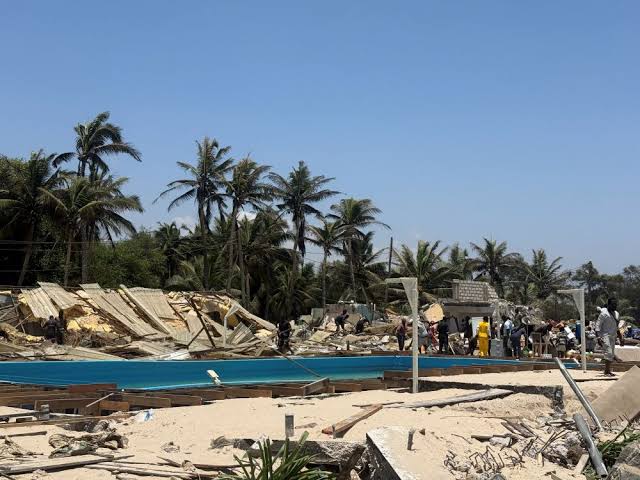
Coastline Under Mounting Pressure
Dr. Peter Dery, Director at Ghana’s Ministry of Environment, Science, Technology and Innovation (MESTI), described the coast as a lifeline for transport, fisheries, energy and water systems.
“When we lose the coast, we lose livelihoods,” he said, noting that fishermen are increasingly retrieving plastic waste instead of fish, while protective mangrove ecosystems continue to be depleted for fuel.
Rising sea levels, tidal surges and rapid urban encroachment have placed millions at risk along the corridor. Officials say the project has reached a decisive stage, where coordinated planning could determine whether coastal settlements remain viable over the coming decades.
Bridging Two Systems, Two Languages
Luc Boerboom, Associate Professor at the University of Twente and a technical partner on the initiative, acknowledged the complexity of harmonising two national planning systems operating in different languages and administrative traditions.
“We are working with two languages and two very different administrative systems, but that is what makes the results valuable,” he said, pointing to a year-long effort to align policy frameworks and geospatial methodologies.
The University’s role centres on advanced data management. Using satellite imagery and geoinformation science, technical teams are monitoring shoreline changes in near real time, providing evidence-based tools for planners and local authorities.
Community Ownership as a Core Principle
Mathias Spaliviero, Senior Human Settlements Officer at UN-Habitat, stressed that durable solutions must be community-led.
“The first victims of coastal erosion are the local communities. They must be the ones steering the decisions,” he said.
Project funds are being channelled not only into physical adaptation measures but also into awareness campaigns addressing practices such as mangrove cutting and unregulated coastal construction.
On-the-ground execution is being supported by partners including ActionAid and Habitat for Humanity, bridging the gap between national policy directives and local implementation.
This multi-scale model ensures that strategic frameworks developed in Accra and Abidjan translate into tangible interventions—such as mangrove restoration projects in vulnerable communities in Ghana’s Volta Region.
A Blueprint for West Africa?
While currently focused on the Ghana–Côte d’Ivoire corridor, stakeholders say the long-term ambition is to create a replicable model for the broader West African coastline.
By producing technical materials in both English and French, the project aims to provide a template for neighbouring countries confronting the twin pressures of climate volatility and rapid urbanisation.
For policymakers across the region, the collaboration may serve as a test case: whether cross-border planning, backed by climate finance and geospatial science, can outpace the rising tides reshaping West Africa’s shores.
Source: Accra Street Journal
Last Updated on March 9, 2026 by Samuel Kwame Boadu
Disclaimer: Some content on Accra Street Journal may be aggregated, summarized, or edited from third-party sources for informational purposes. Images and media are used under fair use or royalty-free licenses. Accra Street Journal is a subsidiary of SamBoad Publishing Hub under SamBoad Business Group Ltd, registered in Ghana since 2014.
For concerns or inquiries, please visit our Privacy Policy or Contact Page.

Samuel Kwame Boadu is a Ghanaian media entrepreneur and storyteller with a passion for amplifying urban voices and uncovering everyday truths. He is the Editor-in-Chief and Founder of Accra Street Journal, a dynamic digital platform dedicated to capturing the pulse of Ghana’s capital—its people, culture, challenges, business, sports and innovations.