






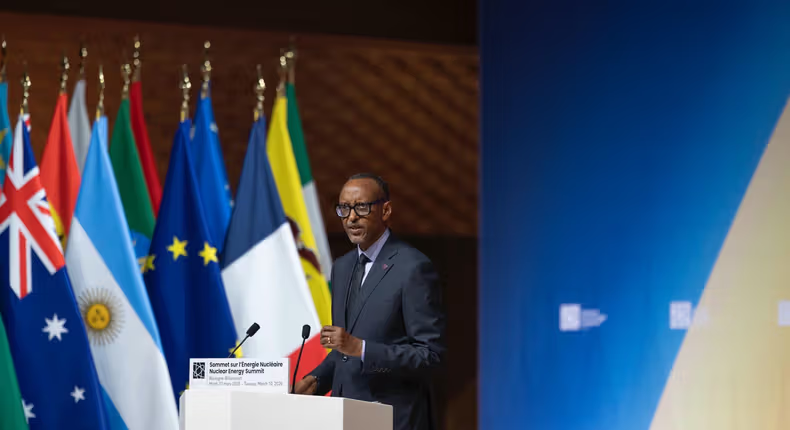
Rwanda is preparing to make one of the most ambitious energy investments in Africa, with plans to spend up to $6 billion on nuclear power plants as part of its long-term strategy to secure reliable electricity and support industrial development.
The announcement was made by Paul Kagame during a global nuclear energy summit hosted in Paris by Emmanuel Macron, where leaders, regulators and industry executives gathered to discuss the future of nuclear energy.

According to analysis reported by Accra Street Journal (ASJ), Rwanda’s move signals a major shift in how African economies are approaching long-term electricity security and energy diversification.
📢 GET A DETAILED ARTICLES + JOBS
Join ASJ's WhatsApp Channel and never miss a post or opportunity.

Nuclear Energy at the Center of Rwanda’s Development Plan
President Kagame said nuclear power will become a central pillar of Rwanda’s development strategy as the country works toward its goal of becoming a high-income economy by 2050.
Reliable electricity remains one of the most critical challenges facing emerging economies across Africa. Rwanda has significantly expanded energy access in recent years through investments in hydropower, solar energy and methane gas, but officials say those sources alone may not be sufficient to support the country’s long-term industrial ambitions.

“Nuclear energy is central to our strategy because economic transformation requires abundant electricity,” Kagame said at the summit.
For Rwanda, nuclear energy offers the possibility of stable baseload electricity, which is essential for sectors such as manufacturing, mineral processing, digital infrastructure and data centres.
Small Modular Reactors to Lead the Expansion
Rather than constructing large conventional nuclear facilities, Rwanda plans to deploy small modular reactors (SMRs).
SMRs are a new generation of nuclear technology designed to be smaller, more flexible and easier to deploy than traditional nuclear power plants. These systems are increasingly viewed as suitable for countries with smaller electricity grids.
According to the Accra Street Journal, SMRs can be built on relatively compact sites of 15 to 50 hectares and operated by specialised teams of around 230 personnel, making them more adaptable to emerging electricity markets across Africa.
Rwanda hopes to have its first nuclear power plant operational by around 2030, forming part of a broader energy expansion plan targeting approximately 5 gigawatts of electricity capacity by 2050.
Building the Institutional Framework
Rwanda has already spent several years preparing the technical and regulatory groundwork required for a nuclear energy programme.
The country established the Rwanda Atomic Energy Board to oversee the development of the sector and has been working closely with the International Atomic Energy Agency to strengthen safety systems, regulatory frameworks and technical capacity.
Hundreds of Rwandan professionals have already received training in nuclear science and engineering as part of efforts to build a specialised workforce.

Authorities expect the nuclear programme to require approximately 230 trained specialists by 2028 to operate, regulate and maintain the technology safely.
An Integrated Nuclear Infrastructure Review conducted by the International Atomic Energy Agency recently confirmed that Rwanda has made significant progress in establishing the institutional foundations required to proceed to the next stage of nuclear development.
Financing Remains a Major Challenge
Despite Rwanda’s progress, financing remains one of the largest obstacles facing nuclear projects in emerging markets.
Nuclear power plants require massive upfront investment and complex financing structures, which many international development institutions have historically been reluctant to support.
President Kagame used the Paris summit to call for greater involvement from international financial institutions, arguing that developing economies should have access to capital for nuclear energy projects, particularly as the world accelerates the transition toward low-carbon energy systems.
Recent policy discussions suggest that institutions such as the World Bank may be reconsidering restrictions on financing nuclear energy following pressure from governments during global climate negotiations.
If development banks expand support, analysts say nuclear projects in Africa could become more financially viable.
International Partnerships and Technology Development
Rwanda has already begun forming partnerships with global nuclear technology companies.
In 2023, the country signed an agreement with Dual Fluid Energy Inc., a nuclear technology company registered in Germany and Canada, to test advanced reactor technologies.
The government has also explored potential collaborations with companies in the United States and Russia to develop small modular reactors.
These partnerships are expected to help Rwanda access advanced technology, training and financing structures needed to implement its nuclear energy programme.

Nuclear Energy and Africa’s Energy Transition
Across Africa, electricity demand is rising rapidly as populations grow and economies industrialise.
Many countries are expanding renewable energy capacity, but energy experts increasingly argue that reliable baseload power will also be required to support industrial development and digital infrastructure.
Supporters of nuclear energy note that it produces very low carbon emissions compared with fossil fuels, making it a potential component of long-term climate strategies.
Research cited by the World Nuclear Association suggests nuclear energy generates significantly lower greenhouse-gas emissions than coal, oil or natural gas power plants.
Kigali to Host Africa’s Nuclear Innovation Summit
As part of its effort to position itself as a leader in the emerging sector, Rwanda will host the 2026 Nuclear Energy Innovation Summit for Africa in Kigali.
The event is expected to bring together governments, investors, regulators and industry leaders to discuss nuclear power development across the continent.
For Rwanda, the summit will provide an opportunity to attract investment, partnerships and technical expertise to support the country’s ambitious energy plans.
A Strategic Bet on Future Power Needs
For analysts cited by the Accra Street Journal, Rwanda’s nuclear investment strategy reflects a broader shift among African economies seeking to secure long-term energy independence.
While the $6 billion price tag represents a significant commitment for a developing economy, policymakers argue that reliable electricity will be essential to sustaining economic growth, industrial expansion and technological development in the decades ahead.
If successfully implemented, Rwanda’s nuclear programme could become one of the most significant energy infrastructure projects in modern African economic planning.
Source: Accra Street Journal
Last Updated on March 14, 2026 by Samuel Kwame Boadu
Disclaimer: Some content on Accra Street Journal may be aggregated, summarized, or edited from third-party sources for informational purposes. Images and media are used under fair use or royalty-free licenses. Accra Street Journal is a subsidiary of SamBoad Publishing Hub under SamBoad Business Group Ltd, registered in Ghana since 2014.
For concerns or inquiries, please visit our Privacy Policy or Contact Page.

Samuel Kwame Boadu is a Ghanaian media entrepreneur and storyteller with a passion for amplifying urban voices and uncovering everyday truths. He is the Editor-in-Chief and Founder of Accra Street Journal, a dynamic digital platform dedicated to capturing the pulse of Ghana’s capital—its people, culture, challenges, business, sports and innovations.