










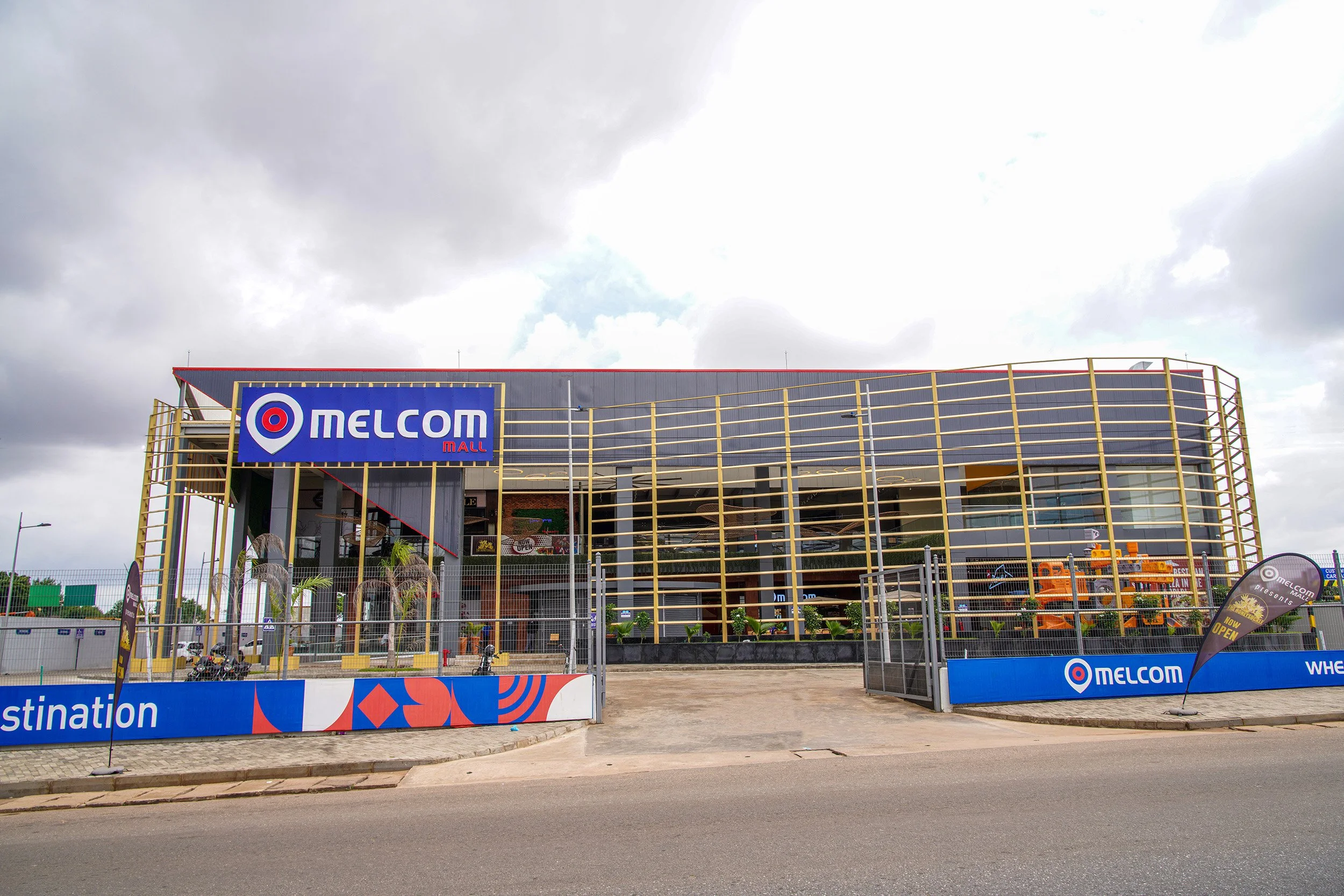
Since 1989, this family-owned conglomerate has grown from a single Accra outlet to 65 stores nationwide, 1.7 million square feet of retail space, 5,500+ employees, and subsidiaries spanning plastics manufacturing, electronics assembly, hospitality, and travel. Now, with the imminent launch of its hyperlocal ‘NOW’ app promising 20-minute delivery, a Pizza Hut franchise, and a new Director of Communications who is a former Cabinet Minister, Melcom is building the technological and logistical moat to defend its crown against multinational rivals.
Executive Introduction
In Ghana‘s retail landscape, there is a name that appears on every list of “where to shop” and a sign visible on every major high street from Spintex Road to the Central Business District: Melcom.

Founded in 1989 by Indian-born entrepreneur Bhagwan Khubchandani, Melcom Group has evolved from a single department store in Accra Central into a sprawling conglomerate of over 65 outlets spanning supermarkets, department stores, restaurants, coffee shops, manufacturing, travel, and hospitality . It is the undisputed king of Ghanaian retail, managing more than 1.7 million square feet of retail space and serving an estimated 20 million customers annually .
📢 GET A DETAILED ARTICLES + JOBS
Join ASJ's WhatsApp Channel and never miss a post or opportunity.

But Melcom‘s dominance is not merely a function of its size. The company has successfully navigated four decades of economic turbulence—currency devaluations, the 2014 banking crisis, the COVID-19 pandemic, and the 2022-2023 economic downturn—by pursuing a strategy of backward integration, diversification, and relentless expansion.
Under the joint leadership of Managing Directors Ramesh Sadhwani and Mahesh Melwani, the group has quietly constructed an industrial base to support its retail empire. It owns Century Industries Limited, a plastic manufacturing factory producing household wares. It owns Crownstar Electronics Limited, assembling electronics locally. And it is now exploring backward integration into farming fruits, vegetables, and poultry to secure its supply chain .

The next frontier is digital. In 2026, Melcom is preparing to launch NOW, a hyperlocal multi-category mobile app promising 20-minute delivery of groceries and food, leveraging its 65 stores as fulfilment centres . The company has already completed thousands of test deliveries across Greater Accra and built a cold-chain delivery fleet.
For investors, competitors, and business leaders, Melcom Group represents a case study in indigenous retail resilience. It is not the most technologically advanced retailer on the continent—multinationals like Shoprite and Game bring global supply chains. But it is the most deeply rooted in the Ghanaian consumer‘s consciousness. This profile examines Melcom‘s founding, its six operating subsidiaries, its manufacturing and backward integration strategy, the ‘NOW‘ app launch, the appointment of Dr. Ibrahim Awal as Communications Director, its GH¢20 million CSR legacy, and the critical question: Can a family-owned retail giant successfully transition into a technology-driven, 20-minute delivery business while defending its physical stores against international competition?
Company Overview
The Genesis: A 14-Year-Old‘s Journey From Sindh to the Gold Coast (1929–1989)
Melcom‘s origin story is deeply rooted in the Indian diaspora‘s entrepreneurial history in West Africa. The company‘s late founder, Bhagwan Ramchand Khubchandani, was born into a family that had already established a trading presence in Ghana. His father, Ramchand Khubchandani, arrived in the then Gold Coast in 1929 as a 14-year-old boy, working as a store boy and eventually building a trading business .
In 1989, Bhagwan Khubchandani partnered with Mahesh Melwani to open the first Melcom Limited store in Accra Central . The name “Melcom“ is a portmanteau of the founding partners‘ surnames: Melwani and Khubchandani.
The company was structured from the outset as a family business, a governance model that persists today. Bhagwan Khubchandani served as Group Chairman until his passing, with his successors carrying forward the vision of providing “value, variety, and convenience“ to Ghanaian families .
Ownership and Governance
| Entity | Details |
|---|---|
| Ownership | Private / Family-owned |
| Founder | Bhagwan Ramchand Khubchandani (deceased) |
| Group Chairman | Position held by Khubchandani family (successor not publicly named) |
| Joint-Group Managing Directors | Mahesh Melwani, Ramesh Sadhwani |
| Director of Brand Management | Sonya Sadhwani |
Source: The High Street Business
Leadership: The Sadhwani-Melwani Era
Ramesh Sadhwani – Joint-Group Managing Director
Ramesh Sadhwani joined the company in the 1990s and has been the public face of Melcom‘s strategic evolution. He is an engineer by training and has driven the company‘s expansion into manufacturing, hospitality, and now, quick-commerce technology.
Sadhwani‘s philosophy, articulated in a March 2026 interview, emphasises backward integration and cost control: “We will continue to keep retail as our core, but we have started to diversify over the last few years. More importantly, we need to keep our foundation strong, which means investing heavily in our supply chain, warehousing and distribution.“

Mahesh Melwani – Joint-Group Managing Director
Mahesh Melwani has been with Melcom since its founding in 1989 and shares the leadership responsibilities, focusing on the group‘s retail operations and expansion strategy.
Sonya Sadhwani – Director of Brand Management
Sonya Sadhwani serves as Director of Brand Management and has represented the company at major events, including the appointment of Dr. Ibrahim Awal as Communications Director in August 2025 .
Key Leadership Metrics:
| Metric | Value |
|---|---|
| Founded | 1989 |
| Headquarters | 2nd Palace Link Road, North Industrial Area, Accra |
| Employees | 5,500+ (as of Aug 2025) ; 1,000–5,000 (SignalHire) |
| Employee Tenure (11+ years) | 38% (as of 2026) |
| MoM Headcount Growth | 0.28% (2026) |
Workforce Stability:
The company‘s employee tenure profile is notable. According to SignalHire data, 38% of employees have over 11 years of service, and only 4% have been with the company for less than one year . This suggests a stable, experienced workforce—critical for a retail operation with complex logistics.
The Six Subsidiaries
The Melcom Group of Companies is a holding structure comprising six distinct operating entities :
| Subsidiary | Year Established | Function |
|---|---|---|
| Melcom Limited | 1989 | Flagship retail department stores and supermarkets |
| Crownstar Electronics Limited | 1997 | Electronics assembly and manufacturing |
| Century Industries Limited | 2000 | Plastic household ware manufacturing |
| Melcom Hospitality | 2013 | Restaurants, coffee shops (including Pizza Hut franchise) |
| Melcom Travels | 2005 | Travel and tours agency |
| Melcom Care Foundation | 2006 | Philanthropic arm; health, education, environment |
The Manufacturing Advantage:
Melcom‘s ownership of Century Industries and Crownstar Electronics is a strategic differentiator. Most retailers in Ghana are pure distributors, importing finished goods. Melcom, by contrast, manufactures its own plastic products (buckets, bowls, storage containers) and assembles electronics locally, capturing margin across the value chain and reducing exposure to import volatility.
The Hospitality Portfolio:
Since 2013, Melcom has diversified heavily into hospitality. In 2021, the company acquired the Pizza Hut franchise for Ghana . It now operates approximately 20 restaurants and 3-4 coffee shops, including the high-end concept Sip Gourmet .
The Retail Empire: 65 Stores, 1.7 Million Square Feet
Store Network
Melcom operates over 65 stores across Ghana, making it the largest chain of retail department stores in the country . The company has expanded far beyond its Accra origins, with outlets in Kumasi (Ashanti Region), Takoradi (Western Region), Tamale (Northern Region), and other major towns.
The store format is a one-stop shop: groceries, electronics, furniture, apparel, household goods, and fresh produce under one roof . This format is designed to capture the full wallet of the Ghanaian family.
Recent Expansions (2022–2025):
| Store Location | Opening Date | Significance |
|---|---|---|
| East Legon Superstore (3-storey) | November 2022 | Mega-store with new departments: Multimedia, Delicatessen, Liquor Store, Petfection, Butchery, Art Kitchen, Frozen Foods, Bakery, Fresh Produce |
| Melcom Mini (Sakumono & Baatsona) | 2022 | Smaller format store with integrated Pizza Hut |
| Takoradi (upcoming at time of 2022 report) | 2022 (or 2023) | Western Region expansion |
| Spintex Road (upcoming) | 2023 (or later) | Most modern Melcom branch |
Store Count Growth:
| Year | Number of Stores | Source |
|---|---|---|
| 2019 | 42 | Wikipedia |
| 2025 | 65+ | Industry reports |
Melcom has added over 20 stores in approximately 6 years, a pace of more than 3 stores per year.
The “Melcom Plus“ Concept
The company has introduced a shop-in-shop concept called MelcomPlus, which places branded boutique sections within larger Melcom stores, offering premium products . This allows Melcom to capture higher-margin sales from affluent customers without changing its mass-market positioning.
The Largest Store
Melcom‘s flagship store, located in Accra, spans 135,000 square feet—the largest retail space of any department store in Ghana .
The 2026 Digital Pivot: ‘NOW‘ App and 20-Minute Delivery
Melcom‘s most significant strategic initiative in 2026 is the launch of NOW, a hyperlocal multi-category mobile app focused on groceries and food delivery .
The Promise: 20-Minute Delivery
The NOW app aims to deliver groceries and food within 20 minutes of order placement. This is not aspirational—the company has already completed several thousand test deliveries across Greater Accra .
How It Works:
| Component | Details |
|---|---|
| Fulfilment Centres | Melcom‘s 65 existing stores act as inventory hubs |
| Inventory Sync | Stores‘ inventory synchronises with the NOW app within 5 minutes |
| Last-Mile Delivery | Melcom is building its own last-mile delivery system |
| Cold Chain | Delivery vehicles are equipped with refrigerators for frozen and fresh goods |
| Target Window | 20 minutes from order to delivery |
Strategic Rationale
The launch of NOW is a defensive and offensive move:
-
Defensive: Against independent quick-commerce startups and international players (Jumia Food, Glovo) that are capturing the online grocery market.
-
Offensive: To leverage Melcom‘s existing physical infrastructure (65 stores) as a competitive advantage that no pure-play e-commerce company can replicate.
As Ramesh Sadhwani explained: “We are about to launch a platform called NOW, our own hyperlocal multi-category mobile app, which will focus primarily on groceries and food delivery.“
Technology Investment
Melcom has invested in technology to enable the NOW app, including:
-
Real-time inventory synchronisation
-
A cold-chain delivery fleet
-
A dedicated last-mile delivery team
The company is not outsourcing delivery to third-party logistics providers; it is building its own capability. This is capital-intensive but provides greater quality control.
Competitive Positioning
| Competitor | Model | Melcom‘s Advantage |
|---|---|---|
| Jumia Food | Marketplace (third-party delivery) | Own stores, own inventory, own delivery |
| Glovo | Third-party logistics | Melcom controls the entire value chain |
| Shoprite (Checkers Sixty60) | Dedicated app for South Africa; not in Ghana | Melcom is first-mover in Ghana for 20-min grocery delivery |
| Informal market sellers | Cash-and-carry | Formalised, tracked, quality-assured |
Melcom is effectively building the infrastructure to compete with international quick-commerce models before they enter the Ghanaian market.
Availability
The NOW app is not yet publicly launched (as of May 2026), but test deliveries have been completed, and the launch is expected in 2026 .
Backward Integration: The Manufacturing Engine
Melcom‘s manufacturing subsidiaries—Century Industries and Crownstar Electronics—are central to its long-term strategy of cost control and supply chain security.
Century Industries Limited (Est. 2000)
Century Industries manufactures domestic household plasticware, including buckets, bowls, storage containers, and kitchenware . These products are sold in Melcom stores under the Melcom brand, allowing the company to capture the margin on manufacturing and retail.
Strategic Benefits:
-
Reduced reliance on imported plastic products
-
Lower cost of goods sold (COGS)
-
Protection against currency depreciation (manufacturing inputs can be sourced locally)
-
Ability to respond quickly to market demand
Crownstar Electronics Limited (Est. 1997)
Crownstar Electronics assembles electronic products, including decoders, televisions, and other consumer electronics . The company was established during a period of major expansion in the electronics market and has since become a significant local manufacturer.
Planned Expansion: Farming and Food Processing
Melcom is actively exploring backward integration into agriculture.
According to Ramesh Sadhwani: “We are looking at partnering with local farmers, entering a joint venture, or starting our own backward integration into the farming of fruits, vegetables and poultry, because the output needed for the public is sizeable.“
The company is also considering establishing a food factory in 2026 or 2027 .
Why This Matters:
-
Ghana imports a significant portion of its food, creating exposure to currency volatility.
-
By controlling its own food supply chain, Melcom can stabilise prices and ensure quality.
-
The grocery segment is the highest-frequency category in retail; controlling its supply is strategically critical.
Wholesale and Informal Market Capture
Melcom operates a retail and wholesale hybrid model. Some outlets serve both consumers and small businesses (resellers who then sell to informal market customers) . This strategy captures the demand that would otherwise flow entirely to open-air markets, formalising a portion of the informal retail economy.
Hospitality: Pizza Hut, Sip Gourmet, and Restaurants
Since 2013, Melcom has diversified into hospitality, operating a portfolio of restaurants and coffee shops.
Pizza Hut Ghana (Acquired 2021)
In 2021, Melcom acquired the Pizza Hut franchise for Ghana . The company now operates Pizza Hut outlets in several locations, including the Melcom Mini stores in Sakumono and Baatsona .
The Pizza Hut acquisition provides:
-
A globally recognised brand to attract customers
-
A food-service revenue stream distinct from grocery
-
Synergies with Melcom stores (customers can pick up Pizza Hut orders while shopping)
Sip Gourmet
Melcom operates Sip Gourmet, a high-end coffee shop concept . This is targeted at affluent customers and professionals, offering a premium experience distinct from the mass-market retail brand.
Restaurant Count
Melcom now operates approximately 20 restaurants and 3-4 coffee shops across its portfolio .
Corporate Social Responsibility: The GH¢20 Million Legacy
Melcom has invested over GH¢20 million in health, medical supplies, and environmental initiatives over the past decade .
Blood Donation Campaigns
Melcom‘s blood donation campaign is one of the most extensive by any corporate entity in Ghana. In July 2025 alone, the campaign recorded nearly 3,000 pints donated . This is a significant contribution to the national blood supply.
Health Infrastructure Support
The company has supported health infrastructure projects across Ghana, including the provision of medical supplies to public hospitals .
Educational Support
Melcom has invested in educational initiatives, including scholarships and infrastructure support. The company also supports journalism training, with Ramesh Sadhwani stating: “Empowering future journalists is vital to strengthening our democracy.“
Environmental Sustainability
Melcom has invested in environmental initiatives, including the use of solar energy in its operations to control costs and reduce its carbon footprint .
Recent Leadership Appointment: Dr. Ibrahim Awal (August 2025)
In August 2025, Melcom announced the appointment of Dr. Ibrahim Mohammed Awal as its new Director of Communications .
Who Is Dr. Ibrahim Awal?
| Position | Organisation |
|---|---|
| Minister for Tourism, Arts and Culture | Government of Ghana (former) |
| Minister for Business Development | Government of Ghana (former) |
| Managing Director | Graphic Communications Group Limited (former) |
| Chief Executive Officer | Chase Petroleum (former) |
Dr. Awal is a veteran media executive, entrepreneur, and former Cabinet Minister. His appointment signals Melcom‘s intent to sharpen its brand visibility, manage media relations, and navigate the competitive retail environment.
Melcom‘s Communications Strategy
Dr. Awal articulated his mandate: “Melcom wants to be known for positive stories—on radio, TV, and in print.“
Sonya Sadhwani, Director of Brand Management, described Dr. Awal as “a long-time friend of the Company with strong ties to its late founder,“ and expressed confidence that he would bring “expertise, value, and dedication to the business“ .
Challenges and Risks
No analysis of Melcom Group is complete without acknowledging the headwinds it faces.
Risk 1: Currency Depreciation and Import Dependency
While Melcom has backward-integrated into plastics manufacturing and electronics assembly, a significant portion of its inventory is still imported. The Ghanaian cedi‘s volatility erodes margins when the company must restock from international suppliers.
Risk 2: Competition from Multinationals
Shoprite, Game, and other international retailers have deeper global supply chains and sometimes lower prices. While Melcom has the advantage of local brand loyalty, it cannot compete on price across all categories.
Risk 3: The ‘NOW‘ App Execution Risk
Launching a 20-minute delivery service is technologically and logistically complex. Melcom must:
-
Ensure the app is stable and user-friendly
-
Recruit and train a reliable last-mile delivery fleet
-
Maintain cold chain integrity (especially for frozen and fresh goods)
-
Manage customer expectations (20 minutes is an aggressive target)
If the NOW app launches with technical glitches or fails to meet delivery promises, it could damage the Melcom brand.
Risk 4: Informal Market Competition
The majority of Ghanaian retail still occurs in open-air markets, where prices are negotiable and no VAT is charged. Melcom competes not only with formal retailers but also with the informal sector, which is not burdened by the same cost structure.
Risk 5: Energy Costs
Melcom‘s 65 stores consume significant electricity. Ghana‘s electricity tariffs are high, and the company has invested in solar energy to mitigate these costs . However, any future tariff increases will directly affect margins.
Risk 6: Family Business Succession
Melcom is a family-owned enterprise. The passing of founder Bhagwan Khubchandani (date not publicly specified) raises questions about succession planning. While the current leadership (Melwani, Sadhwani) is experienced, the next generation‘s capacity to lead is unproven.
Risk 7: Employee Retention
While 38% of employees have over 11 years of service, the company has recently seen turnover (5 employee movements recorded in a quarter, including a Head of Marketing and an IT Executive Manager leaving) . Replacing experienced retail managers is costly.
Risk 8: The ‘NOW‘ App Cannibalisation
If the NOW app succeeds in capturing online grocery sales, it may cannibalise foot traffic to physical Melcom stores. The company must manage this channel conflict carefully.
Economic and Industry Impact
Employment
Melcom is one of Ghana‘s largest private-sector employers, with over 5,500 employees . The company‘s stable workforce (38% with over 11 years of service) provides reliable livelihoods for thousands of Ghanaian families.
Local Manufacturing
Through Century Industries and Crownstar Electronics, Melcom supports local manufacturing jobs and reduces Ghana‘s import bill for plastic goods and electronics.
Formalising Retail
By expanding into smaller cities and towns, Melcom is formalising retail in regions where open-air markets have historically dominated. This brings products into the VAT net, contributes to government revenue, and provides employment.
Health and Education
Melcom‘s GH¢20 million CSR investment in health and education supports public infrastructure that the government would otherwise have to fund.
Supply Chain Development
Melcom‘s investment in warehousing, cold chain logistics, and last-mile delivery develops infrastructure that benefits the broader Ghanaian economy, even if it is primarily for the company‘s own use.
Future Outlook
As of May 2026, Melcom Group is executing a dual strategy: defend its physical retail dominance while building a quick-commerce digital business.
The Immediate Agenda (2026-2027)
-
Launch the NOW App: Public launch of the hyperlocal delivery platform; scale from Greater Accra to other cities.
-
Expand Backward Integration into Agriculture: Partner with or acquire farms to secure fruit, vegetable, and poultry supply.
-
Open a Food Factory: Establish a food processing facility to manufacture products for Melcom stores.
-
Continue Store Expansion: Open additional stores in underserved regions (Northern, Upper East, Upper West).
-
Integrate Pizza Hut More Deeply: Expand the number of Pizza Hut outlets, particularly within Melcom stores.
The Bull Case (Optimistic)
-
NOW App Disrupts Ghanaian E-Commerce: The 20-minute delivery promise attracts a generation of customers who abandon informal markets for the convenience of home delivery. Melcom captures 30%+ of the Accra grocery delivery market within 18 months.
-
Backward Integration Protects Margins: Melcom‘s farming and food processing operations insulate it from import price shocks. The company reduces its cost of goods sold by 10-15%, allowing it to lower prices and gain market share.
-
Hospitality Cross-Sell Drives Traffic: Pizza Hut and Sip Gourmet become destinations that drive foot traffic to adjacent Melcom stores. The restaurant division becomes a profit centre, not just a brand-building exercise.
-
Family Business Continuity Is Smooth: The next generation of leadership is well-prepared, and the company continues its growth trajectory without disruption.
-
NOW App Expands to Other Categories: After mastering grocery delivery, Melcom extends the NOW app to electronics, household goods, and apparel—transforming it into a full e-commerce platform.
The Bear Case (Pessimistic)
-
NOW App Launch Fails: Technical glitches, delivery delays, or poor user experience derail the launch. Melcom abandons the project after burning significant capital, damaging its reputation as an innovator.
-
Currency Crisis Erodes Margins: The cedi depreciates sharply; Melcom‘s imported inventory costs spike; the company cannot pass the full cost to price-sensitive customers; margins collapse.
-
Multinationals Undercut Melcom: Shoprite or Game launch aggressive price wars, targeting Melcom‘s core categories. Melcom loses market share to better-capitalised international rivals.
-
Backward Integration Stalls: The farming and food processing initiatives fail to achieve scale; the company remains dependent on imported food, vulnerable to currency volatility.
-
Family Succession Dispute: The passing of the founder triggers a succession dispute among family shareholders, distracting management from strategic execution.
The Verdict
Melcom Group is not Ghana‘s most technologically advanced retailer—that title might belong to Jumia or a future quick-commerce startup. It is not Ghana‘s cheapest retailer—open-air markets will always undercut formal prices. But it is Ghana‘s most deeply entrenched retailer.
The company has spent 36 years building a network of 65 stores, 1.7 million square feet of retail space, manufacturing capacity in plastics and electronics, a hospitality portfolio, and a brand that is synonymous with “where Ghana shops“ .
The launch of the NOW app is a recognition that physical retail alone is insufficient to defend against digital-first competitors. Melcom is not building a separate e-commerce business; it is transforming its existing physical assets (65 stores) into distribution nodes for a digital platform. This is the same strategy that propelled Walmart (USA) and Carrefour (Europe) into e-commerce leadership in their home markets.
The risks are real: execution failure on NOW, currency crises, multinational competition, family succession. But Melcom has demonstrated resilience over 36 years—through economic crises, political transitions, and a global pandemic. The company‘s leadership is experienced, its workforce is stable (38% with over 11 years of service), and its balance sheet appears sound.
For the Ghanaian consumer, Melcom offers the most reliable, consistent retail experience in the country. For the Ghanaian economy, Melcom is a significant employer, manufacturer, and taxpayer. For the company itself, the next five years will determine whether it transitions from a successful physical retailer to a dominant omnichannel player—or whether it watches as digital-first competitors eat its lunch.
Melcom Group is not trying to be the biggest retailer in Africa—Shoprite holds that crown. It is trying to be the most resilient retailer in Ghana. With a 36-year track record, a 65-store network, a manufacturing base, and a digital app on the horizon, it is well-positioned to defend its title.
FAQ SECTION
1. Who owns Melcom Group?
Melcom Group is a privately held, family-owned company. It was founded in 1989 by Bhagwan Khubchandani and Mahesh Melwani. The company remains under family ownership, with joint-group managing directors Mahesh Melwani and Ramesh Sadhwani leading the business .
2. How many stores does Melcom have in Ghana?
Melcom operates over 65 stores across Ghana, making it the largest chain of retail department stores in the country . The company has expanded from 42 stores in 2019 to over 65 in 2025.
3. Where is Melcom headquartered?
Melcom‘s headquarters are located at 2nd Palace Link Road, Off Dadeban Road, North Industrial Area, Accra, Ghana .
4. Who is the Managing Director of Melcom?
Melcom has two Joint-Group Managing Directors: Mahesh Melwani and Ramesh Sadhwani. Ramesh Sadhwani has been the public face of the company‘s strategic initiatives, including the NOW app and backward integration plans .
5. What is the ‘NOW‘ app?
NOW is Melcom‘s upcoming hyperlocal multi-category mobile app focused on groceries and food delivery. It promises 20-minute delivery from order to placement, using Melcom‘s 65 stores as fulfilment centres. The company has completed thousands of test deliveries across Greater Accra and plans a public launch in 2026 .
6. Does Melcom own any manufacturing companies?
Yes. Melcom owns Century Industries Limited (plastic household ware manufacturing, est. 2000) and Crownstar Electronics Limited (electronics assembly, est. 1997) .
7. Does Melcom own Pizza Hut in Ghana?
Yes. Melcom acquired the Pizza Hut franchise for Ghana in 2021 . The company operates Pizza Hut outlets at several locations, including Melcom Mini stores in Sakumono and Baatsona .
8. How many employees does Melcom have?
Melcom employs over 5,500 Ghanaians, according to a 2025 announcement by the company . Other sources estimate between 1,000 and 5,000 employees . Approximately 38% of employees have over 11 years of service, indicating a stable workforce .
9. What is the Melcom Care Foundation?
The Melcom Care Foundation is the philanthropic arm of Melcom Group, established in 2006. It focuses on health, education, environmental sustainability, and community development. The company has invested over GH¢20 million in health-related projects over the past decade .
10. Who is Dr. Ibrahim Awal and what is his role at Melcom?
Dr. Ibrahim Awal is a former Ghanaian Minister for Tourism, Arts and Culture, and former Managing Director of Graphic Communications Group Limited. He was appointed as Melcom‘s Director of Communications in August 2025 .
11. Is Melcom expanding its store network?
Yes. Melcom continues to expand. Recent openings include a three-storey mega-store at East Legon (November 2022), Melcom Mini stores at Sakumono and Baatsona (2022), and planned stores in Takoradi and off Spintex Road . The company has added over 20 stores since 2019.
12. Does Melcom offer online shopping?
Currently, Melcom does not have a publicly available e-commerce platform for non-grocery items. However, the company is preparing to launch the NOW app for grocery and food delivery. Test deliveries have been completed, and the app is expected to launch in 2026 .
QUICK FACTS BOX
| Item | Details |
|---|---|
| Founded | 1989 |
| Founder | Bhagwan Ramchand Khubchandani |
| Headquarters | 2nd Palace Link Road, North Industrial Area, Accra, Ghana |
| Industry | Retail (Department Stores, Supermarkets), Hospitality, Manufacturing, Travel |
| Number of Stores | 65+ |
| Retail Space | 1.7 million square feet |
| Employees | 5,500+ |
| Employee Tenure (11+ years) | 38% |
| Joint-Group Managing Directors | Mahesh Melwani, Ramesh Sadhwani |
| Director of Brand Management | Sonya Sadhwani |
| Director of Communications | Dr. Ibrahim Awal (appointed August 2025) |
| Manufacturing Subsidiaries | Century Industries Ltd (Plastics), Crownstar Electronics Ltd (Electronics) |
| Hospitality | Pizza Hut franchise (since 2021), Sip Gourmet, ~20 restaurants, ~4 coffee shops |
| Philanthropic Arm | Melcom Care Foundation (est. 2006) |
| CSR Investment (10 years) | Over GH¢20 million (health, medical supplies, environment) |
| Upcoming Digital Product | NOW app (20-minute grocery & food delivery) |
| Website | melcomgroup.com |
Source: Accra Street Journal
Last Updated on May 31, 2026 by Samuel Kwame Boadu
Disclaimer: Some content on Accra Street Journal may be aggregated, summarized, or edited from third-party sources for informational purposes. Images and media are used under fair use or royalty-free licenses. Accra Street Journal is a subsidiary of SamBoad Publishing Hub under SamBoad Business Group Ltd, registered in Ghana since 2014.
For concerns or inquiries, please visit our Privacy Policy or Contact Page.

Samuel Kwame Boadu is a Ghanaian media entrepreneur and storyteller with a passion for amplifying urban voices and uncovering everyday truths. He is the Editor-in-Chief and Founder of Accra Street Journal, a dynamic digital platform dedicated to capturing the pulse of Ghana’s capital—its people, culture, challenges, business, sports and innovations.





