From cash-laden bags to scan-and-go — how the universal QR code is reshaping the way Accra buys and sells
Executive Introduction
On a typical Monday morning, Hannah Bilila, an online clothing retailer, arrived at Tudu market with just GH¢43 in her purse. By 7 a.m., she had completed all her purchases—paying drivers, fabric vendors, and accessory sellers—without needing a single additional banknote. She used her mobile money account, bank app, and QR codes to transact seamlessly .
This is the quiet revolution transforming Accra’s retail landscape. In 2026, QR payments are no longer a novelty for tech-savvy businesses or a premium feature for large retailers. They are becoming the new normal—a cost-effective, accessible digital payment method that even street vendors can adopt without expensive point-of-sale (POS) hardware.

The numbers tell a compelling story: about 37 percent of businesses in Ghana have adopted digital payment systems, with adoption significantly higher in Accra and other urban centres . The shift is primarily driven by two innovations: mobile money, which has already familiarised millions with cashless transactions, and the GHQR (Ghana Quick Response) code, introduced by the Ghana Interbank Payment and Settlement Systems (GhIPSS) to make digital payments affordable and interoperable for businesses of all sizes .
📢 GET A DETAILED ARTICLES + JOBS
Join ASJ's WhatsApp Channel and never miss a post or opportunity.

This report examines how QR payments are changing retail in Accra: the technology driving adoption, the benefits for merchants, the persistent barriers, the role of loyalty apps in deepening usage, and the future of the cashless retail experience.
Part 1: The Technology — What Is GHQR and Why Does It Matter?
A Universal, Interoperable Standard
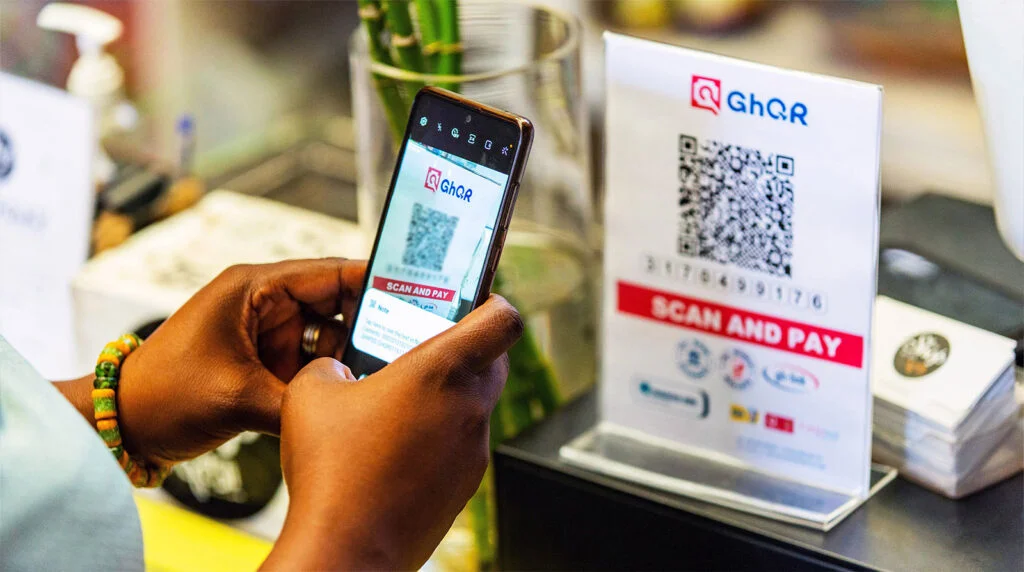
The GHQR (Ghana Quick Response) code is a universal QR code payment system regulated by the Bank of Ghana and operated through GhIPSS, the country’s central payment infrastructure operator . Unlike proprietary QR systems that lock merchants into specific networks, GHQR is interoperable: customers can scan the same code using any participating bank app or mobile money wallet, regardless of their service provider .

This interoperability is the system’s defining advantage. A customer with an MTN MoMo wallet and a customer with a CalBank app can both pay the same merchant using the same QR code . Funds are transferred instantly, and both parties receive real-time notifications .
GHQR vs. POS Terminals
The most significant impact of QR payments is on small and micro-businesses that could never afford a POS terminal. Traditional POS setups require hardware, merchant accounts, ongoing maintenance, and transaction fees that eat into already thin margins. GHQR offers a cheaper alternative: a printed QR code, a smartphone, and a mobile money or merchant account .
The GhIPSS executive’s assessment: “This isn’t just about convenience—it’s about reclaiming economic agency” . By localising payment infrastructure, GhIPSS ensures that transaction data and fees bolster domestic institutions rather than foreign corporations .
Bank Integration
Major banks have integrated GHQR into their mobile apps. CalBank, for example, enables customers to scan merchant QR codes using the CalBank App, completing transactions in seconds without cash or cards . Fidelity Bank promotes GHQR as a tool that accepts payments from bank accounts or mobile money wallets from any financial institution or telco provider .
Part 2: The Benefits — Why Merchants Are Adopting QR Payments
1. Lower Costs and Instant Settlement
For small businesses operating on thin margins, transaction costs are a critical consideration. GhIPSS claims that merchants can save up to 40 percent in fees compared to international card alternatives . The system offers instant settlement, meaning merchants receive funds immediately rather than waiting days for payment clearing .
For market traders who once needed to carry large cash sums—risking theft, pickpocketing, and counting errors—the shift has been transformative. Hannah Bilila reflected on her experience: “One does not need to carry large amounts of cash and be worried about being robbed or having to join a long queue in order to make payments.” She recalled earlier days when she had to carry large sums of money to Tudu market, “always holding her bag tightly” .
2. Reduced Cash-Handling Risks
Businesses that accept digital payments reduce theft risk and security costs . Fintech platforms such as Hubtel and ExpressPay have democratised tools once reserved for large corporations, enabling small vendors to accept QR-code payments, access real-time transaction analytics, and generate instant invoices—all without a traditional bank account .
3. Better Record-Keeping and Access to Credit
Digital transactions generate automatic audit trails. Businesses can easily track sales, manage inventory, and comply with tax obligations .
Perhaps most importantly, digital transaction histories create credit profiles. Businesses that once struggled to access formal credit—because they lacked financial statements—can now demonstrate revenue patterns and qualify for merchant loans . This is a significant driver of formalisation for informal retail businesses.

4. Customer Convenience and Loyalty
Customers increasingly expect digital payment options. Businesses that offer QR payments attract and retain more customers . Platforms like Otto are adding loyalty features: users earn cashback or points for QR purchases, redeemable for rewards—creating an incentive to choose merchants that accept QR .
Part 3: The Barriers — What’s Holding Back Adoption
37 Percent Adoption: Why Most Businesses Still Lag
Nationwide, only about 37 percent of businesses in Ghana have adopted digital payment systems . Even in Accra, adoption remains uneven. The ReFinD Research Initiative, in collaboration with the Ghana Statistical Service, found that digital payments adoption is heavily concentrated in the service sector (38.4 percent), with significantly lower uptake in agriculture (22.4 percent) .
Lead Researcher Prof. Francis Annan explained: “There are a lot of barriers to cross… fraud is such a very classic barrier. That requires a lot of engagement from regulators, commercial providers like MTN and other fintechs to think really hard about how to build a more resilient financial system” .
Cost and Trust
Setting up digital payment acceptance involves fees, merchant account requirements, and transaction costs. For small market stalls operating on thin margins, the perceived costs can outweigh benefits . Some business owners also worry about fraud, scams, or technical failures .
Knowledge Gaps and Infrastructure
ISSER Director Prof. Peter Quartey noted that “inadequate or lack of knowledge accounted for the non-adoption of digital platforms by most businesses” . The report also highlighted uncertainty in the business environment, cost elements, and taxation as limiting factors .
Infrastructure gaps persist: power fluctuations and poor mobile data still hamper continuous operations. A POS terminal is useless during an outage; an online store cannot process orders without connectivity .
The Gender Divide
Female-owned businesses are significantly smaller and less profitable than male-owned businesses, and they see lower revenue benefits from digital adoption . However, businesses with female managers generate higher revenue and adopt digital merchant accounts more effectively than those with only male owners and managers .
Part 4: Loyalty Apps and the Next Phase
The next phase of QR payment adoption is the integration of loyalty and rewards. Otto, a mobile app launched in Accra, allows merchants to manage customer loyalty programmes through their phones—setting up point rules, analysing customer spending, and sending targeted promotions. Users earn cashback or points for QR payments, which can be redeemed for rewards .
This model creates a virtuous cycle: customers are incentivised to use QR payments; merchants are incentivised to accept them and invest in merchant accounts; and the loyalty data enables better customer retention and marketing.
Conclusion: From Convenience to Necessity
In 2026, QR payments in Accra have moved from an experiment to a strategic necessity. Businesses that accept QR payments are reaching more customers, operating more safely, keeping better records, and scaling more effectively . The technology—GHQR—is affordable, interoperable, and accessible to businesses of all sizes.
But the transition remains uneven. The 37 percent adoption rate masks significant gaps across sectors, regions, and gender. Addressing these gaps requires better education, more reliable infrastructure, stronger fraud prevention, and incentives for adoption.
The GHIPSS vision: “We’re witnessing more than a cashless shift—this is the rebirth of Nkrumah’s economic independence dream, one digital transaction at a time” .
For Accra’s retailers, the choice is no longer about whether to adopt digital payments. It is about how quickly—and how well.
Quick Reference: QR Payments at a Glance
| Indicator | Value |
|---|---|
| National business digital payment adoption | 37% |
| Service sector adoption | 38.4% |
| Agriculture sector adoption | 22.4% |
| Informal sector adoption | 35.2% |
| GhQR interoperability | Banks, mobile money wallets, all providers |
| GhQR founding organisation | GhIPSS (Bank of Ghana) |
| Key benefit | No POS terminal required; instant settlement |
| Primary barrier | Knowledge gaps, fraud concerns, perceived uncertain returns |
Source: Accra Street Journal
Last Updated on July 13, 2026 by Samuel Kwame Boadu
Disclaimer: Some content on Accra Street Journal may be aggregated, summarized, or edited from third-party sources for informational purposes. Images and media are used under fair use or royalty-free licenses. Accra Street Journal is a subsidiary of SamBoad Publishing Hub under SamBoad Business Group Ltd, registered in Ghana since 2014.
For concerns or inquiries, please visit our Privacy Policy or Contact Page.

Samuel Kwame Boadu is a Ghanaian media entrepreneur and storyteller with a passion for amplifying urban voices and uncovering everyday truths. He is the Editor-in-Chief and Founder of Accra Street Journal, a dynamic digital platform dedicated to capturing the pulse of Ghana’s capital—its people, culture, challenges, business, sports and innovations.