An Accra Street Journal Urban Intelligence Brief
Executive Introduction
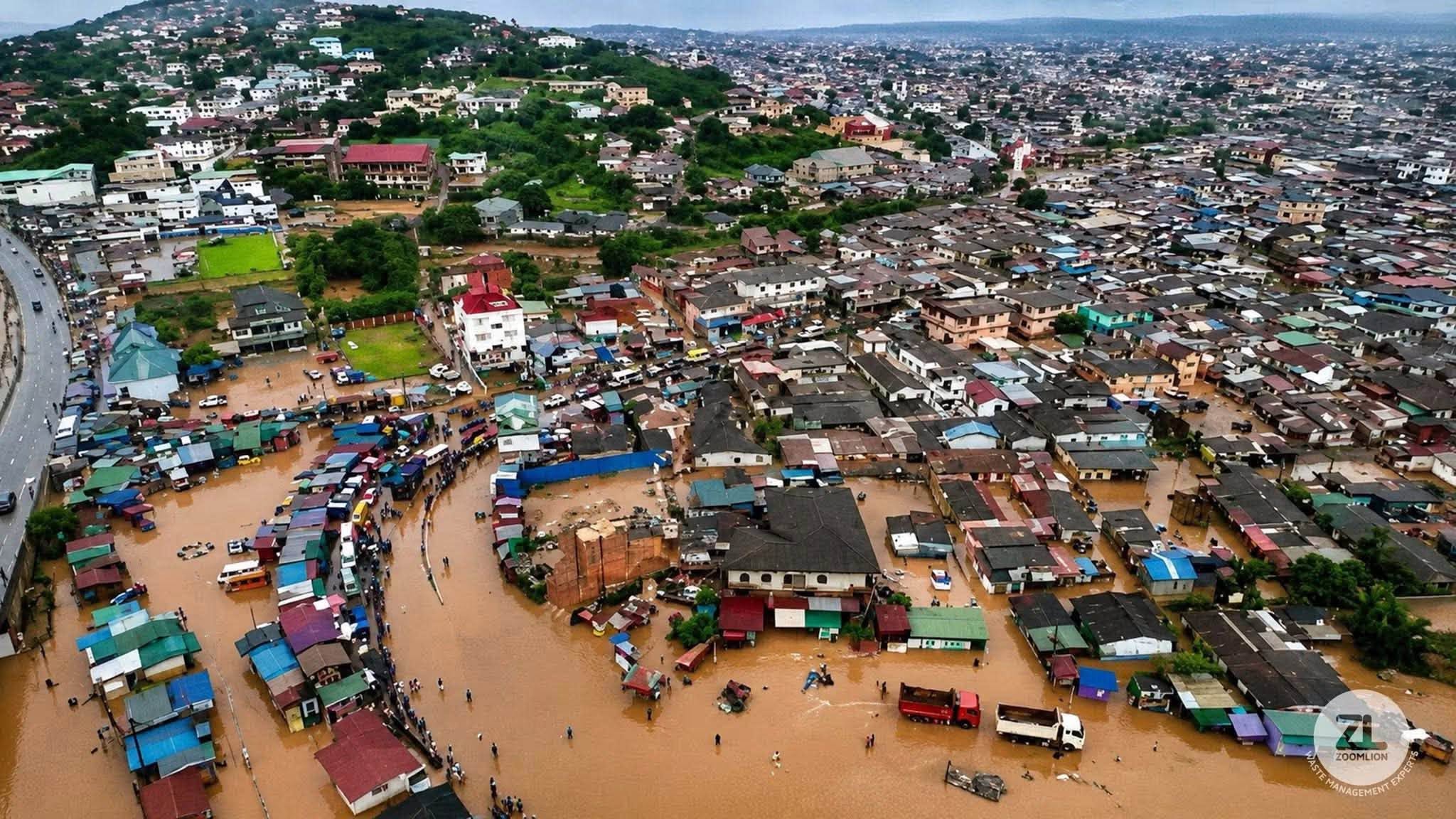
On June 29, 2026, Accra experienced yet another devastating flood. Torrential rains submerged communities across the capital, claiming lives, displacing hundreds, and destroying homes, businesses, and public infrastructure across Circle, Alajo, Kaneshie, Adabraka, Achimota, Weija, Madina, Adenta, Lapaz, and Spintex . The disaster was tragically familiar. As one resident lamented, “We are reliving the same story every rainy season… when it rains like this, we know trouble is coming” .

But this is not a weather event. It is a systemic failure. A new assessment by the Greater Accra Resilient and Integrated Development (GARID) Project has revealed that approximately 16% of legally designated 25-metre drainage buffer zones across selected assemblies have been encroached upon, with 10,497 structures built within protected corridors—despite planning regulations prohibiting such developments .
📢 GET A DETAILED ARTICLES + JOBS
Join ASJ's WhatsApp Channel and never miss a post or opportunity.

The data is unequivocal: Accra’s rapid growth has fundamentally outpaced its critical infrastructure . The city records about 2.77 billion trips annually, while over 90% of flood-prone areas are informal settlements with weak drainage and substandard housing . Yet the city’s governance remains fragmented, with twenty-four assemblies operating in isolation, roads and drainage cutting across multiple jurisdictions, and weak enforcement of planning regulations .
This ASJ report examines why urban planning matters more than ever in Accra: the governance failures that have allowed the crisis to deepen, the spatial consequences of unregulated development, the transport mismanagement that drains the economy, and the emerging solutions that could finally break the cycle.

Part 1: The Governance Failure — Fragmentation, Not Capacity
Accra’s problems are not capacity problems. They are governance and strategy problems . The roots of the crisis are institutional.
The Fragmentation Problem
Between 1989 and 2017, Accra moved from one assembly to about twenty-four. Decentralisation itself is not the problem. The challenge lies in running policy in silos in a city where most residents commute daily toward one central business district . As Appiah Kusi Adomako, Director of CUTS International’s West Africa Regional Centre, put it: “You cannot run a single city with multiple transport decision centers working in isolation. Urban movement does not respect political boundaries. Planning must follow how people live and commute” .
This fragmentation has weakened planning, reduced accountability, and made effective management difficult. Roads, drainage systems, housing development, and transport corridors cut across several jurisdictions, with minimal coordination between agencies responsible for spatial planning, road infrastructure, and public transport .
The Enforcement Gap
Planning regulations exist, but enforcement is weak. A 2026 study by the GARID Project found that illegal developments within protected drainage corridors increased steadily between 2022 and 2026, with the most significant increases in Ga North (1,049 to 2,261 structures), Ablekuma West (904 to 1,293), and Ayawaso East (337 to 494) . Second Deputy Speaker of Parliament Andrews Asiamah Amoako has attributed the persistent flooding to weak urban planning, poor land use practices, and indiscipline: “If you pass the law but we are not able to implement it to address the problem, then it is more or less useless” .
The Road Traffic Regulation 2012 (LI 2180) requires private transport operators to work under defined route-based systems with clear service standards, but this framework remains largely inactive . Assemblies issue permits that apply broadly rather than to specific routes. Drivers choose only high-profit corridors, leaving many routes underserved. In practice, transport unions allocate routes based on influence rather than planning data .
The Institutional Void
Cities across the world plan transport centrally, determine routes, control frequency, and invest heavily in operations. London operates through thirty-two boroughs, yet Transport for London coordinates the entire system . Accra lacks a similar structure with statutory funding and fixed terms that do not expire with each administration .
The Greater Accra Passenger Transport Executive (GAPTE), established in 2005, has a mandate that spans transport planning and public transport regulation. But its predecessor, the Project Advisory Office, lacked the statutory authority to align mandates across institutions. It depended on voluntary cooperation, which proved insufficient to break down entrenched institutional silos . The Minister for Local Government has called on the new GAPTE Council to abandon siloed approaches and adopt coordinated, inter-jurisdictional strategies , but without real authority and statutory backing, coordination alone will not suffice.
Part 2: The Spatial Consequences — Floods, Encroachment, and Informality
Accra’s planning failures are visible on every flooded street. The spatial consequences of unregulated development are not just an environmental problem; they are a human and economic crisis.
The Drainage Encroachment Crisis
A new assessment by the GARID Project has quantified the scale of the problem: 10,497 structures are now situated within legally designated drainage buffer zones across the Greater Accra Region, representing approximately 16% of the protected land . The study compared satellite and field data between 2022 and 2026, finding a steady increase in structures built within these protected corridors.

Key findings:
| Assembly | Structures (2022) | Structures (2026) | Increase |
|---|---|---|---|
| Ga North | 1,049 | 2,261 | +1,212 |
| Ablekuma West | 904 | 1,293 | +389 |
| Ayawaso East | 337 | 494 | +157 |
| Ga Central | 2,275 (2023) | 2,329 | +54 |
| Okai Koi North | 596 | 729 | +133 |
| Krowor | 178 | 295 | +117 |
Sources: ASJ
The GARID Project Coordinator warned that continued encroachment on waterways is reducing the capacity of drainage systems to carry stormwater, increasing the likelihood of flooding during periods of heavy rainfall: “When we have the volume of rain that we do, the water doesn’t have a natural path. That will inevitably impact people; it will affect them” .
The “Over 90%” Problem
A 2024 academic study published in Frontiers in Sustainable Cities found that over 90% of flood-prone areas in the Greater Accra Metropolitan Area are informal settlements with weak drainage and substandard housing . These are areas where vulnerable populations—mostly low-income residents, migrants, and informal workers—settle in high-risk zones . This is not a coincidence; it is the result of decades of poor land use planning and weak enforcement of regulations .
The Predictability Paradox
A 2026 study of 1,050 households in the Greater Accra Metropolitan Area found that geophysical attributes—particularly housing elevation, proximity to drainage channels, and wall materials—are the most consistent predictors of flood incidence . The study also identified a “predictability paradox”: households capable of predicting floods are more likely to experience them, reflecting “a cycle of learned exposure rather than effective avoidance” . The study concluded that adaptive capacity alone does not reduce flood occurrence; systemic interventions are required .
The Long-Term Solution: A New City Outside Accra
In the aftermath of the June 29, 2026 floods, President John Dramani Mahama announced a long-term strategy to decongest Accra: the development of a new city outside the capital where key government institutions would be relocated . The project is expected to be implemented over approximately 20 years, with experts currently preparing the design and master plan. The President indicated that the government would provide essential infrastructure—road networks, electricity, and water supply—to attract individuals and businesses to settle outside Accra .
While the new city proposal is ambitious, it does not address the immediate crisis. As the Minister for Local Government has urged, the Accra Metropolitan Assembly must adopt innovative and practical approaches to addressing the city’s infrastructure challenges, including the redevelopment of old public structures into modern facilities . The current patterns of development, unchecked and uncoordinated, are unsustainable.
Part 3: The Transport Mismanagement — GH¢4.5 Billion a Year
The fragmentation that allows drainage encroachment also cripples Accra’s transport system. A 2026 study by Glima Research found that traffic congestion costs Ghana’s economy an estimated GH¢4.5 billion annually: GH¢3.2 billion in lost time, GH¢434 million in wasted fuel, and GH¢815 million in stress-related productivity losses . Idling vehicles generate approximately 73,000 metric tons of excess carbon dioxide annually .
The Tro-Tro Paradox
Tro-tros carry approximately 70% of daily commuters in Accra . They are organically efficient but structurally fragile: vehicles are poorly maintained, safety standards are essentially unenforced, and the “fill-and-run” model means passengers wait indefinitely. No government system has ever matched their coverage, but their dominance is also a symptom of a formal system that has never consistently shown up .
The BRT That Became “Bus Slow Transit”
In November 2016, the government launched the Aayalolo Bus Service with roughly $95 million in international funding. The vision was sound: dedicated lanes, scheduled departures, and electronic payment. But the dedicated lanes were never built. The government purchased nearly three times more buses than recommended. Successive administrations neglected the system. By 2025, Aayalolo drivers were observed stopping indiscriminately along the Accra-Nsawam highway, competing directly with tro-tros . Aayalolo is not proof that BRT cannot work in Ghana; it is proof that without physically separated lanes, institutional independence, and continuity across administrations, no bus system will ever justify its investment .
The Institutional Reform Agenda
CUTS International has called for the establishment of an Accra City Transportation Authority with legal power to plan routes, terminals, and services across all assemblies . Strict route-based licensing under LI 2180, using census and mobility data to determine optimal fleet numbers, can help address demand and supply imbalances. There must also be sustained public investment in dedicated lanes, terminals, and modern public transport systems . As Adomako concluded: “Accra does not suffer from a shortage of buses alone. Accra suffers from a shortage of planning, coordination, and political commitment to treat transportation as the lifeline of the city” .

Part 4: The Emerging Solutions — What Could Change
Despite the challenges, a range of reforms—some simple, some structural—could significantly improve Accra’s urban condition.
1. An Independent Urban Transport Authority
A 2026 policy brief by CUTS International argues for establishing an independent Accra City Transportation Authority with statutory funding and fixed terms that do not expire with each administration . This would provide the institutional continuity that has historically been missing from transport reform.
2. One Fully Operational BRT Corridor
The policy brief recommends committing to one fully operational BRT corridor, not another pilot. The Mallam-Kasoa corridor is the strongest candidate. Build the physical lane. Enforce it legally. Create an independent authority to manage it .
3. Formalise the Tro-Tro Sector
The government must create a route licensing framework built with, not against, the GPRTU. Digital ticketing to generate planning data and fleet renewal incentives tied to compliance are essential first steps .
4. The AMA’s Electric Metro Bus Vision
The Accra Metropolitan Assembly is planning to introduce the city’s first metro transport system, starting with electric buses on major routes at low fares . The Mayor noted that while about 70% of trips in Accra are made by public transport, road space still largely benefits private car users. The vision is to build a “modern, mobile Accra” where residents can move freely, reach destinations on time, and breathe cleaner air . A US$3 million grant from the African Development Bank is supporting the development of Accra’s Waste Optimization Strategy and source segregation and composting project, signalling investor confidence in Accra’s sustainability efforts .
5. The 20-Year New City Project
President Mahama has announced the development of a new city outside Accra with essential infrastructure to attract individuals and businesses to settle outside the capital . While this is a long-term solution, it is part of a broader national development agenda that could, if implemented with discipline, reduce the pressure on Accra.
Conclusion: The Discipline to Match Ambition with Execution
Urban planning matters more than ever in Accra because the costs of planning failure are no longer abstract. They are measured in lives lost to floods, in GH¢4.5 billion drained from the economy by traffic congestion, in 10,497 structures built illegally in drainage buffers, and in the daily struggle of millions of residents to move through an unwalkable, unlivable city.
The solutions are known: an independent Accra City Transportation Authority, dedicated BRT corridors with physically separated lanes, formalisation of the tro-tro sector, electric buses on major routes, and investment in rail. The challenge is not identifying the solutions—it is implementing them with discipline and continuity across administrations .
As the Glima Research study concluded, “this is not a capacity problem. It is a governance and strategy problem” . The era of announcements without accountability must end. For each reform, the question is not whether it will happen, but which corridor, which timeline, which agency head is responsible, and what are the consequences for failure .
As the UNDP noted after the June 2026 floods: “Infrastructure alone cannot deliver resilience. Financial preparedness must become part of urban policy” . The same principle applies to governance and planning. The city that cannot plan for its own growth will be shaped by its failures. Accra is at a crossroads. The question is whether its leaders will choose the path of discipline, coordination, and execution, or whether the city will continue to be shaped by the floodwaters that come every rainy season.
Quick Reference: Accra’s Urban Planning Crisis by the Numbers
| Indicator | Value |
|---|---|
| Structures in drainage buffers | 10,497 |
| Drainage buffer land lost to encroachment | ~16% |
| Annual congestion cost | GH¢4.5 billion |
| Flood-prone areas that are informal | Over 90% |
| Annual trips in Accra | 2.77 billion |
| Ghanaians making daily trips on foot | 75.3% |
| Increase in Ga North (2022-2026) | 1,049 → 2,261 structures |
Source: Accra Street Journal
Last Updated on July 21, 2026 by Samuel Kwame Boadu
Disclaimer: Some content on Accra Street Journal may be aggregated, summarized, or edited from third-party sources for informational purposes. Images and media are used under fair use or royalty-free licenses. Accra Street Journal is a subsidiary of SamBoad Publishing Hub under SamBoad Business Group Ltd, registered in Ghana since 2014.
For concerns or inquiries, please visit our Privacy Policy or Contact Page.

Samuel Kwame Boadu is a Ghanaian media entrepreneur and storyteller with a passion for amplifying urban voices and uncovering everyday truths. He is the Editor-in-Chief and Founder of Accra Street Journal, a dynamic digital platform dedicated to capturing the pulse of Ghana’s capital—its people, culture, challenges, business, sports and innovations.