EXECUTIVE INTRODUCTION
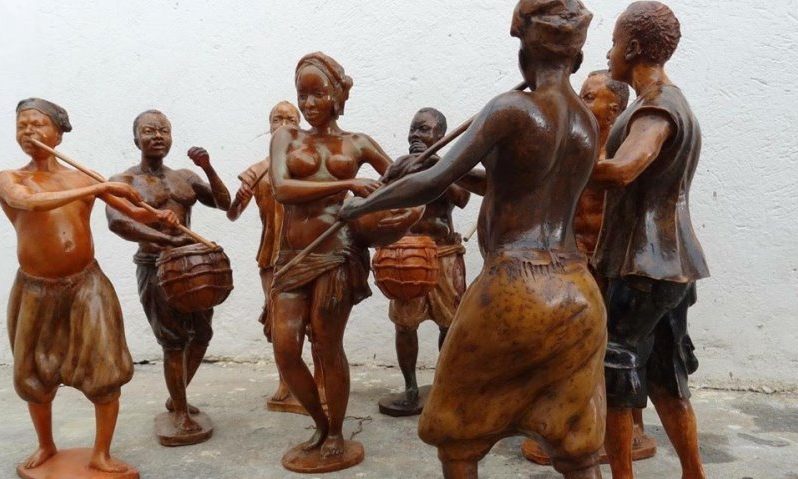
Before the oil discoveries, before the cocoa boom, and long before the branding of “Ghana Beyond Aid,” there was a different kind of Ghanaian export—one that required no shipping container, no bill of lading, and no commodity exchange. It was the export of aesthetic genius, encoded in wood, bronze, gold, and terracotta. The history of Ghanaian sculptors and artists is not a decorative footnote to the nation’s political and economic narrative; it is a primary text, a material record of sovereignty, spirituality, and intellectual sophistication that predates the colonial encounter and continues to whisper into the ear of contemporary global art markets.
This Accra Street Journal spotlight is an act of historical recovery and analytical re-framing. It positions the master sculptors and painters of the Gold Coast and early independent Ghana not as primitive craftsmen or anonymous tribal artisans, but as what they truly were: intellectual giants, spiritual philosophers, political commentators, and commercial entrepreneurs operating within complex patronage systems. From the unbroken lineage of the royal Asante goldsmiths and the psychological intensity of Akuaba figures to the modernist rupture of the independence-era “Ghana School,” this profile traces a continuous, evolving argument about form, power, and African personhood. For the investor, the cultural curator, and the inquiring Ghanaian mind, understanding these masters is to understand a foundational layer of Ghana’s soft power and its undervalued position in the global cultural economy.

THE PRE-COLONIAL MASTERS: SACRED GEOMETRY AND ROYAL WORKSHOPS
The historical Ghanaian sculptor was not an individualist artist in the post-Renaissance Western sense, signing a canvas and seeking gallery representation. They were a highly trained, often hereditary, master technician embedded within a politico-spiritual system. The apex of this tradition was, and remains, the Asante royal court. The abrammo (brass casters) and the goldsmiths who served the Golden Stool were not mere decorators; they were the material philosophers of statehood. Their work—the kuduo brass vessels, the cast gold weights (abrammuo) depicting an encyclopedia of proverbs and social life, and the jewellery of the Asantehene—was a technology of knowledge storage.
📢 GET A DETAILED ARTICLES + JOBS
Join ASJ's WhatsApp Channel and never miss a post or opportunity.

The anonymous masters of the Akuaba fertility figures exemplify this sacred geometry. These highly stylized wooden figures, with their distinctive flat, disc-shaped heads, long ringed necks, and abstracted, cruciform bodies, are not naive attempts at naturalism. They are conceptually sophisticated objects of ritual efficacy, carried by women seeking conception. The radical abstraction is deliberate; it is a distillation of form to its spiritual essence. Similarly, the carvers of the Queen Mothers’ stools across Akanland operated within a strict stylistic grammar that communicated lineage continuity and feminine power. These objects were the legal documents of an oral culture, their intricate symbolic carvings encoding proverbs and historical narratives that validated political authority. The artist was a historian, a lawyer, and a priest, working in a medium that held the weight of a constitution.
It would be a grave analytical error to confine pre-colonial mastery to the Akan heartland. The figurative pottery and ancestral terracotta heads of the Koma Land culture (Northern Ghana), dating back centuries and discovered only recently, reveal a completely different, yet equally profound, sculptural intelligence. These expressive, sometimes haunting, anthropomorphic clay forms point to a sophisticated, non-Akan artistic civilization about which we still know dangerously little, and whose works are now scattered across the global antiquities market, often looted and decontextualized. This is the silent haemorrhage of Ghanaian heritage—objects of immense spiritual and historical value, traded as curios.

THE COLONIAL CONTACT AND ITS DISCONTENTS
The arrival of the British colonial state and Christian missions in the late 19th and early 20th centuries fundamentally disrupted this integrated artistic ecosystem. The royal courts, the primary patrons of the master sculptors, were subjugated. The gold weights and fertility figures were reclassified from sacred and utilitarian objects into “ethnographic specimens” or “idols” to be suppressed. The colonial educational system, with its emphasis on literacy and Victorian craft, dismissed the intellectual sophistication of the indigenous workshop. This was the period of what the great Nigerian artist and scholar Uche Okeke would later call “the great cultural pit”: a time when the master sculptor’s status was systematically devalued from a purveyor of state philosophy to a producer of tourist curios.
Yet, even in this pit, the master’s hand continued. Sculptors adapted, producing works for a new, largely foreign, market. The carving workshop at Achimota College, established under the British but increasingly directed by African agency, became a curious and crucial intermediate space. It was here, under the early tutelage of teachers like the Russian-born sculptor Herbert Vladimir Meyerowitz, that some of the first generation of formally trained African artists began to bridge the chasm between the royal workshop and the modern art school. The Achimota experiment, flawed and colonial in framing, inadvertently became the nursery of the Ghanaian modernist movement.
THE GOLDEN AGE OF THE INDEPENDENCE SCHOOL: MODERNISM AS STATE POLICY
The independence era under Kwame Nkrumah produced the most studied, yet still profoundly misunderstood, constellation of Ghanaian artists. Nkrumah understood art as statecraft. The national project required new symbols, new heroes, and a new visual language to project Pan-African leadership. This was a golden age of state patronage, and it birthed the titans of the “Ghana School.”
Oku Ampofo (1908-1998) is the patriarch of this movement. Trained in medicine at the University of Edinburgh and later in art in the United States, Ampofo returned not just to practice as a pioneering physician of herbal medicine but to become a foundational sculptor and cultural philosopher. Working primarily in hardwood and terracotta, Ampofo did not just carve sculptures; he articulated a theory of African aesthetics, arguing for the spiritual and rhythmic continuity between the old masters and the modern artist. His elongated, serene heads and figures are meditations on Akan concepts of inner peace and transcendent beauty. He was the first to forcefully re-frame the sculpture not as an ethnographic artifact but as a modern, individual art object.
Kofi Antubam (1922-1964) was the aesthetic architect of the Nkrumah state. His role was monumental and unparalleled. Commissioned to produce massive murals, mosaic panels, sculpted reliefs, and official chairs for the new state apparatus, Antubam’s work is the visual language of the First Republic. His style synthesized realist representation with heavily stylized, symbolic Akan gold weight motifs and Adinkra symbolism. He literally carved the proverbs of state into the architecture of Parliament House and the Ambassador Hotel. He defined the iconography of the “African Personality” in a public, accessible, and official form. His early death in 1964 remains a catastrophic loss to the nation’s cultural record.
Vincent Kofi (1923-1974) brought a muscular, Pan-African modernism to sculpture. Trained at Achimota and later at the Royal College of Art in London, Kofi’s work in wood and bronze moved from naturalism to a powerful, abstracted monumentality. His most famous work, the monumental bronze statue of an anonymous, triumphant hornblower that stood for decades outside the Ambassador Hotel, was a departure from specific Akan figuration. It was a deliberate attempt to create a civic, continental symbol—the anonymous, heroic African spirit. Kofi was an artist-philosopher, arguing ferociously for the African artist’s right to interrogate their own traditions critically and to create work that was not merely illustrative but conceptually challenging.
THE FORGOTTEN WOMEN: GENDER, CRAFT, AND THE MARGINS OF THE CANON
The established narrative of Ghanaian sculpture is overwhelmingly male. This demands a corrective. Historically, the canon has dismissed the monumental ceramic traditions of women across the Volta Region and Northern Ghana as “pottery,” a domestic craft, distinct from the masculine “high art” of carving and casting. This is a deep intellectual error. The large-scale, richly decorated water storage vessels, figurative funerary pots, and ritual clay objects produced by generations of women are, by any critical standard, major sculptural achievements. They command space, embody complex technical knowledge of kiln-firing and clay chemistry, and carry dense symbolic meanings. Artists like Grace Kwami (1923-2006), who studied under Kofi Antubam and Vincent Kofi, navigated this gender divide, becoming a pioneering modern sculptor in her own right, creating delicate, deeply humanistic figures that were overshadowed by the monumental male school. The recovery of these female lineages—both the unnamed potter-sculptors and the trained modernists—is not political correctness; it is an urgent archaeological and art historical necessity to complete the archive.
THE SURVIVORS AND THE BRIDGE: EL ANATSUI AND THE CONTEMPORARY CONVERSATION
Between the death of the independence titans and the rise of the contemporary art fair circuit, there was a lean period. Ghana’s economic collapse in the 1970s and 1980s destroyed the domestic art market. Sculptors survived by teaching, producing commissioned portraits, or leaving. This is the context in which El Anatsui, born in Anyako, Ghana in 1944, must be understood. Anatsui is not merely Ghana’s most globally successful sculptor; he is the bridge figure who shattered the false dichotomy between the local and the global. His education at KNUST, where he absorbed the legacy of the Ghana School but bristled against its nationalistic prescriptions, and his long teaching and practice career in Nigeria, forged a unique voice.
Anatsui’s intellectual breakthrough was to engage with the tradition of African monumental form while completely deconstructing its material basis. He rejected the sanctity of the carved hardwood block and instead created his shimmering, flexible, wall-hanging “cloths” from thousands of discarded aluminium bottle-neck wrappers and copper wire. The work is a conceptual masterstroke: a reference to the rich textile traditions of kente and adinkra, a commentary on the global commodity chains of the liquor trade, and a monumental sculptural object made from the detritus of consumption. Anatsui’s market ascension—with works selling for over a million dollars at Sotheby’s—is the ultimate case study of how a conceptual rigour born from a specific Ghanaian experience can recalibrate the global art market’s valuation of African creativity. He proved that the material thinking of the Ghanaian sculptor, the capacity to imbue object with overwhelming metaphorical meaning, was a first-tier global asset.

THE MARKET, THE MUSEUM, AND THE FUTURE OF THE CANON
The contemporary market for historical Ghanaian sculpture is a paradox. Works by Kofi Antubam, when they rarely surface at international auctions, fetch modest sums compared to their Nigerian contemporaries like Ben Enwonwu, whose Tutu painting famously sold for over a million pounds. This is not a reflection of artistic quality but of market infrastructure. Nigeria, with its larger collector base, more aggressive gallery system, and a robust auction scene, has engineered a secondary market for its modern masters that Ghana has failed to replicate. The result is a persistent undervaluation of the Ghanaian historical canon. A crucial Antubam state commission remains at risk in a deteriorating public building, while it would be a blue-chip asset in a managed Nigerian collection.
The national collections, particularly at the National Museum of Ghana and the KNUST Museum, hold treasures, but they suffer from chronic conservation underfunding, inadequate curatorial research, and a low public profile. The narrative of the Ghana School is largely absent from the international museum circuit, told in fragments rather than as the coherent, intellectually formidable movement it was. The future of this legacy depends on a few strategic interventions: the digitization of the scattered archives, the aggressive repatriation of works held in Western museum storerooms, and the deliberate cultivation of a local collector class that sees the acquisition of an Oku Ampofo or a Grace Kwami not as charity but as a generational investment in a cultural asset class.
The story of Ghanaian historical sculptors is the story of the nation’s soul in physical form. From the anonymous goldsmiths who encoded the constitution in brass weights to the modernists who carved Pan-African dreams into hardwood, these artists built a visible, tangible civilization. The urgent task is to ensure that civilization is not just remembered, but is properly valued, studied, and positioned as the formidable, foundational economic and cultural patrimony that it is.
QUICK FACTS BOX: HISTORICAL GHANAIAN SCULPTORS & ARTISTS
-
Pre-Colonial Masters: Anonymous Asante goldsmiths and brass-casters (abrammo), Akuaba figure carvers (Akan), Koma Land terracotta sculptors (Northern Ghana).
-
Foundational Institution: Achimota College Art Department (established in the 1930s, nursery of the Ghanaian modernist movement).
-
Pioneering Modernists (The Independence School): Dr. Oku Ampofo (1908-1998), Kofi Antubam (1922-1964), Vincent Kofi (1923-1974).
-
Key Women Artists: Grace Kwami (1923-2006), pioneering female sculptor; the vast but often anonymous tradition of monumental ceramic potter-sculptors across the Volta Region and Northern Ghana.
-
Global Bridge Figure: El Anatsui (b. 1944), KNUST-educated sculptor whose work redefined African materiality on the global stage.
-
Primary Materials: Hardwoods (ebony, odum, sese), terracotta, lost-wax cast brass/bronze, gold, aluminium, clay.
-
Key Repositories: National Museum of Ghana (Accra), KNUST Museum (Kumasi), The Arts Centre (Accra – historical site of a major Antubam mural).
-
Market Reality: Historically undervalued at international auction relative to Nigerian contemporaries; weak local secondary market infrastructure.
FAQ SECTION
1. Who is considered the father of modern Ghanaian sculpture?
Dr. Oku Ampofo (1908-1998) is widely regarded as the patriarch. A physician and sculptor, he pioneered a modern aesthetic rooted in Akan spiritual and philosophical concepts, bridging the pre-colonial workshop tradition and the contemporary art school.
2. What are the traditional Asante gold weights and what do they represent?
Cast from brass using the lost-wax method, these small sculptures (abrammuo) were used to measure gold dust. They form an encyclopedia of Akan life, depicting hundreds of proverbs, animals, human figures, and objects, encoding social knowledge and ethics.
3. Why are Akuaba fertility figures carved with a distinct disc-shaped head?
The flat, disc-shaped head with a high, arched brow is a radical aesthetic abstraction associated with ideals of beauty, composure, and spiritual potency. It is a conceptual rendering, not an attempt at naturalistic portraiture, designed for ritual efficacy.
4. What is Kofi Antubam’s most enduring contribution to Ghanaian art?
Antubam was the artistic architect of the Nkrumah state. He developed the official visual language of the First Republic through massive public murals, sculpted reliefs, and state furniture that fused Adinkra symbolism with a modern Pan-African style, prominently seen in the Parliament House.
5. How did El Anatsui change the perception of African sculpture globally?
Anatsui dismantled the traditional materials of sculpture, using discarded bottle caps to create flexible, shimmering “cloths.” This transformed African sculpture from a perceived static, wooden tradition into a contemporary, conceptual, and monumental form, achieving record-breaking global art market valuations.
6. Where can I see original works by Vincent Kofi in Ghana?
Works by Kofi are held in the collection of the National Museum of Ghana and at the KNUST Museum in Kumasi. His large-scale public commissions, like the famous Hornblower statue, are critical to the memory of early-modern Accra’s civic spaces.
7. Why are there so few recognized historical female sculptors from Ghana?
The art historical canon historically dismissed the monumental and technically sophisticated pottery traditions of women as “craft,” excluding it from the “high art” category of sculpture. Trained female modernists like Grace Kwami were also marginalized in a male-dominated field.
8. What was the role of Achimota College in the development of Ghanaian art?
Under the colonial era, Achimota’s art department became the accidental nursery for modern Ghanaian art. It brought together African and European teaching methods, providing the first formal training for figures like Amon Kotei (designer of the national coat of arms) and Kofi Antubam.

9. What are the Koma Land terracottas?
They are a recently discovered corpus of highly expressive, often enigmatic anthropomorphic and zoomorphic clay figures from an ancient archaeological culture in Northern Ghana. Their existence challenges the Akan-centric narrative of Ghanaian sculptural history.
10. Is historical Ghanaian sculpture a good investment?
The market is currently undervalued compared to Nigerian modern art, presenting a potential long-term growth opportunity. However, the market is thin, works by the titans are rare, provenance is critical, and the primary value remains profound cultural and historical significance rather than short-term speculative returns.
Source: Accra Street Journal
Last Updated on July 23, 2026 by Samuel Kwame Boadu
Disclaimer: Some content on Accra Street Journal may be aggregated, summarized, or edited from third-party sources for informational purposes. Images and media are used under fair use or royalty-free licenses. Accra Street Journal is a subsidiary of SamBoad Publishing Hub under SamBoad Business Group Ltd, registered in Ghana since 2014.
For concerns or inquiries, please visit our Privacy Policy or Contact Page.

Samuel Kwame Boadu is a Ghanaian media entrepreneur and storyteller with a passion for amplifying urban voices and uncovering everyday truths. He is the Editor-in-Chief and Founder of Accra Street Journal, a dynamic digital platform dedicated to capturing the pulse of Ghana’s capital—its people, culture, challenges, business, sports and innovations.