EXECUTIVE INTRODUCTION
The formal economic indicators paint a picture that should spell the death of the traditional Accra market. Inflation has been at catastrophic levels, at times exceeding 50%, eroding the purchasing power of the consumer. The cedi has depreciated relentlessly against the dollar, making imported goods—the lifeblood of the market—punishingly expensive. Formal retail, in the form of well-capitalised supermarkets and shopping malls, has expanded aggressively. The government, in periodic fits of modernisation, has threatened to demolish, relocate, or “decongest” the very spaces where these markets operate. The digital economy, with its promise of frictionless e-commerce, was supposed to render the crowded, chaotic, physical marketplace obsolete. By every orthodox economic logic, the old markets of Accra—Makola, Kaneshie, Agbogbloshie, Malata, Tema Station—should be in terminal decline.
They are not. They are, against all these headwinds, stubbornly, impressively, and structurally resilient. This Accra Street Journal analysis is an investigation into the deep, non-obvious reasons for this resilience. It moves beyond the romantic cliché of the “indomitable Ghanaian trader” to identify the specific, durable economic, social, and spatial structures that insulate the traditional market from collapse. We argue that the Accra market is not a primitive, inefficient relic of a pre-modern economy. It is a sophisticated, adaptive, and deeply embedded economic organism with a set of built-in shock absorbers that the formal retail sector, for all its capital and efficiency, fundamentally lacks. Understanding this resilience is not an exercise in nostalgia; it is essential for any serious analysis of the Ghanaian economy, and for any policy intervention that hopes to engage with, rather than foolishly attempt to erase, this foundational commercial institution.

THE MICRO-CREDIT ARCHITECTURE: THE INVISIBLE FINANCIAL NERVOUS SYSTEM
The single most powerful structural advantage of the Accra market, and the primary reason for its resilience against the formal banking sector’s credit crunches, is its internal, informal, and highly efficient credit architecture. This system operates entirely outside the purview of the central bank, the credit bureau, and the formal lending contract. It is a dense, trust-based network of daily, short-term, unsecured credit that lubricates every transaction in the market chain, from the importer to the wholesaler to the retailer to the final consumer.
📢 GET A DETAILED ARTICLES + JOBS
Join ASJ's WhatsApp Channel and never miss a post or opportunity.

The “market day” loan is its most basic unit. A trader receives goods from a supplier in the morning, sells them throughout the day, and settles the cost of the goods with the supplier at the close of business, keeping the margin. This is a one-day, zero-interest, pure-trust loan. The supplier extends it because they have a long-term, personal, face-to-face relationship with the retailer, because they know the retailer’s selling capacity and character, and because the entire system is underwritten by a powerful, informal enforcement mechanism: reputation. A trader who defaults on a daily settlement is not sued; they are simply, and permanently, cut off from credit by every supplier in the network. In a business where cash flow is king and margins are thin, this is a commercial death sentence. The system therefore has an extraordinarily low default rate.
This credit architecture acts as a massive, distributed shock absorber during economic crises. When the cedi depreciates and the cost of restocking inventory doubles overnight, the formal retailer must go to the bank for a larger overdraft, a slow, bureaucratic, and often impossible process. The market trader, by contrast, renegotiates the daily credit terms with their supplier, perhaps shifting to a twice-daily settlement, or arranging a short-term grace period based purely on their personal relationship and history of reliability. The credit system is flexible, personal, and instantaneous. It allows the entire market to adjust its financial metabolism to a crisis in real-time, absorbing the shock without the systemic seizure that a formal credit crunch produces. This is not a flaw of the traditional market; it is a profound, resilient competitive advantage that the formal sector has been unable to replicate.

THE DENSITY AND THE BUNDLE: THE MARKET AS A ONE-STOP ECOSYSTEM
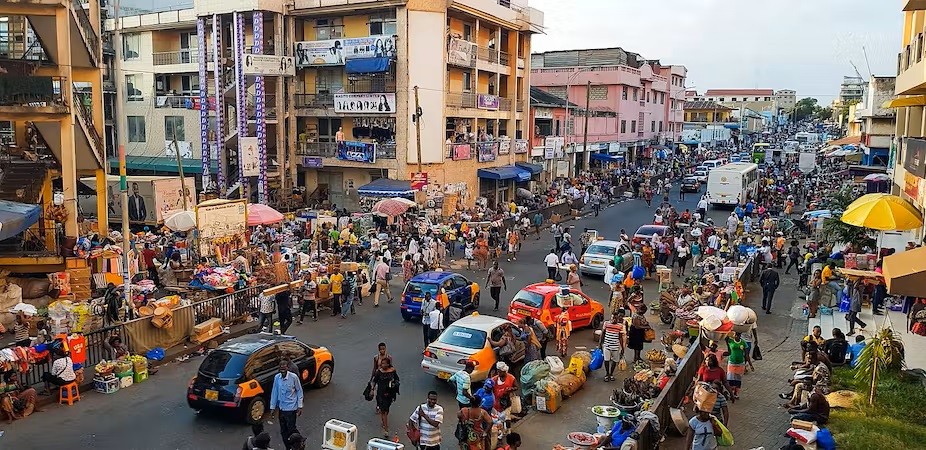
The Accra market is an extreme form of commercial density, and this density is a deliberate, resilient economic strategy. The consumer who enters Makola or Kaneshie is not visiting a single shop. They are entering a fully integrated commercial ecosystem where, within a few hundred square metres, they can access an astonishingly complete basket of goods and services. They can buy the cloth, negotiate with the tailor who will sew it, purchase the matching shoes and bag, send money via a mobile money merchant, eat a hot meal, buy a phone credit top-up, and arrange for a trotro or taxi to carry their goods home. The market bundles a trip that would require hours of driving and multiple stops in the dispersed, formal retail landscape.
This density of foot traffic creates a massive, self-reinforcing commercial gravity. The sheer volume of humanity flowing through the market’s narrow lanes reduces the cost of customer acquisition for each individual trader to nearly zero. The customer is already there, already in a purchasing mindset. No advertising, no social media campaign, and no promotional discount can compete with the raw, organic, free customer flow generated by the market’s density. When economic times are hard and the consumer’s disposable income shrinks, this bundled convenience becomes even more valuable. The consumer saves money on transportation and time by fulfilling all their heterogeneous needs in a single, intense trip. The market, therefore, does not just compete on the price of individual goods; it competes on the total cost of the shopping mission, including the hidden costs of transport, time, and the ability to combine errands. The mall cannot replicate this density or this bundling logic, and the online store cannot offer the immediacy, the sensory experience, or the bundling of food, finance, and physical services.
THE POLITICAL ECONOMY OF THE MARKET: THE IMPOSSIBILITY OF DEMOLITION
The Accra market is not just an economic space; it is a critical political constituency. The market women and men represent a formidable, concentrated voting and mobilising bloc that no political party, and no ambitious municipal chief executive, can afford to ignore. The periodic attempts by the Accra Metropolitan Assembly and central government to “decongest,” demolish, or relocate the markets have consistently failed, not because of a lack of political will, but because of the sheer, organised, and highly vocal political power of the traders themselves.
The market traders are organised into well-structured associations and unions, often led by formidable, politically connected “market queens.” These associations collect dues, resolve disputes, and, crucially, function as a powerful collective bargaining and lobbying unit. A threat to demolish a section of the market is met with an immediate, well-coordinated political response: press conferences, petitions, direct appeals to the party hierarchy, and the credible, unspoken threat of electoral retaliation. The trader’s vote is not a passive, individual preference; it is an organised, bloc asset, and it has proven, repeatedly, to be a more powerful force than the bulldozer and the city plan. This political insulation is a core structural reason for the market’s resilience. The formal supermarket, for all its economic power, cannot summon a bloc vote or shut down the central business district with a protest. The market’s political embeddedness is a form of existential insurance that ensures its survival, even when the official planning logic demands its removal.
THE GENDERED ECONOMY: THE MARKET AS FEMALE FINANCIAL INFRASTRUCTURE
The Accra market is, at its core, a female economic space. While men are certainly present, the majority of the retail traders, and almost all the dominant market leaders, are women. The market functions as a vast, distributed, female-controlled financial system, a space where women have, for generations, accumulated capital, built businesses, accessed credit, and asserted economic independence outside the formal, male-dominated banking and corporate structures. This gendered dimension is a critical, and often overlooked, source of the market’s resilience.
The market woman is typically the primary financial manager of her household. The profits she generates from her stall do not just sustain her business; they pay the children’s school fees, they fund the family’s medical expenses, and they provide the daily “chop money” that keeps the household fed. Her business is not a discretionary economic activity; it is the fundamental economic lifeline of the family unit. This dual burden—business and household—creates a ferocious, relentless motivation. The market woman cannot afford to fail. She cannot take a sick day. She cannot close the stall because the exchange rate has moved against her. She will adapt, diversify, and fight for her place in the market with a tenacity that is born of absolute economic necessity. This motivation, multiplied across thousands of stalls, is an immense, distributed engine of resilience. The market does not close because the women who run it cannot afford to let it close.
THE INFORMAL LOGISTICS NETWORK: THE UNMAPPED SUPPLY CHAIN
Behind the visible chaos of the market stall lies an invisible, highly efficient, and remarkably resilient logistics network. The goods that fill the stalls of Makola do not arrive through a formal, single-company supply chain. They arrive through a complex, adaptive, and deeply personal web of small-scale importers, travelling wholesalers, regional aggregators, and “truck-pushers” who form the un-mapped human infrastructure of the market’s supply chain. This network is the ultimate expression of the Ghanaian entrepreneurial genius for logistics.
This system is resilient precisely because it is decentralised and personal. When the formal port is congested or a major shipping line is disrupted, the market’s supply chain does not seize up. The small-scale importer shifts their container to a different clearing agent, the wholesaler activates a different, personally known supplier in a neighbouring country, and the goods find an alternative route, often across a porous land border, at a different cost, and through a different set of personal contacts. The network reroutes around the blockage because it is not a single, brittle, centrally planned pipeline. It is a mesh. This is the logistical logic of the organism, not the machine. It is less “efficient” in the cold, abstract sense of a supply-chain consultant’s PowerPoint, but it is vastly more resilient in the face of the specific, unpredictable shocks that afflict the Ghanaian economy. The market’s goods keep arriving, by one route or another, because the people who supply them have the relationships, the knowledge, and the adaptive ingenuity to find a way.
CONCLUSION: THE INDESTRUCTIBLE ECOSYSTEM
The resilience of Accra’s markets is not a mystery. It is the perfectly logical outcome of a set of deeply embedded, mutually reinforcing structures that the formal economy has failed to understand, replicate, or displace. The market thrives on an informal credit system that is more adaptive than any bank. It offers a bundled consumer experience that is more convenient than the mall. It wields a political power that is more formidable than any planning regulation. It is powered by a female workforce whose motivation is absolute. And it is supplied by a logistics network that is more shock-resistant than the formal container port.

The market will continue to confound the predictions of its demise. It will absorb the next inflationary spike, the next currency crash, and the next well-funded, elegantly designed e-commerce platform. The strategic question for policymakers, investors, and development partners is not how to replace the market with a more “modern” alternative. It is how to intelligently invest in the market’s own infrastructure—its sanitation, its security, its fire safety, and its digital connectivity—to strengthen an ecosystem that has already proven itself to be the most resilient commercial institution in the Ghanaian economy. The market table remains unshaken because it is built on foundations far deeper and more durable than the concrete of the mall or the code of the app.
QUICK FACTS BOX: THE RESILIENCE OF ACCRA’S MARKETS
-
Internal Credit System: A dense, trust-based network of daily, short-term, unsecured credit between suppliers and traders, acting as a highly adaptive and crisis-responsive financial shock absorber.
-
Commercial Density: The bundling of an extraordinarily wide range of goods, services, food, and financial transactions in a single high-footfall location, reducing the total cost of the consumer’s shopping mission.
-
Political Constituency: The markets are a concentrated, organised, and electorally critical voting bloc, represented by powerful trade associations and “market queens,” providing existential political insulation against demolition or forced relocation.
-
Gendered Economic Engine: The market is a predominantly female economic space, with the trader’s dual role as businesswoman and household financial manager creating a deep, non-negotiable motivation for survival and adaptation.
-
Decentralised Logistics: The supply chain is not a single corporate pipeline but a complex, personal, and adaptive mesh of small-scale importers and wholesalers, capable of rerouting around formal port and shipping disruptions.
-
Core Strategic Insight: The market’s resilience is not an accident of culture but the outcome of specific, durable, and mutually reinforcing economic, social, and political structures that the formal sector has failed to replicate.

Last Updated on July 27, 2026 by Samuel Kwame Boadu
Disclaimer: Some content on Accra Street Journal may be aggregated, summarized, or edited from third-party sources for informational purposes. Images and media are used under fair use or royalty-free licenses. Accra Street Journal is a subsidiary of SamBoad Publishing Hub under SamBoad Business Group Ltd, registered in Ghana since 2014.
For concerns or inquiries, please visit our Privacy Policy or Contact Page.

Samuel Kwame Boadu is a Ghanaian media entrepreneur and storyteller with a passion for amplifying urban voices and uncovering everyday truths. He is the Editor-in-Chief and Founder of Accra Street Journal, a dynamic digital platform dedicated to capturing the pulse of Ghana’s capital—its people, culture, challenges, business, sports and innovations.