









EXECUTIVE INTRODUCTION
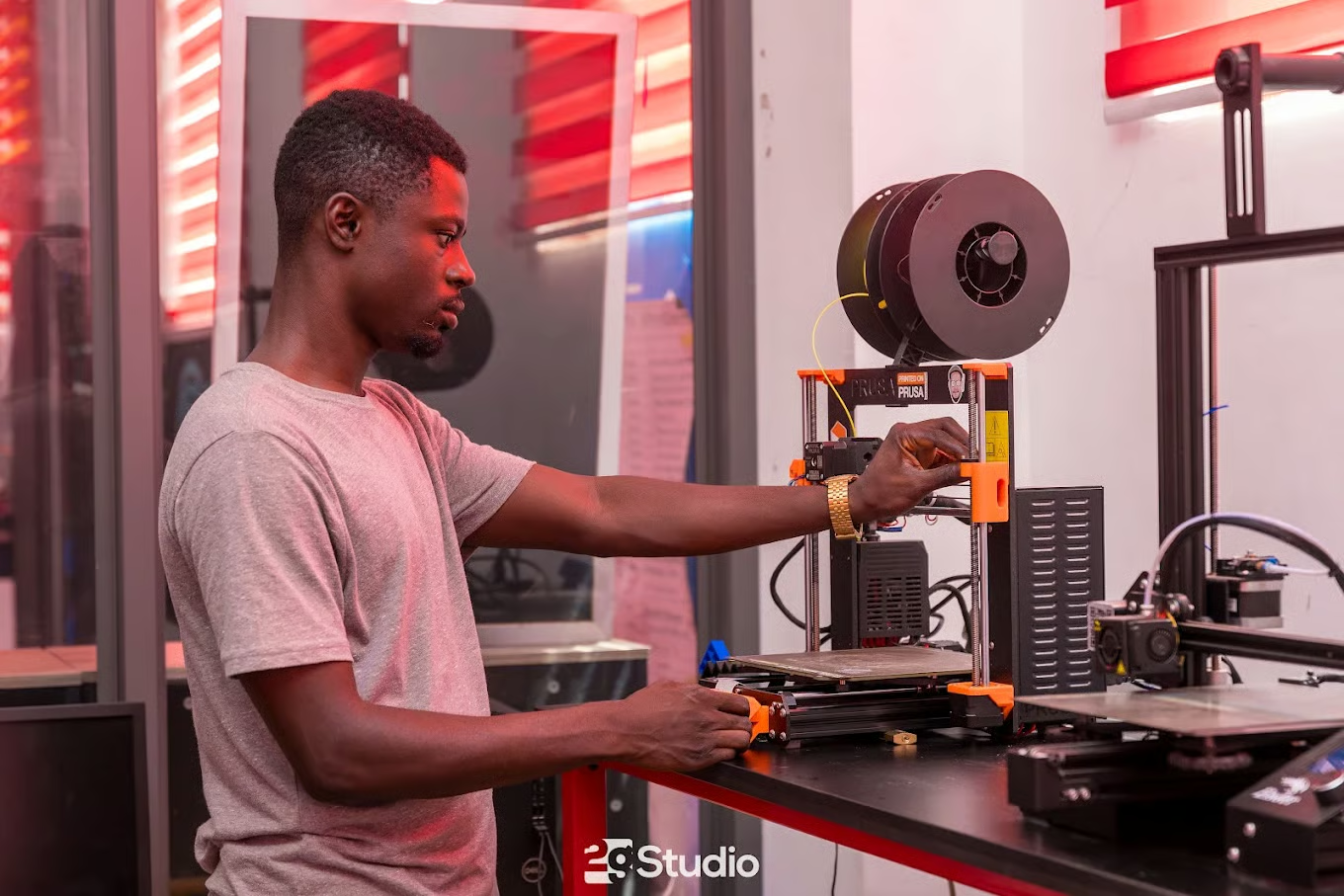
Imagine a machine, no larger than a small office photocopier, that can produce, layer by microscopic layer, a perfectly functional spare part for a broken piece of hospital equipment, a custom-fitted prosthetic limb tailored precisely to a specific patient’s body, a complex architectural model for a client presentation, or a bespoke piece of jewellery of intricate, breathtaking design. Imagine this machine operating not in a distant, high-tech factory in Germany or China, but in a modest workshop in an industrial area of Accra, in a university engineering lab in Kumasi, or in a startup’s office in one of the capital’s innovation hubs. This is not science fiction. This is the established, rapidly maturing, and increasingly accessible technology of three-dimensional printing, or additive manufacturing. And its potential to reshape the productive landscape of a country like Ghana is immense, specific, and largely untapped.

This Accra Street Journal analysis is a forward-looking, grounded assessment of the transformative potential of 3D printing for the Ghanaian economy. This is not a breathless, hype-filled technology forecast. It is a measured, practical examination of where this technology can solve real, deep-seated Ghanaian problems, and the significant, non-trivial barriers that stand in the way of its widespread adoption. We argue that the true, revolutionary power of 3D printing for Ghana lies not in the distant, headline-grabbing prospect of printing entire houses, but in its immediate, practical capacity to solve the critical, daily problem of the spare part, to enable a new, agile, and highly productive model of local, small-batch manufacturing, to unlock a wave of innovation in education and prototyping, and to create new, high-value service businesses across the economy. The factory on a desk is not going to replace the massive assembly lines of global manufacturing. It is going to do something far more important for Ghana: it is going to fill the gaps those global supply chains cannot reach, at a speed and a cost that can transform a business, and perhaps, over time, an entire economy.
THE SPARE PARTS SOLUTION: THE END OF THE LONG WAIT FOR THE TINY, CRITICAL COMPONENT
The most immediate, most practical, and most economically compelling application of 3D printing in the Ghanaian context is not the creation of new, complex consumer products. It is the solving of an old, persistent, and deeply damaging problem: the spare part. Every sector of the Ghanaian economy, from advanced healthcare to small-scale manufacturing to the transport industry, is plagued by the same, recurring nightmare. A critical piece of equipment—a dialysis machine, a printing press, a factory conveyor belt, a farmer’s irrigation pump, a trotro’s engine component—fails because of a single, small, often plastic, and now broken part. That part is not available locally. It must be sourced from the original manufacturer, often in Europe or Asia. The cost of the part itself may be modest, but the shipping, the customs delay, the weeks or months of downtime while the entire machine sits idle, unproductive, and bleeding money—this is the true, devastating cost. The entire, complex machine is held hostage by the absence of one tiny, simple component.
📢 GET A DETAILED ARTICLES + JOBS
Join ASJ's WhatsApp Channel and never miss a post or opportunity.
3D printing offers a radical, practical solution to this specific, painful problem. With a digital scan of the broken part, or access to its digital design file, a local technician can simply print a functional, durable replacement on a modest desktop 3D printer, often in a matter of hours. The wait is not weeks or months; it is the time it takes to print. The cost is not the exorbitant price of international shipping and the lost revenue of downtime; it is the negligible cost of the printing filament and the machine’s electricity. This is not a theoretical application; it is already being used by resourceful engineers and mechanics around the world. The impact on the Ghanaian economy, if this capability were to be systematically developed and distributed, would be profound. It would dramatically reduce the downtime of critical equipment across every sector, increase the productivity of capital, and build a powerful, decentralised resilience into the very fabric of the economy. The spare part problem is a constant, quiet tax on Ghanaian productivity. 3D printing offers the most elegant and immediate tax cut the country has ever seen.
THE NEW LOCAL MANUFACTURING: BESPOKE, AGILE, AND CAPITAL-LIGHT PRODUCTION
Beyond the spare part, a second, and more strategically transformative, potential lies in the use of 3D printing to enable a completely new model of local, small-scale manufacturing. The old model of manufacturing is a fortress of high barriers to entry. To make a physical product, you need a large amount of capital for expensive moulds and tooling, you need to commit to a massive, inflexible production run of thousands of identical units to justify the cost of that tooling, and you need access to a complex, multi-stage supply chain. This old model heavily favours the large, established, and usually foreign, manufacturer. It is a game the small Ghanaian entrepreneur is structurally excluded from playing. 3D printing smashes these barriers. The same machine can print one unique unit or a hundred, without any costly moulds or tooling changes. The capital cost of entry is not a massive factory; it is a modest printer. The production run can be as small as a single, custom-designed item. The supply chain is a spool of printing filament.
This new model of manufacturing is agile, bespoke, and capital-light, and it opens up entirely new commercial possibilities for the Ghanaian entrepreneur. The creative professional can design and manufacture a unique, complex, and highly personalised product—custom jewellery, bespoke phone cases, intricate fashion accessories, personalised medical devices—in small batches, on demand, right here in Accra. They can sell directly to the customer, bypassing the old, import-dependent wholesale model entirely. The local workshop can offer specialised, high-value, rapid prototyping services to other businesses, turning a new product idea into a tangible, testable model in a single day. The school or university can bring student engineering and design projects to life in a way that was previously impossible. This is the democratisation of manufacturing, the empowerment of the local, creative, and nimble producer. It is a shift from an economy that is entirely dependent on importing mass-produced goods to one that can also design, customise, and manufacture high-value items locally, for local needs and local tastes. The printer does not just make things; it makes new kinds of businesses possible.
THE DESIGN AND PROTOTYPING REVOLUTION: FAILING FAST AND CHEAPLY ON THE WAY TO SUCCESS
The third great pillar of 3D printing’s potential in Ghana lies in the creative and educational process itself: the ability to design, prototype, and test a new physical product with a speed and at a cost that was previously unimaginable. The old product development cycle for a physical good was slow, expensive, and deeply discouraging. An inventor or a student with an idea for a new device would have to invest significant time and money in creating a crude, often unworkable prototype. The gap between the idea in the mind and the tangible object in the hand was vast and difficult to cross. 3D printing collapses that gap. A design created in the morning on a free, open-source software programme can be a physical, testable object in the inventor’s hand by the afternoon. The design is flawed? The prototype breaks? No matter. The design is tweaked on the computer, and a new, improved version is printed the next day.
This capacity to “fail fast and fail cheaply” is the engine of all genuine innovation. It removes the paralysing fear of the costly mistake. It encourages experimentation, iteration, and continuous improvement. For the Ghanaian engineering student, the aspiring product designer, or the small-scale manufacturer with a new product idea, this is a revolutionary capability. It transforms the process of invention from a high-stakes gamble into a rapid, low-risk learning cycle. The result is not just better, more refined products; it is a fundamental shift in the mindset of the producer, from a passive consumer of imported designs to an active, confident, and empowered creator and problem-solver. The technology builds not just objects, but the creative and technical capacity of the people who use it. And it is that human capacity, far more than any single machine, that is the true foundation of a competitive, modern, and self-reliant economy. The 3D printer is not just a tool for manufacturing; it is a tool for learning, for thinking, and for building the confident, hands-on, problem-solving culture that Ghana needs to thrive in the twenty-first century.
THE ROADBLOCKS TO THE REVOLUTION: POWER, FILAMENT, SKILLS, AND THE COST OF THE BOX
The transformative potential of 3D printing is immense, but the path from potential to widespread, productive reality in Ghana is blocked by a set of significant, non-trivial, and deeply familiar barriers. The first, and most obvious, is the same barrier that confronts every piece of productive machinery in the country: the unreliable and expensive supply of electricity. A 3D printer is a precision instrument that is acutely sensitive to power fluctuations and cannot easily tolerate the sudden, mid-print failure that is a daily reality of the Accra grid. A complex, multi-hour print ruined by a power cut is an expensive waste of not just electricity, but precious, often imported, printing filament. The second major barrier is the filament itself, the raw material of the process. The market for high-quality, specialist 3D printing filament in Ghana is thin, expensive, and entirely import-dependent, subject to the same foreign exchange volatility and customs delays as any other imported good. The third, and perhaps most decisive, barrier is the skills gap. Owning a 3D printer is not enough. A productive, commercial operation requires a specific, integrated set of competencies: the ability to use computer-aided design software, the knowledge to maintain and troubleshoot a precision machine, and the deep understanding of material properties to select the right filament for the specific job. This combination of digital, mechanical, and material skills is rare and not yet taught at scale in the Ghanaian education system. Finally, the initial capital cost of acquiring a reliable, professional-grade 3D printer remains a significant barrier for the typical small workshop or entrepreneur, and the ongoing, slow process of securing spare parts and maintenance for the machine itself simply replicates, at one level removed, the very spare parts problem the technology is meant to solve. The potential is real, but the barriers are formidable. The gap between the promise and the practice will only be closed by a concerted, collaborative effort involving government technical and vocational education policy, private-sector innovation, and the patient, practical, problem-solving genius of Ghanaian engineers and entrepreneurs themselves.
QUICK FACTS BOX: 3D PRINTING POTENTIAL IN GHANA
-
The Spare Parts Solution: The most immediate application: printing custom, obsolete, or hard-to-source spare parts on demand, dramatically reducing equipment downtime across all sectors of the economy.
-
The Democratisation of Manufacturing: 3D printing enables a new, capital-light, agile, and bespoke local manufacturing model, bypassing the high barriers of traditional mass production.
-
The Prototyping Revolution: It allows designers, engineers, and students to rapidly and cheaply create and test physical prototypes, accelerating innovation and building critical technical skills.
-
Core Barriers to Adoption: The standard Ghanaian operational challenges—unreliable and expensive power, the high cost and import-dependency of printing filament—combined with a profound skills gap in design and machine operation, and the high upfront capital cost of the equipment.
-
The Strategic Prize: A successful, scaled adoption of the technology would build a powerful, decentralised productive capacity and reduce the nation’s structural dependency on imported manufactured goods.
FAQ SECTION
1. What is 3D printing, in simple terms for someone who is not an engineer?
Think of it like a very precise, computer-controlled glue gun. Instead of squeezing out glue, it squeezes out a thin thread of melted plastic, building an object layer by tiny layer, from the bottom up, following a digital design. It is sometimes called “additive manufacturing” because it adds material to create an object, unlike cutting or drilling which removes material.
2. What is the single most useful thing a 3D printer could do for a small business in Ghana right now?
Print a custom, hard-to-find spare part. If a critical plastic component on a machine breaks, instead of waiting weeks and paying a fortune to import a replacement, a local shop with a 3D printer could scan the broken part and print a new one that same day.
3. Can a 3D printer make anything, or is it limited to plastic toys?
While many affordable desktop printers use plastics, the technology is far more versatile. Industrial machines can print in strong, durable materials like nylon and carbon-fibre composites, and even in metals like titanium, though the cost for metal printing is currently very high and less accessible.
4. Why is 3D printing not more common in Ghana already?
The main barriers are the familiar ones: the high upfront cost of a good-quality machine, the expensive and imported printing materials, the unreliable electricity which can ruin a long print job, and a significant lack of training in the design and technical skills needed to operate the machine profitably.
5. How could a fashion designer or a jeweller in Accra use a 3D printer?
They could use it to design and print incredibly complex, unique, and intricate pieces of jewellery or fashion accessories that would be impossible to make by hand. It allows for the creation of custom-fit pieces and rapid prototyping of new, bold designs before committing to expensive traditional materials.
6. What does the education sector stand to gain from this technology?
It is a game-changer for practical, hands-on learning. Engineering and science students can design and print their own functional prototypes. Medical students can print accurate anatomical models for surgical practice. It transforms abstract theory into tangible, exciting reality.
7. I keep hearing about 3D printed houses. Is that going to happen in Ghana soon?
The technology to print large structures with a special concrete mix does exist. However, this is a massive, expensive, and complex engineering feat that is still very experimental globally. It is not a near-term solution for Ghana’s housing challenges, which are better served by improving conventional building efficiency and materials.
8. What skills would I need to learn to start a 3D printing business in Accra?
You would need to build a combination of skills. The most critical is learning a Computer-Aided Design, or CAD, software to create your digital models. You would also need to develop hands-on mechanical skills to maintain and troubleshoot a sometimes temperamental machine and a good understanding of the properties of different printing materials.
9. How does the cost of making something with a 3D printer compare to importing it from China?
For a mass-produced, simple, identical item like a thousand plastic cups, the imported good will always be far cheaper. The 3D printer wins when you need just one or a few highly customised items, a precise spare part that is no longer made, or a unique, complex design where the cost of a traditional mould would be prohibitive.
10. What is the first step Ghana could take to unlock the potential of this technology?
A deliberate, focused investment in skills training. A national programme to teach computer-aided design and 3D printing operation in technical universities, polytechnics, and innovation hubs would build the foundational human capacity needed for the technology to spread and be used productively across the economy.
Source: Accra Street Journal
Last Updated on August 6, 2026 by Samuel Kwame Boadu
Disclaimer: Some content on Accra Street Journal may be aggregated, summarized, or edited from third-party sources for informational purposes. Images and media are used under fair use or royalty-free licenses. Accra Street Journal is a subsidiary of SamBoad Publishing Hub under SamBoad Business Group Ltd, registered in Ghana since 2014.
For concerns or inquiries, please visit our Privacy Policy or Contact Page.

Samuel Kwame Boadu is a Ghanaian media entrepreneur and storyteller with a passion for amplifying urban voices and uncovering everyday truths. He is the Editor-in-Chief and Founder of Accra Street Journal, a dynamic digital platform dedicated to capturing the pulse of Ghana’s capital—its people, culture, challenges, business, sports and innovations.