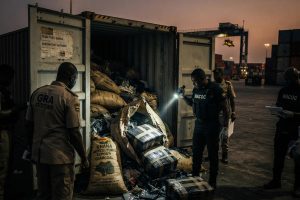




In September 2026, French customs officers at the port of Dunkirk opened a container of plastic waste that had sailed from Ghana. Inside, they found 3.9 tonnes of cocaine—a haul worth $261 million. It was not an isolated case. It was the latest evidence of a transformation that has turned Ghana from a peripheral player into a critical node in the global narcotics supply chain.
The Numbers That Changed the Conversation
For years, Ghana’s role in the international drug trade was acknowledged but rarely quantified. That changed in January 2026, when Belgium’s Finance Minister, Jan Jambon, released customs data showing that Ghana ranked as the fifth-largest country of origin for cocaine seized at the Port of Antwerp in 2025 .

The list read like a who’s who of the global cocaine trade: Ecuador, Costa Rica, Brazil, Colombia—and Ghana. The only African nation in the top five .
📢 GET A DETAILED ARTICLES + JOBS
Join ASJ's WhatsApp Channel and never miss a post or opportunity.
Belgian authorities intercepted nearly 55 tonnes of cocaine at Antwerp in 2025, a 24% increase from the 44 tonnes seized the previous year . Of that total, seizures linked to Ghanaian consignments accounted for approximately four tonnes—or about 7%—from just two shipments in November and December alone .
The classification is precise: “country of origin” means the point where the container was loaded, not where the narcotics were cultivated. None of the cocaine is grown in Ghana. The drugs originate in the Andes and are concealed in legitimate Ghanaian exports—cassava flour, timber, plastic waste, sugar, charcoal.
But the distinction matters less than the pattern. A 2022 analysis by the EU’s drugs agency and Europol named Côte d’Ivoire, Senegal, Benin, Sierra Leone, and The Gambia as West African countries linked to major cocaine seizures. Ghana was not mentioned . By 2025, Ghana was in the top five.
The Method: From Mules to Industrial Concealment
The shift is not just about volume. It is about sophistication.
The traditional image of drug trafficking—individual couriers swallowing pellets or hiding packages in luggage—has been eclipsed by something far more industrial. Traffickers now use Ghana’s legitimate export infrastructure as a Trojan horse.
The Dunkirk seizure involved 3.9 tonnes of cocaine hidden inside a container of plastic waste destined for Antwerp . The Amsterdam seizure in June 2025 uncovered 4.5 tonnes concealed in timber from Tema . The Belgian seizures in late 2025 involved 2,829 kilogrammes hidden in cassava flour, followed by another 1,158 kilogrammes the next month .
The methods recorded by Ghanaian authorities and cited by the opposition NPP include sand in tipper trucks, traditional artefact boxes, gari, charcoal shipments, and plastic waste containers. In April 2025, NACOC intercepted 89.74 kilogrammes of cocaine at the Swissport Cargo Terminal at Kotoka International Airport, concealed in wooden boxes declared as traditional artefacts and destined for the Netherlands .
The common thread: traffickers are not smuggling drugs into Ghana. They are smuggling them through Ghana, using the country’s ports, airports, and export networks as a legitimate-looking conduit to Europe and beyond.
The Domestic Hauls: The Cape Coast Interception
Not all the cocaine leaves. In March 2025, NACOC and the National Intelligence Bureau intercepted a tipper truck travelling from the Western Region to Accra. Buried under piles of sand, they found 3,313 kilogrammes of cocaine—one of the largest domestic seizures in Ghanaian history .
The drugs, valued at over $350 million, were later destroyed at the Bundase Military Camp in a joint exercise that also saw the incineration of 13,513.91 kilogrammes of assorted narcotics, including cannabis, tramadol, and codeine .
The seizure demonstrated two things: that Ghanaian authorities are capable of intercepting major consignments, and that the volume moving through the country is large enough to support multi-tonne domestic operations.
The Enforcement Paradox: Three Times More Caught Abroad
Here is the statistic that should concern every Ghanaian policymaker.
Of the roughly 16 tonnes of Ghana-linked cocaine intercepted over a trailing 12-month period, only 3.6 tonnes were caught domestically. The remaining 12.4 tonnes were caught abroad—in Antwerp, Amsterdam, Dunkirk, and Sydney .
For every one kilogram seized by Ghanaian authorities, more than three kilograms slipped past local borders and ports, only to be intercepted by foreign customs agencies.
This is not a failure of individual officers. It is a structural gap. Ghana’s port and airport screening systems are not designed to detect sophisticated industrial concealment. The traffickers have adapted faster than the enforcement infrastructure.
The political consequences have been immediate. The opposition New Patriotic Party has demanded the removal of multiple officials responsible for ports, maritime security, national security, and customs, alleging complicity and compromised checkpoints . The Minority in Parliament pushed for a full parliamentary inquiry, which the Speaker blocked to avoid prejudicing active prosecutions.
The Political Protection Question
The most uncomfortable finding in the 2025 Global Organised Crime Index is not about seizures. It is about the absence of them.
The report states that “law enforcement officials and civil society stakeholders suggest that political protection being given to illicit markets, particularly the cocaine trade, by sections of the government is the main reason for a drop in visible trafficking” .
The report identifies Ghanaian organised crime groups as “big players in the global cocaine trade” and cites allegations that politicians have accumulated wealth through connections to illicit economies, with some political parties benefiting from drug-linked funding.
This is not unique to Ghana. A GI-TOC analysis of West Africa’s cocaine markets found that state-embedded actors are the most powerful criminal figures in the region, and that an estimated 50% of cocaine trade protection payments are allocated to supporting patronage networks . The analysis notes that major seizures tend to occur in periods when the protection system is damaged—often at times of political volatility or change .
The implication is uncomfortable but difficult to ignore: the cocaine trade does not persist in West Africa despite the state. In some cases, it persists because of elements within it.
What NACOC Is Doing
The Narcotics Control Commission has not been idle. Under new leadership since March 2025, NACOC’s enforcement statistics have shifted dramatically.
Arrests increased from 73 in 2024 to 217 in 2025—a 197% rise. Seizures reached 1,497.75 kilogrammes of narcotic substances, valued at $5.24 million, alongside 61,974 units of controlled substances. Asset-based enforcement led to cash seizures of **GH¢6.93 million and $440,382**, plus 19.72 kilogrammes of gold suspected of being used for drug-money laundering.
NACOC’s district commands expanded from fewer than 10 to 77, extending its presence to all 16 regions. The government approved the recruitment of 1,200 additional personnel and provided 35 operational vehicles. A dedicated forensic laboratory and a specialised narcotics court are being established .
But the conviction rate remains low. Of the 217 arrests in 2025, only six convictions were secured from 165 cases—a rate of 3.6% . The gap between enforcement and prosecution is a vulnerability that traffickers can exploit.
The Regional Context: A West African Crisis
Ghana’s situation is not isolated. Across West Africa, cocaine seizures have surged from two metric tonnes in 2018 to more than 30 metric tonnes in 2025—a fifteenfold increase .
The GI-TOC’s regional baseline study, presented at a high-level dialogue in Accra in November 2025, found that West Africa is no longer merely a transit corridor. It is becoming a consumer market and, in some instances, a production hub .
“Here in West Africa, we see a clear sign that our region is shifting from being only a transit route to becoming a market and, in some cases, a production hub,” NACOC Director-General Brigadier-General Maxwell Mantey said at the Accra dialogue.
The dialogue, co-hosted by Ghana, the Netherlands, and GI-TOC, produced the Accra Call to Action, a regional commitment to strengthen intelligence sharing, financial investigations, and coordinated responses. It was formally adopted by Ghana’s Foreign Minister and submitted to the UN Commission on Narcotic Drugs .
ASJ Bottom Line
Ghana’s emergence as a top-five source of cocaine into Europe is not a statistical anomaly. It is the result of a deliberate adaptation by transnational criminal networks that have learned to use the country’s legitimate trade infrastructure as a conduit. The traffickers have moved faster than the enforcement systems designed to stop them.
The response so far has been mixed. NACOC has expanded its presence, increased arrests, and seized record quantities. But the conviction rate remains low, the domestic interdiction gap remains wide, and the allegations of political protection remain unresolved.
The question is not whether Ghana is part of the global cocaine trade. The evidence is conclusive. The question is whether the country’s institutions can adapt fast enough to prevent the trade from becoming entrenched—and whether the political will exists to confront the protection networks that allow it to operate.
Quick Facts
| Topic | Details |
|---|---|
| Ghana’s Antwerp Ranking (2025) | 5th largest country of origin for cocaine seized |
| Ghana-Linked Cocaine Intercepted (12 months) | ~16 tonnes total; 3.6 tonnes domestic, 12.4 tonnes abroad |
| Largest Domestic Seizure | 3,313kg cocaine under sand on Cape Coast highway, March 2025 |
| Dunkirk Seizure (Sept 2026) | 3.9 tonnes in plastic waste container, valued at $261 million |
| NACOC Arrests (2025) | 217, up 197% from 2024 |
| Conviction Rate (2025) | 3.6% (6 convictions from 165 cases) |
| West Africa Cocaine Seizures (2025) | 30+ metric tonnes, up from 2 tonnes in 2018 |
Frequently Asked Questions
1. Is Ghana a major cocaine trafficking country?
Yes. Ghana ranked as the fifth-largest country of origin for cocaine seized at the Port of Antwerp in 2025, the only African nation in the top five. Ghanaian organised crime groups are identified as significant players in the global cocaine trade .
2. How does cocaine enter Ghana?
Cocaine arrives primarily by sea from Brazil, concealed in legitimate cargo such as sugar containers and transported through trans-shipment points like Spain or Turkey before reaching Ghana’s ports at Tema and Takoradi.
3. How does cocaine leave Ghana?
Traffickers conceal cocaine in legitimate Ghanaian exports including cassava flour, timber, charcoal, plastic waste, and agricultural products. Major seizures have occurred in Antwerp, Amsterdam, Dunkirk, and Sydney involving consignments from Ghana .
4. Why are more Ghana-linked drugs caught abroad than domestically?
Of roughly 16 tonnes of Ghana-linked cocaine intercepted in a 12-month period, only 3.6 tonnes were caught domestically. The remaining 12.4 tonnes were caught abroad—a ratio of more than 3:1. This reflects gaps in Ghana’s port and airport screening systems .
5. What is the political protection allegation?
The 2025 Global Organised Crime Index cites law enforcement and civil society sources suggesting that political protection by sections of government is the main reason for declining cocaine seizures and reduced visibility of trafficking .
6. What is NACOC doing about drug trafficking?
NACOC expanded its district commands from fewer than 10 to 77, increased arrests by 197% in 2025, and seized 1,497.75 kilogrammes of narcotics plus 61,974 units of controlled substances. Asset-based enforcement recovered GH¢6.93 million and $440,382 .
7. What is the conviction rate for drug offences in Ghana?
The conviction rate remains low. Of 217 arrests in 2025, only six convictions were secured from 165 cases—a rate of 3.6% .
8. What is the Accra Call to Action?
A regional commitment adopted at a high-level dialogue in Accra in November 2025, co-hosted by Ghana, the Netherlands, and GI-TOC. It aims to strengthen intelligence sharing, financial investigations, and coordinated responses to West Africa’s drug markets .
9. How has West Africa’s cocaine trade changed?
Annual cocaine seizures in West Africa surged from two metric tonnes in 2018 to more than 30 metric tonnes in 2025. The region is transitioning from a transit corridor to a consumer market and, in some cases, a production hub .
10. Which other West African countries are affected?
Senegal has emerged as a strategic hub, with major seizures in 2025 and 2026. Guinea-Bissau, Cape Verde, Côte d’Ivoire, The Gambia, Liberia, Benin, and Togo have also recorded increased trafficking activity
Source: Accra Street Journal
Last Updated on October 5, 2026 by Samuel Kwame Boadu
Disclaimer: Some content on Accra Street Journal may be aggregated, summarized, or edited from third-party sources for informational purposes. Images and media are used under fair use or royalty-free licenses. Accra Street Journal is a subsidiary of SamBoad Publishing Hub under SamBoad Business Group Ltd, registered in Ghana since 2014.
For concerns or inquiries, please visit our Privacy Policy or Contact Page.

Samuel Kwame Boadu is a Ghanaian media entrepreneur and storyteller with a passion for amplifying urban voices and uncovering everyday truths. He is the Editor-in-Chief and Founder of Accra Street Journal, a dynamic digital platform dedicated to capturing the pulse of Ghana’s capital—its people, culture, challenges, business, sports and innovations.