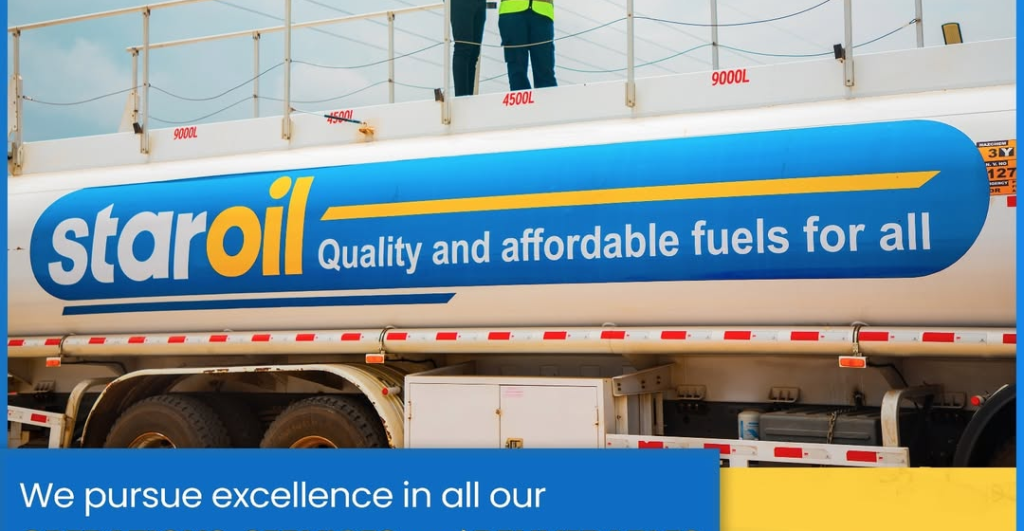
From 13th place in 2020 to market leader by 2025, Star Oil executed one of the most dramatic ascents in Ghana‘s corporate history—fueled by lean operations, aggressive pricing, and a contrarian bet on direct employment. Now, with over 254 stations, 2,714 employees, a 14% market share, GH¢2.63 billion in annual tax payments, and an ongoing battle with the industry‘s pricing floor and its own trade association, the indigenous giant is proving that the state-owned monopoly is no longer the only game in town. The only question is whether its challenger strategy can withstand the counter-offensive from the establishment.
Executive Introduction
For decades, the narrative of Ghana‘s downstream petroleum sector was remarkably stable: GOIL, the state-owned giant, sat at the top of the pyramid. TotalEnergies and Shell (now Vivo Energy) occupied the premium tiers. Smaller players fought for the remainder. This was the established order—until Star Oil decided to ignore it.

Founded as a modest player, Star Oil has executed one of the most rapid and consequential ascents in Ghana‘s corporate history. In 2020, the company languished around 13th place in the industry rankings. Just five years later, it had surged to the number one position by sales volume, overtaking the state-owned giant GOIL and outpacing multinational brands with deep pockets and longer histories .
📢 GET A DETAILED ARTICLES + JOBS
Join ASJ's WhatsApp Channel and never miss a post or opportunity.

The company‘s rise has been staggering. Its network grew from 85 stations in 2020 to 254 by the end of 2025 . Direct employment ballooned to 2,714 staff , and the company‘s market share peaked at an estimated 14% . In the first half of 2025 alone, Star Oil sold over 400 million litres of petroleum products, generating GH¢1.1 billion in taxes and a staggering GH¢2.63 billion for the full year .
For investors, energy sector analysts, and competitors, Star Oil represents a case study in indigenous disruption. Its strategy has been multi-pronged: aggressive but disciplined pricing, vertical integration (cutting out middlemen), direct employment of station attendants (rather than outsourcing), and a contrarian expansion into underserved regions. The company is led by CEO Philip Tieku, who has fashioned a lean, cost-conscious operation that has forced every other player in the market to reevaluate their business model.

This ASJ profile examines Star Oil‘s founding, its five-year ascent from obscurity to market leadership, its financial and tax contribution to the Ghanaian economy, its strategic differences from competitors (direct employment, real-time station monitoring, the Star Savers loyalty app), its departure from the Chamber of Oil Marketing Companies (COMAC) over the price floor policy, and the critical question: Having stormed the citadel, can Star Oil defend its position against the counter-offensive of a resurgent GOIL and the deep pockets of international rivals?
Company Overview: The Challenger‘s Blueprint
The Genesis: A Lean Operation With a Big Ambition
Star Oil‘s exact founding year is less documented than its meteoric rise. However, its public emergence as a significant force began around 2020, when it was ranked approximately 13th among Ghana‘s oil marketing companies (OMCs) . The company is a wholly-owned Ghanaian enterprise, with no reliance on international brand licensing (unlike Shell or TotalEnergies) and no state backing (unlike GOIL).
Star Oil‘s Strategic Framework:
| Element | Star Oil‘s Approach |
|---|---|
| Pricing | Aggressive, disciplined, with savings passed to consumers |
| Operations | Centralised, real-time monitoring, direct station management |
| Employment | Direct employees (not outsourced), performance incentives |
| Expansion | Focus on underserved regions, not just Accra |
| Technology | Star Savers app, fuel cards, real-time data |
| Governance | Lean overhead, tight cost control, elimination of leakages |
Ownership and Leadership
Mr. Philip Tieku – Chief Executive Officer
Philip Tieku is the public face and driving force behind Star Oil‘s strategy. He has been the primary spokesperson for the company‘s philosophy, frequently challenging industry orthodoxy on pricing, competition, and consumer welfare.
Tieku has consistently argued that Star Oil‘s success is not merely a function of low prices. He attributes the company‘s rise to a combination of “prudent management of resources, tight control of overhead costs, elimination of leakages, focus on fuel quality, and effective management of service stations and dealer engagement“ .
His philosophy on leadership is rooted in operational discipline and employee welfare:
“We decided that cost savings from improved controls should benefit our workers, not just our balance sheet. Our attendants, all direct employees, not outsourced, now earn higher wages and performance incentives than anywhere in the industry.”
Tieku has also introduced innovative incentive systems, such as the 20°C temperature compensation system, which rewards tanker drivers for efficient deliveries, with a portion of savings reinvested into employee remuneration .
Ownership:

Star Oil is a privately held Ghanaian company. Unlike GOIL (state-owned) or TotalEnergies and Vivo Energy (multinational subsidiaries), Star Oil‘s ownership is local and independent. This allows the company to make rapid strategic decisions without the layers of approval required by foreign parents or state boards.
Key Operational Metrics (2025–2026)
| Metric | Value |
|---|---|
| Network Size | 254 filling stations (end of 2025) |
| Direct Employees | 2,714 |
| Peak Market Share | 14% |
| Annual Sales Volume | ~819 million litres |
| Annual Tax Contribution | GH¢2.63 billion |
| 2020 Ranking | ~13th |
| 2025 Ranking | 1st (mid-year), currently 2nd (early 2026) |
The Meteoric Ascent: How Star Overtook the Establishment (2020–2025)
The Turning Point: First Half of 2025
Star Oil‘s ascent to the top was confirmed by data from the National Petroleum Authority (NPA) for the first half of 2025 . The numbers were decisive:
| Company | Sales Volume (H1 2025) | Petrol (Litres) | Diesel (Litres) |
|---|---|---|---|
| Star Oil | 403.3 million | 193.9 million | 139.3 million |
| GOIL | 271.3 million | 156 million | 111 million |
For the first five months of 2025, Star Oil sold 336.3 million litres, firmly establishing its leadership . The company‘s momentum was not a flash in the pan; it was a sustained surge built over years of strategic execution.
The Three Pillars of Star Oil‘s Strategy
1. Pricing Discipline and the ‘Cost-Plus‘ Model
Star Oil‘s most visible differentiator has been its pricing. The company has consistently offered fuel at prices below many of its competitors. However, CEO Philip Tieku has insisted that this is not merely a race to the bottom.
“There‘s a level that price can take you, but sustaining it comes with a lot of strategies, and we worked hard to achieve that.”
Star Oil‘s model focuses on cutting supply-chain leakages, centralising operations, and reducing overhead. By operating its own efficient logistics and eliminating unnecessary intermediaries, the company achieves a cost structure that allows it to lower prices while maintaining profitability .
2. Direct Employment and Incentive Systems
Unlike many OMCs that outsource station attendants, Star Oil employs its staff directly . This has allowed the company to:
-
Train attendants to higher standards
-
Offer performance incentives (higher wages than the industry average)
-
Foster loyalty and reduce turnover
-
Ensure consistent customer service across the network
The innovative 20°C temperature compensation system is an example of Tieku‘s approach to operational efficiency. The system rewards tanker drivers for efficient deliveries, with savings shared among drivers, stations, and the company‘s remuneration pool .
3. Expansion into Underserved Markets
While competitors focused heavily on Accra and Kumasi, Star Oil systematically expanded its retail footprint into regions that were underserved by major brands . By bringing quality fuel to these areas, the company captured market share that larger competitors had neglected.

The Tax Contribution Story
Star Oil has emerged as one of the most significant private-sector contributors to Ghana‘s fiscal purse.
-
Full Year 2025 Tax Payment: GH¢2.63 billion
-
First Half 2025 Tax Payment: GH¢1.1 billion
To put the GH¢2.63 billion figure in perspective, it is approximately seven percent of Ghana‘s IMF bailout package . This demonstrates that Star Oil is not only a commercial success but also a critical pillar of the national revenue base.
The company‘s tax payments support critical public services and national development efforts, alongside job creation and business growth .
The Star Oil Model: What Makes It Different
Star Oil‘s success has prompted analysts to dissect its business model . Several elements distinguish it from both state-owned and multinational competitors.
Direct Operations vs. Franchising
| Model | Star Oil | Competitors (typical) |
|---|---|---|
| Station Management | Direct (company employees) | Franchised or dealer-managed |
| Quality Control | Centralised, real-time monitoring | Variable |
| Employee Status | Direct employees | Often outsourced |
| Brand Consistency | High | Variable |
| Profit Retention | Company retains full margin | Shared with franchisee |
The Star Fuel Card and Star Savers App
Star Oil has invested in customer-facing technology to build loyalty beyond price.
-
Star Fuel Card: Offers corporate clients and frequent users payment options, discounts, and fuel management services .
-
Star Savers App: A data-driven mobile platform that integrates payments, rewards, and customer engagement .
Real-Time Station Monitoring
Star Oil has implemented a system for real-time monitoring of its stations . This provides:
-
Instant visibility into sales volumes
-
Inventory management alerts
-
Performance tracking for individual outlets
-
Ability to respond rapidly to market changes
The ‘Direct Import‘ Ambition
In 2026, Star Oil was awaiting the completion of licensing to enable direct imports of petroleum products . Currently, most OMCs purchase from Bulk Distribution Companies (BDCs), who import the fuel. By securing a direct import licence, Star Oil would be able to:
-
Bypass the BDC layer, reducing costs further
-
Control its supply chain end-to-end
-
Offer even lower prices to consumers
The 2026 Market Reality: The GOIL Counter-Attack and Second Place
NPA Data (January–March 2026): A Shift at the Top
By early 2026, the competitive dynamics had shifted. GOIL, the state-owned giant, reclaimed its position as the overall market leader .
Q1 2026 Market Share (by volume):
| Rank | OMC | Total Sales (Litres) | Key Strength |
|---|---|---|---|
| 1 | GOIL | 256,779,451 | Overall leader, state backing, diverse product mix |
| 2 | Star Oil | ~242.6 million | Leader in Petrol and Diesel volumes |
| 3 | Vivo Energy (Shell) | 145,472,100 | Premium brand |
| 4 | Zen Petroleum | 103,000,000+ | Fast-growing indigenous |
| 5 | TotalEnergies | 93,029,530 | Premium, margin-focused |
Key Observations:
-
Star Oil Still Dominates Petrol and Diesel: Even though GOIL reclaimed the top spot overall, Star Oil sold the highest volumes of both petrol (147.7 million litres) and diesel (94.9 million litres) in Q1 2026 .
-
The Race Is Tight: The gap between Star Oil and GOIL is narrow, suggesting that the battle for leadership will continue throughout 2026.
-
Second Place Is Not a Retreat: Star Oil‘s fall to second place is a testament to the intense competition, not a sign of failure. The company remains the most significant challenger to the state-owned establishment.
Why GOIL Reclaimed the Lead
GOIL‘s resurgence can be attributed to:
-
Aggressive price matching
-
Debt restructuring and improved financial health
-
Expansion of its own network (400+ stations)
-
The intangible value of the “national champion” brand
However, Star Oil‘s ability to lead in the high-volume petrol and diesel categories indicates that its core value proposition continues to resonate with consumers.
The COMAC Exit: A Battle Over Pricing Policy (January 2026)
On January 21, 2026, Star Oil announced its indefinite suspension of membership from the Chamber of Oil Marketing Companies (COMAC) , citing unfair representation within the association and its failure to advocate for consumer-friendly pricing policies .
The Core Dispute: The Fuel Price Floor
The primary point of contention was COMAC‘s support for the fuel price floor—a mechanism that sets a minimum price for petroleum products. Star Oil has been a vocal opponent of the price floor, arguing that it restricts competition and prevents cost savings from being passed on to consumers .
Originally introduced as a temporary safeguard against predatory pricing, the price floor has, according to critics, evolved into a structural barrier that penalises high-volume, cost-efficient operators while protecting less efficient business models .
ASEC‘s Analysis
The Africa Sustainable Energy Centre (ASEC) weighed in on the standoff, calling it a defining moment for Ghana‘s downstream petroleum sector . ASEC noted that the removal of price floors for Bulk Distribution Companies (BDCs) did not result in market instability, arguing that the continued application of the policy to OMCs is inconsistent with Ghana‘s deregulation framework introduced in 2015 .
ASEC also raised concerns about governance and representation within COMAC. As the association‘s largest financial contributor, Star Oil expected its pro-consumer views to be fairly represented .
“Trade associations must accommodate divergent perspectives to remain legitimate. Failure to do so risks turning such bodies into shields for inefficiency rather than platforms for reform.”
Implications of the Exit
Star Oil‘s departure has significant implications for COMAC, including potential financial shortfalls that could affect its research, advocacy, and operational capacity . ASEC cautioned that further withdrawals could weaken industry cohesion and diminish the association‘s influence with regulators and government .
For Star Oil, the exit is a statement of independence. The company is willing to challenge industry orthodoxy and go its own way when it believes consumer interests are not being served.
Star Oil‘s Call for Reform
ASEC proposed a series of reforms to resolve the impasse, which align with Star Oil‘s stated positions:
-
Governance reforms within COMAC (weighted communication protocols, independent research unit)
-
Phased withdrawal of the price floor, replaced with a competition monitoring framework
-
Integration of consumer advocacy into decision-making processes
Future Outlook: The Hypermarket Ambition and EV Transition
Star Oil is not resting on its laurels. CEO Philip Tieku has articulated a long-term vision that extends far beyond fuel retail.
The “Hypermarket Retail Model“
Tieku has stated that Star Oil‘s long-term plan is to develop sites similar to hypermarket retail models . This would transform Star Oil stations from simple fuelling points into destinations, offering:
-
EV charging infrastructure
-
Shopping centres and retail outlets
-
Enhanced convenience services
-
Integration of the Star Savers loyalty ecosystem
Direct Import Licensing
Star Oil was awaiting completion of licensing to enable direct imports of petroleum products at the time of reporting . This would be a game-changer, allowing the company to:
-
Reduce costs further by bypassing BDCs
-
Control supply chain quality and timing
-
Potentially lower prices even more
Commitment to Green Energy
As the government encourages OMCs to align with its green transition agenda, Star Oil has signalled its intention to add EV charging infrastructure . This positions the company for the long-term shift away from internal combustion engines.
Challenges and Risks
No analysis of Star Oil is complete without acknowledging the headwinds it faces.
Risk 1: The GOIL Counter-Offensive
GOIL has reclaimed the top spot and is fighting aggressively to maintain it. The state-owned giant has the backing of the government and a massive station network (400+). Star Oil must continue innovating to stay competitive.
Risk 2: Price War Sustainability
Star Oil‘s aggressive pricing model relies on tight cost control and high volume. If global oil prices spike or the cedi depreciates sharply, the company‘s margins could be compressed. Competitors with deeper pockets (TotalEnergies, Vivo Energy) could absorb shocks that Star Oil cannot.
Risk 3: Regulatory Environment
The price floor remains in place, despite Star Oil‘s objections. Without regulatory reform, the company‘s ability to compete on price is constrained. The COMAC exit also means Star Oil has lost a voice in industry advocacy.
Risk 4: Direct Import Licensing Delays
The company‘s ambition to import directly is contingent on regulatory approval. Delays in licensing would maintain the status quo, forcing Star Oil to continue purchasing from BDCs and sharing margins.
Risk 5: Currency Volatility
Like all OMCs, Star Oil is exposed to the cedi‘s volatility. Depreciation increases the cost of imported fuel, compressing margins or forcing price increases that could erode the company‘s competitive advantage.
Risk 6: The EV Transition
While Star Oil plans to add EV charging, the transition away from fossil fuels is a long-term threat to any fuel retailer. If EV adoption accelerates faster than expected, Star Oil‘s core business model could be disrupted.
The Verdict
Star Oil Ghana Ltd is the most significant indigenous challenger to emerge in Ghana‘s downstream petroleum sector in a generation. Its ascent from 13th place in 2020 to market leader in 2025 is a textbook case of strategic disruption: lean operations, aggressive but disciplined pricing, direct employment, and expansion into underserved markets .
The company‘s achievements are quantifiable and substantial. With 254 stations, 2,714 direct employees, and GH¢2.63 billion in annual tax payments, Star Oil has become a pillar of the Ghanaian economy . The company‘s innovative incentive systems, real-time station monitoring, and customer loyalty apps have set new standards for the industry .
The counter-offensive from GOIL has pushed Star Oil to second place in early 2026, but the company remains the leader in the high-volume petrol and diesel categories . The battle for market leadership is far from over.
The COMAC exit is a defining moment. Star Oil has shown a willingness to challenge industry orthodoxy and walk away from the established trade association when it believes consumer interests are not being served . Whether this isolation proves to be a strategic advantage or a vulnerability remains to be seen.
Looking ahead, Star Oil‘s ambition to become a hypermarket-style retail operator, to secure direct import licensing, and to invest in EV charging infrastructure positions it for long-term relevance .
For the Ghanaian consumer, Star Oil has been a force for lower prices and increased competition. For the Ghanaian economy, the company has been a significant taxpayer and employer. For the industry, Star Oil has been a disruptor—and disruptors are never comfortable with the status quo.
Star Oil is not trying to be a quiet, comfortable number two. It is trying to be the most efficient, most consumer-friendly, and most innovative OMC in Ghana. Having already rewritten the rules of the industry, it is now engaged in the harder work of defending its gains against a resurgent establishment.
FAQ SECTION
1. Is Star Oil Ghana a Ghanaian-owned company?
Yes. Star Oil is a wholly-owned Ghanaian private company. It is not state-owned (unlike GOIL) and not a subsidiary of a multinational (unlike TotalEnergies or Vivo Energy).
2. Who is the CEO of Star Oil?
The Chief Executive Officer is Mr. Philip Tieku. He has been the driving force behind Star Oil‘s rise, emphasising operational discipline, cost control, and employee welfare .
3. How did Star Oil become the market leader?
Star Oil rose from approximately 13th place in 2020 to number one by 2025 through a combination of aggressive pricing, lean operations, direct employment of station attendants, expansion into underserved regions, and innovative incentive systems .
4. How many stations does Star Oil have?
As of the end of 2025, Star Oil operated 254 filling stations nationwide .
5. How many people does Star Oil employ?
Star Oil employs 2,714 direct staff .
6. What is Star Oil‘s market share?
Star Oil‘s market share peaked at approximately 14% in 2025 .
7. How much tax does Star Oil pay?
Star Oil paid GH¢2.63 billion in taxes and statutory levies in 2025 . This represents approximately 7% of Ghana‘s IMF bailout package .
8. What is the Star Savers app?
The Star Savers app is a data-driven mobile platform developed by Star Oil to integrate payments, rewards, and customer engagement .
9. Why did Star Oil leave COMAC?
Star Oil suspended its membership of the Chamber of Oil Marketing Companies (COMAC) in January 2026, citing unfair representation and the association‘s failure to advocate for consumer-friendly pricing policies, specifically its support for the fuel price floor .
10. What is the fuel price floor?
The fuel price floor is a mechanism that sets a minimum price for petroleum products. Star Oil opposes it, arguing that it restricts competition and prevents cost savings from being passed on to consumers .
11. Is Star Oil still the market leader?
As of Q1 2026, GOIL has reclaimed the overall market leadership. However, Star Oil remains the leader in petrol and diesel sales volumes and is a close second overall .
12. What are Star Oil‘s future plans?
Star Oil plans to secure direct import licensing to bypass BDCs, develop hypermarket-style retail sites, add EV charging infrastructure, and continue expanding its network .
Source: Accra Street Journal
Last Updated on June 3, 2026 by Samuel Kwame Boadu
Disclaimer: Some content on Accra Street Journal may be aggregated, summarized, or edited from third-party sources for informational purposes. Images and media are used under fair use or royalty-free licenses. Accra Street Journal is a subsidiary of SamBoad Publishing Hub under SamBoad Business Group Ltd, registered in Ghana since 2014.
For concerns or inquiries, please visit our Privacy Policy or Contact Page.

Samuel Kwame Boadu is a Ghanaian media entrepreneur and storyteller with a passion for amplifying urban voices and uncovering everyday truths. He is the Editor-in-Chief and Founder of Accra Street Journal, a dynamic digital platform dedicated to capturing the pulse of Ghana’s capital—its people, culture, challenges, business, sports and innovations.