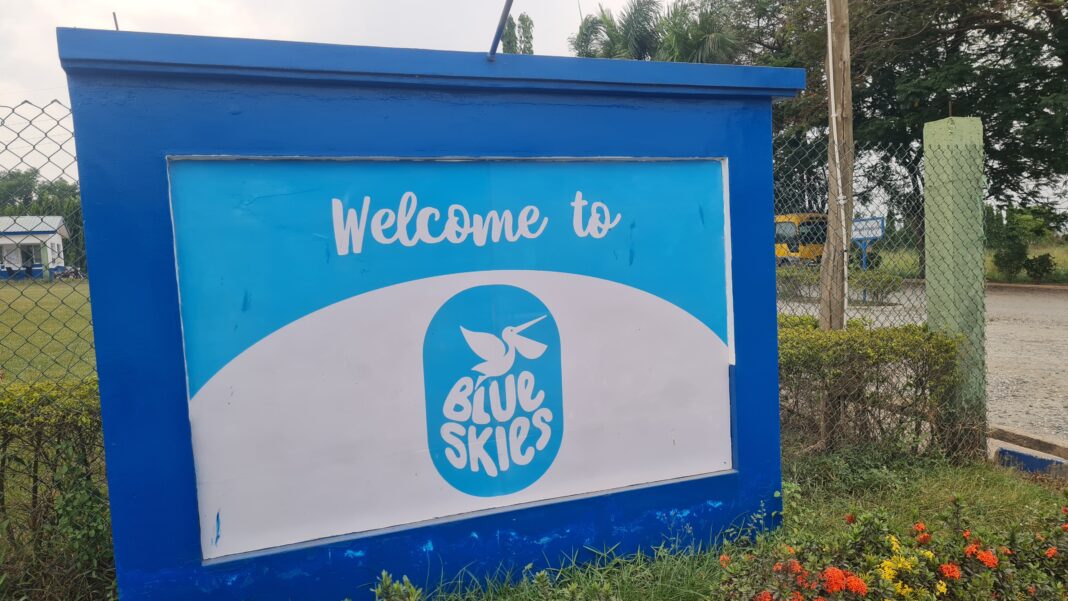
For over 25 years, this Ghanaian agribusiness trailblazer has defied logistics, perishability, and conventional wisdom to become a global leader in fresh-cut fruit exports, directly employing over 1,000 Ghanaians, supporting 150 smallholder farms, and accounting for a staggering 70% of Ghana‘s mango exports. With a newly opened Benin factory, a royal reception for the President of Ghana, and a visionary founder who refuses to cut corners, Blue Skies is the ultimate case study in African value addition—proving that the freshest fruit in a European supermarket can still be processed by hand in the tropics just 48 hours earlier.
Executive Introduction
In the vast, complex machinery of global agribusiness, the prevailing logic has long been to extract raw materials from the Global South and process them closer to the consumer in the Global North. Raw pineapples are shipped across oceans; mango pulp is frozen and reconstituted. But for over two decades, a company based in a rural corner of Ghana‘s Eastern Region has systematically dismantled that logic—one perfectly cut pineapple spear at a time.

Blue Skies Products (GH) Ltd. is not merely a fruit processor; it is a pioneer of a revolutionary concept: value addition at source. Founded by the British entrepreneur Anthony Pile in 1998, the company’s premise was deceptively simple but logistically audacious. Instead of shipping raw fruit to Europe for processing, Blue Skies builds its factories in the countries where the fruit grows—harvesting at peak ripeness, cutting and packing by hand, and flying the finished product to European supermarket shelves within 48 hours .
📢 GET A DETAILED ARTICLES + JOBS
Join ASJ's WhatsApp Channel and never miss a post or opportunity.

What began as a single factory in Nsawam with just 36 employees has grown into a global network with facilities in Ghana, South Africa, Egypt, and Brazil . The group now employs over 2,500 people worldwide . In Ghana alone, the direct workforce has grown from those 36 original employees to over 1,000 today—a 27-fold increase—with the company also supporting a supply base of 150 smallholder farms .
The company‘s scale is staggering for a single exporter from a developing nation. It is responsible for approximately 1% of Ghana‘s total exports, 30% of her pineapple exports, and the majority—70%—of her mango exports . With an annual group turnover exceeding £30 million and a historic growth rate of 25% year-on-year, Blue Skies supplies the biggest supermarket chains in the UK, Europe, and South Africa, including Sainsbury’s, Waitrose, ASDA, Albert Heijn, and Monoprix .

But perhaps more impressive than the financial metrics is the institutional recognition. In 2024, Blue Skies was honoured to host the President of the Republic of Ghana, Nana Addo Dankwa Akufo-Addo, at its Dobro factory . The President toured the state-of-the-art facility, engaged with employees, and pledged government support to protect the company from land challenges that threaten its out-grower farms .
For investors, policymakers, and business analysts, Blue Skies Ghana represents a case study in sustainable, ethical, and scalable agribusiness. It has successfully navigated currency volatility, logistical hurdles, and the immense challenge of keeping fruit fresh across continents. This profile examines the company‘s 1998 founding, its unique “value addition at source” model, its role as a titan of Ghanaian non-traditional exports (NTEs), its leadership under founder Anthony Pile and General Manager Janet Lutterodt, and the critical question: As it expands into new markets like Benin and diversifies into products like dairy-free ice cream, can Blue Skies maintain its competitive edge without compromising the hand-crafted quality that built its brand?
Company Overview: From a Bold Vision in 1997 to a Global Network
The Genesis: “Adding Value at Source”
The Blue Skies story begins in the mid-1990s with its founder, Anthony Pile. An entrepreneur with a background in retail logistics, Pile saw a fundamental flaw in the fresh fruit supply chain. By the time exotic fruits from Africa reached European consumers, they were often weeks old, having lost much of their flavour, texture, and nutritional value .
His solution was both simple and radical: process the fruit where it is grown. Instead of exporting raw pineapples or mangoes, he would build a factory in Ghana, employ local workers to cut and pack the fruit by hand at the peak of its ripeness, and then fly the finished product directly to Europe .
The company was registered in Ghana on April 1, 1997 , commencing operations in 1998 . The first facility was established in Nsawam, in the Eastern Region, a strategic location close to key pineapple and mango growing areas.
The Blue Skies Group Structure:
| Operation | Location | Status (2026) |
|---|---|---|
| Blue Skies Products (GH) Ltd. | Nsawam / Dobro, Ghana | Active |
| Blue Skies Ltd. | Pitsford, Northamptonshire, UK | Head Office |
| Blue Skies | South Africa | Active |
| Blue Skies | Egypt | Active |
| Blue Skies | Brazil | Active |
| Blue Skies | Benin | New (2024-2026) |
In addition to the UK head office and the Ghanaian manufacturing hub, the group has expanded to include facilities in South Africa, Egypt, Brazil, and most recently, Benin .
The founder, Anthony Pile, remains deeply involved as CEO, spending time at the various facilities. During a 2025 Founders‘ Day celebration, Ruth Smith-Adjei, a General Manager for West Africa, noted that Pile still speaks passionately about the company’s mission and is proud to call himself an honorary Ghanaian .
Blue Skies in Ghana: The Flagship Operation
The Ghanaian operation, legally incorporated as Blue Skies Products (GH) Ltd. , is the flagship and largest facility in the group . Located in the Free Zones Enclave at Ankwa Dobro, near Nsawam, it is a sprawling campus that includes the main processing factory, ripening rooms, cold storage, and administrative offices .

| Metric | Value |
|---|---|
| Legal Name | Blue Skies Products (GH) Ltd. |
| Licence Date | April 1, 1997 |
| Founder | Anthony Pile |
| Nationality of Founder | British / Ghanaian (Honorary) |
| Head of Operations (Ghana) | Janet Lutterodt (General Manager) |
| Global Employees | 2,500+ |
| Ghana Employees | 1,000+ |
| Smallholder Farms Supported (Ghana) | 150 |
| Annual Group Turnover (Historic) | £30+ Million |
| Export Share (Ghana) | 1% of total exports |
| Pineapple Export Share (Ghana) | 20-30% |
| Mango Export Share (Ghana) | 70% (Majority) |
| Exports Per Day | 10+ tonnes of processed fruit |
The Supply Chain: 150 Smallholder Farms and Fairtrade Roots
Unlike industrial plantations, Blue Skies sources its fruit from a network of approximately 150 smallholder farms in Ghana . This decentralised sourcing model distributes wealth to rural communities and de-risks the supply chain.
From its early days, the company was a proponent of ethical trade. It holds Fairtrade and Organic certifications, ensuring that farmers receive a premium for their produce and that environmentally harmful pesticides are avoided .
The fruit portfolio is diverse, drawing from the best of each season:
-
Pineapple (key export)
-
Mango (majority of Ghana‘s exports)
-
Papaya
-
Coconut
-
Passion fruit
The Business Model: Speed, Freshness, and the 48-Hour Miracle
The core of Blue Skies‘ competitive advantage is its speed-to-market.
The 48-Hour Journey
-
Harvest: Fruit is harvested at its optimal maturity (not before, not after) by local smallholder farmers.
-
Processing: The fruit is transported to the Nsawam factory, where it is hand-selected for quality, peeled, cut, and packed. This is labour-intensive by design, maximising local employment.
-
Chilling: The packaged fruit is immediately blast-chilled to preserve freshness.
-
Airfreight: The finished product is loaded into the cargo holds of passenger aircraft flying out of Kotoka International Airport (KIA) in Accra.
-
Shelf Arrival: The product arrives at European supermarkets such as Waitrose and Sainsbury‘s, still fresh, within 48 hours of harvest .
This model relies entirely on airfreight. As Blue Skies noted in evidence to the UK Parliament, this is not a luxury but a necessity for highly perishable goods. It is also a significant contributor to Ghana‘s economy, using passenger aircraft belly space that might otherwise fly empty .
Innovation: From Fresh Fruit to Juices and Dairy-Free Ice Cream
While fresh-cut fruit remains the core, Blue Skies has diversified to capture more value and reduce waste.
-
Fresh Juices: The company produces 100% natural fruit juices without preservatives or concentrates .
-
Dairy-Free Ice Cream: In a significant product pivot, Blue Skies has launched a dairy-free ice cream made from coconut milk and blended with other fresh fruits. This high-margin product diversifies the revenue stream beyond the volatile fresh fruit market .
Financial Footprint: The £30 Million Exporter
Blue Skies is a privately held company and does not publish detailed financial statements. However, several data points triangulate its significant scale.
-
Group Turnover: As of the late 2000s, the group turnover exceeded £30 million, with a historical growth rate of 25% per annum . Given the expansion into Brazil and Benin since then, current revenues are likely substantially higher.
-
Ghana Revenue (2020 Estimate): A single source estimates Blue Skies‘ revenue at $50 million in 2020, specifically for pineapple exports . While this figure should be treated with caution as it is not audited, it aligns with the company‘s overall scale.
The Pricing Challenge
Blue Skies operates in a difficult macroeconomic environment. Ghana‘s inflation and currency volatility increase the cost of local wages and utilities. However, because the company earns its primary revenue in Pounds Sterling and Euros (selling to European supermarkets), the currency risk is partly mitigated by the fact that it earns in stable foreign currency while paying some costs in Cedis.
Export Dominance
Blue Skies is a titan of Ghana‘s non-traditional export (NTE) sector:
-
1% of all Ghanaian exports flows through Blue Skies .
-
20-30% of Ghanaian pineapple exports are handled by Blue Skies .
-
70% of Ghanaian mango exports are attributable to Blue Skies .
Leadership and Strategy
Anthony Pile (Founder & Group CEO)
Anthony Pile remains the driving philosophical force. His leadership is defined by a refusal to compromise on quality or ethics. At a 2025 Founders‘ Day event, he urged staff not to “cut corners” and emphasised environmental stewardship: “We don’t always have to cut down trees to grow,” he said .
His relationship with Ghana is deep. He is a board member of the Ghana Free Zones Authority and has publicly stated his pride in being accepted as an “honorary Ghanaian” .

Janet Lutterodt (General Manager, Ghana)
Janet Lutterodt is the on-ground leader of the Ghana operation . She has played a crucial role in the company‘s expansion and in liaising with the government. During the 2024 visit of President Akufo-Addo, she highlighted the existential threats facing the business, specifically illegal sand winning and land encroachment, which threaten the out-grower farms .
The Presidential Visit (2024): A Seal of Approval
In 2024, President Nana Akufo-Addo toured the Blue Skies facility at Dobro. The visit was a significant endorsement. The President was impressed by the factory’s adherence to sustainable practices and ethical standards .
Outcome of the Visit:
President Akufo-Addo pledged his government‘s support to ensure that Blue Skies’ operations are not affected by land challenges, which were impeding the expansion of out-grower farmers. This high-level political intervention underscores the company‘s strategic importance to the Ghanaian economy .
Economic and Industry Impact
Blue Skies transcends its identity as a mere company; it is a development engine.
Employment
The company is a major employer in the Eastern Region. It provides over 1,000 direct jobs . In a country where formal manufacturing jobs are scarce, Blue Skies offers stable, skilled employment, particularly for women who dominate the hand-cutting and packing lines.
Smallholder Farmer Support
The model of supporting 150 smallholder farms is more impactful for poverty reduction than working with large plantations. It provides a guaranteed market and technical assistance for independent farmers, improving their livelihoods and stabilising rural communities .
Infrastructure and Logistics
The need for speed has strengthened Ghana‘s logistics infrastructure. Blue Skies is a major user of airfreight capacity out of Accra, making the route more viable and supporting the cold chain logistics industry in the country.
Challenges and Risks
No analysis of Blue Skies is complete without acknowledging the significant headwinds.
1. The Perishability Risk
This is the most fundamental risk. A delay of a few hours in the cold chain, a strike at a European airport, or a customs hold-up can result in the spoilage of an entire week‘s production. The 48-hour model is a high-wire act.
2. Land Encroachment and Illegal Mining
As highlighted by General Manager Janet Lutterodt to the President, one of the greatest threats is the loss of farmland to real estate developers and illegal sand winning (galamsey) . If out-grower farms are displaced, the supply chain collapses.
3. Currency Volatility
While Blue Skies earns in Pounds and Euros, the cost of local labour and utilities has risen sharply with Ghana‘s inflation. If the Cedi stabilises, local costs rise; if it collapses, import costs for packaging (which may come from Europe) rise.
4. Competition from Imitators
The “value addition at source” model pioneered by Blue Skies is now being replicated by other companies in Africa and South America. While Blue Skies has a first-mover advantage and brand reputation, price competition could squeeze margins.
5. Airfreight Carbon Footprint
As consumers and retailers in Europe become increasingly environmentally conscious, the carbon footprint of airfreighted goods faces scrutiny. Blue Skies relies on its ethical labour practices and long-standing relationships to defend its premium positioning, but this remains a vulnerability.
6. Expansion Integration
Opening a new factory in Benin and expanding operations in Brazil presents classic integration risks. Can the company maintain the same rigorous quality control in new geographies as it has in Ghana?
Future Outlook
As of June 2026, Blue Skies is in an expansion phase.
The Immediate Agenda (2026-2027)
-
Consolidating the Benin Factory: Integrating the new West African facility to increase regional capacity.
-
Scaling Up Dairy-Free Products: The dairy-free ice cream line offers a higher-margin product that is less perishable than fresh fruit, potentially opening new retail channels (freezer aisles vs. produce sections).
-
Securing Farmland: Working with the Ghanaian government to formalise land use agreements for out-grower farms to prevent encroachment.
-
Product Diversification: Continuing to develop new value-added products (smoothie bowls, frozen fruit packs) to maximise return on the fresh fruit supply.
The Verdict
Blue Skies Products (Ghana) Ltd. is a national asset. It stands as perhaps the most compelling example of how ethical capitalism can drive industrialisation in Africa.
For the Ghanaian economy, Blue Skies is a major employer, a significant exporter, and a driver of rural development. For the global consumer, it delivers a superior product that defines the fresh fruit category. For the investor, it represents a mature, global private company with a proven, resilient business model.
The company has survived for 25 years by refusing to compromise on two things: freshness and fairness. As it expands into Benin and Brazil, the greatest challenge will be ensuring that the “Blue Skies way”—hand-packed, ethical, and incredibly fast—can be scaled without losing its soul. If anyone can do it, the team in Nsawam has proven they have the courage to try.
FAQ SECTION
1. Is Blue Skies a Ghanaian-owned company?
No. Blue Skies is a privately held international group founded by British entrepreneur Anthony Pile. The Ghanaian operation, Blue Skies Products (GH) Ltd., is a subsidiary of this group. However, the company is deeply integrated into the Ghanaian economy and Pile has expressed pride in being an “honorary Ghanaian” .
2. Who is the founder of Blue Skies?
The founder and Group CEO is Mr. Anthony Pile. He founded the company in 1997 .
3. Who runs the Ghana operation?
The General Manager for the Ghana operation is Ms. Janet Lutterodt .
4. When was Blue Skies founded in Ghana?
The company was registered as a Free Zone enterprise on April 1, 1997, and commenced operations in 1998 .
5. Where is the Blue Skies factory located?
The factory is located at Ankwa Dobro, near Nsawam in the Eastern Region of Ghana .
6. How many people does Blue Skies employ in Ghana?
Blue Skies directly employs over 1,000 people in Ghana .
7. What percentage of Ghana‘s mango exports does Blue Skies handle?
Blue Skies is responsible for the majority of Ghana‘s mango exports, estimated at about 70% .
8. Does Blue Skies only sell fresh fruit?
No. While fresh-cut fruit is the core product, the company also produces 100% natural fruit juices and has recently launched a dairy-free ice cream line .
9. Who are Blue Skies‘ main customers?
Blue Skies supplies major supermarket chains in the UK and Europe, including Waitrose, Sainsbury‘s, ASDA, Albert Heijn, and Monoprix .
10. How does Blue Skies keep the fruit fresh?
The company follows a strict 48-hour turnaround. Fruit is harvested, processed, chilled, and airfreighted to Europe within 48 hours, utilising the cargo holds of passenger aircraft .
11. Did the President of Ghana visit Blue Skies?
Yes. In 2024, President Nana Addo Dankwa Akufo-Addo toured the Blue Skies facility in Dobro to commend its contribution to the agribusiness sector .
12. Is Blue Skies Fairtrade certified?
Yes. Blue Skies holds Fairtrade and Organic certifications, ensuring ethical treatment of farmers and sustainable farming practices .
QUICK FACTS BOX
| Item | Details |
|---|---|
| Company Name | Blue Skies Products (GH) Ltd. |
| Founded | 1997 (Licensed) / 1998 (Operations) |
| Founder | Anthony Pile |
| Group CEO | Anthony Pile |
| General Manager (Ghana) | Janet Lutterodt |
| Headquarters (Ghana) | Ankwa Dobro, near Nsawam, Eastern Region |
| Global HQ | Pitsford, Northamptonshire, UK |
| Industry | Agribusiness / Food Processing |
| Ownership | Privately Held |
| Employees (Global) | 2,500+ |
| Employees (Ghana) | 1,000+ |
| Smallholder Farms (Ghana) | 150 |
| Exports (Group) | £30+ Million (Historic) |
| Ghana Export Share | ~1% of total exports |
| Pineapple Export Share | 20-30% |
| Mango Export Share | 70% (Majority) |
| Key Products | Fresh-cut fruit, juices, dairy-free ice cream |
| Key Markets | UK, Europe, South Africa |
| Certifications | Fairtrade, Organic, LEAF |
| Regulator | Ghana Free Zones Authority |
| Website | blueskies.com |
Last Updated on June 7, 2026 by Samuel Kwame Boadu
Disclaimer: Some content on Accra Street Journal may be aggregated, summarized, or edited from third-party sources for informational purposes. Images and media are used under fair use or royalty-free licenses. Accra Street Journal is a subsidiary of SamBoad Publishing Hub under SamBoad Business Group Ltd, registered in Ghana since 2014.
For concerns or inquiries, please visit our Privacy Policy or Contact Page.

Samuel Kwame Boadu is a Ghanaian media entrepreneur and storyteller with a passion for amplifying urban voices and uncovering everyday truths. He is the Editor-in-Chief and Founder of Accra Street Journal, a dynamic digital platform dedicated to capturing the pulse of Ghana’s capital—its people, culture, challenges, business, sports and innovations.