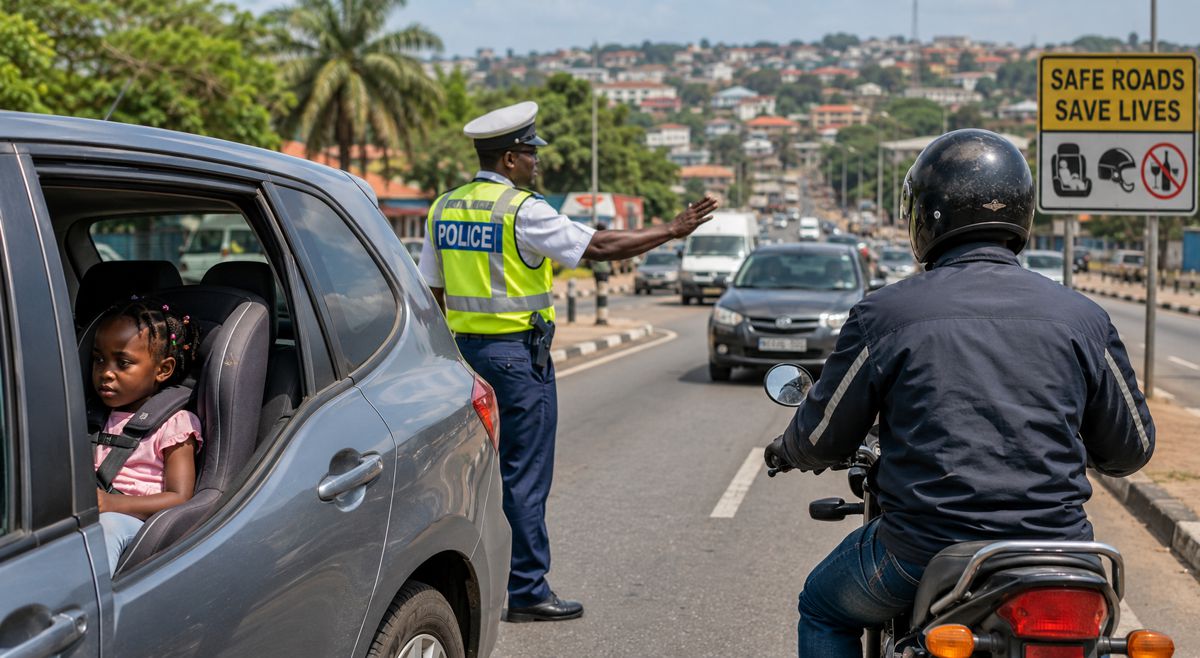
A Proposal for Stronger Collaboration among DVLA, MTTD, NIC and Other Road-Safety Stakeholders
Prepared as an expanded development of Advocate Ebenezer Forson’s proposal on the integration of the Driver and Vehicle Licensing Authority (DVLA), Motor Traffic and Transport Department (MTTD) and National Insurance Commission (NIC) to improve road safety, reduce fraudulent motor claims and encourage responsible driving in Ghana.

Introduction
Ghana’s road-safety challenge requires a coordinated response rather than isolated interventions. The DVLA holds critical information about drivers, licences, vehicles and registration; the MTTD has direct involvement in traffic enforcement and crash investigations; and the NIC oversees the insurance regulatory framework and motor-insurance information. Connecting these functions through secure, lawful data-sharing can create a stronger prevention, enforcement, underwriting and claims system.
📢 GET A DETAILED ARTICLES + JOBS
Join ASJ's WhatsApp Channel and never miss a post or opportunity.

The proposal is not simply to punish drivers. It is to create a system that rewards safe behaviour, identifies high-risk patterns early, improves enforcement, supports fair insurance pricing, reduces fraud and gives policymakers better evidence for road-safety decisions.
The numbers tell a stark story. According to the National Road Safety Authority (NRSA), road crash deaths in Ghana surged by 21.6% in the first half of 2025. Road crashes drain 1.6% of national GDP yearly, and families spend an average of US$1,687 on crash-related injuries. Ebenezer Forson, the architect of this proposal, has described the situation as so severe that “if road accidents were a disease, Ghana would declare a state of emergency”.

The Points-Based System
A national driver points framework could assign points for verified traffic offences and remove or reduce points over time where the driver demonstrates sustained compliance. Serious offences could attract more points, while less serious offences could attract fewer points. The rules should be published clearly so drivers understand how their records are affected.
The system should be linked to the driver’s unique licence record rather than relying only on the vehicle registration number. This distinction is important because a vehicle may change owners, while the driving behaviour of an individual remains relevant to that person’s risk profile.
Forson’s original proposal suggests a points structure such as:
| Offence Type | Points |
|---|---|
| Minor offences (e.g., slight speeding) | 1 point |
| Moderate offences (e.g., reckless overtaking) | 3 points |
| Major accidents due to negligence | 5 points |
Safe driving for 12+ months without violations reduces points.
Linking the Points System to Motor Insurance
With an appropriate legal and regulatory framework, the driver’s verified safety record could become one of several factors considered in motor-insurance risk assessment. It should not automatically determine a person’s premium. Instead, it could complement other factors such as vehicle type, usage, claims history, location, driving experience and other legitimate underwriting information.
The original proposal suggests the following risk categories:
| Points Range | Risk Category | Premium Impact |
|---|---|---|
| 0–2 points | Low-risk | Discounted premiums |
| 3–5 points | Moderate-risk | Standard premiums |
| 6+ points | High-risk | Higher premiums |
A responsible driver with a sustained record of compliance could potentially qualify for appropriate risk-based incentives where permitted by regulation. Conversely, repeated verified serious offences could indicate increased risk and encourage additional risk-management measures.
A Driver Safety Score
The points system could be converted into an understandable Driver Safety Score. The score could combine verified traffic behaviour, serious offences, crash involvement where responsibility has been established through due process, and periods of safe driving. The objective should be to make the system preventive and educational, not merely punitive.
Roles of the Key Institutions
DVLA
The DVLA can provide authoritative driver and vehicle information, including licensing, registration and roadworthiness-related records. Its 2025 Annual Report states that historical vehicle records from 1995 to 2024 were digitised and that the Authority has been strengthening data-driven road-safety management. This creates an important foundation for better inter-agency verification.

MTTD
The MTTD can provide verified enforcement and crash information, including relevant traffic offences and accident-report references. Digital capture of information at the scene can improve accuracy, timeliness and auditability.
NIC
The NIC can provide the regulatory and insurance perspective, including policy validation and appropriate use of motor-insurance information. This can help insurers distinguish legitimate risks and claims from inconsistent or fraudulent information.
Insurance Companies
Insurance companies can detect accident patterns through claims data, encourage behavior-based insurance, and refuse coverage to dangerous vehicles.
Digital Accident Verification
A digital accident-reporting process could give authorised MTTD officers the ability to capture essential information such as vehicle registration, driver identification, location, date and time, and the official accident reference. Once verified, selected information could be made available to authorised insurance users for legitimate claims processing.
The MTTD is already rolling out the iMAAP-RADMS accident reporting system, which allows officers to input accident details directly on-site for real-time data transfer to central servers — a vast improvement over the outdated paper-based system.
This can reduce delays caused by manual verification and make it more difficult for the same incident to be presented differently to different insurers.
Preventing Insurance Fraud
The integrated system could help identify duplicate claims, inconsistent driver information, mismatched vehicle ownership, questionable accident dates and other anomalies. It could also help insurers verify whether an alleged accident has an official record before significant claim payments are made.
Fraud prevention should remain evidence-based. A database flag should trigger further verification, not automatically mean that a claimant is guilty.
Real-Time Verification of Motor Insurance
Authorised enforcement personnel could use a secure digital verification service to establish whether a vehicle has valid insurance. This could complement physical and electronic proof of insurance and reduce opportunities for the use of false documents.
Linking Roadworthiness to Risk Management
Driver behaviour is only one part of road safety. Vehicle condition is another. The framework could therefore connect verified roadworthiness information with driver and insurance records. Vehicles with repeated safety-related failures could be directed toward appropriate inspection or corrective action.
Forson has noted that brake failures, worn-out tires, and mechanical problems contribute heavily to fatal crashes.
Rewarding Safe Driving
A successful points system should contain positive incentives. Drivers who maintain clean records over defined periods could receive recognition, educational benefits or, subject to approved insurance rules, risk-based incentives. The message should be that safe driving has measurable value.
Early-Warning and Predictive Road Safety
Aggregated data can be used to identify high-risk locations, times, vehicle categories and behavioural patterns. This would allow authorities to move from responding to crashes after they occur toward preventing crashes before they happen.
Accident Hotspot Mapping
Verified crash information can be mapped to identify dangerous intersections, highways, pedestrian crossings and other locations. Authorities can then investigate whether road design, lighting, signage, speed management or pedestrian facilities require improvement.
Fleet and Commercial Driver Management
The same framework could support commercial fleets. Companies could monitor authorised driver records, training requirements, vehicle roadworthiness and repeated violations. This is particularly relevant for buses, taxis, haulage companies and other high-mileage operations.
Driver Education and Rehabilitation
Accumulating points should not only result in sanctions. At appropriate thresholds, drivers could be directed toward approved refresher training, defensive-driving education or other rehabilitation measures. The objective would be to correct unsafe behaviour before it results in a serious crash.
Appeals and Data Accuracy
Because the system could affect licensing and insurance decisions, drivers should have a clear process to challenge incorrect records. There should be procedures for correcting data, reviewing disputed offences and removing records where legally required. This will strengthen public confidence.
Data Protection and Governance
Inter-agency integration must be supported by strong governance. Access should be limited to authorised users and legitimate purposes. The system should use appropriate security controls, audit trails, authentication, encryption and data-retention rules. Data sharing should operate within Ghana’s applicable laws and regulatory requirements.
Proposed Digital Triangle Plus Model
The original three-way concept can be expanded into a broader Digital Triangle Plus model:
| Institution | Role |
|---|---|
| DVLA | Driver, licence, vehicle and registration verification |
| MTTD | Traffic enforcement and verified crash information |
| NIC | Insurance verification, regulation and insurance-sector coordination |
| NRSA | Road-safety policy, education, research and coordination |
| Road agencies | Road condition, infrastructure and engineering interventions |
| Emergency services | Timely response and relevant crash-outcome information |
Implementation Roadmap
Phase 1 – Policy and Governance
Establish an inter-agency steering committee, define responsibilities, develop data-sharing rules and conduct legal and privacy assessments.
Phase 2 – Technical Design
Define common data fields, secure APIs or other approved interfaces, user-access controls and audit mechanisms.
Phase 3 – Pilot
Test the model in selected locations with a limited group of authorised users and measurable performance indicators.
Phase 4 – Evaluation
Assess accuracy, fraud detection, claims-processing time, enforcement outcomes, public feedback and data-security performance.
Phase 5 – National Rollout
Gradually extend the system nationwide after the pilot has demonstrated reliability and legal compliance.
Expected Benefits
| Benefit | Impact |
|---|---|
| Reduction in repeat dangerous-driving behaviour | Lives saved |
| Better identification of high-risk drivers and vehicles | Targeted interventions |
| Improved verification of motor-insurance status | Reduced fake insurance |
| Faster and more reliable claims verification | Efficient claims processing |
| Reduction in fraudulent and duplicate claims | Industry savings |
| Better evidence for insurance underwriting | Fairer premiums |
| Improved roadworthiness and enforcement monitoring | Safer vehicles |
| More targeted road-safety education and interventions | Behaviour change |
| Better identification of accident hotspots | Infrastructure improvements |
| Stronger public confidence through transparent information | Trust in the system |
Important Safeguards
The points system should not be designed as an automatic mechanism for increasing premiums or imposing sanctions without safeguards. Insurance pricing must remain subject to applicable law, regulation and sound actuarial and underwriting principles. Only verified information should be used, and drivers should have appropriate rights to review and challenge inaccurate information.
Conclusion
Advocate Ebenezer Forson’s points-based concept can be developed into a wider national road-safety and insurance-data framework. The central idea is to connect the strengths of DVLA, MTTD and NIC while bringing in NRSA, road agencies and emergency-response institutions where appropriate.
Ghana can move toward a system in which safe driving is recognised, serious and repeated violations are identified earlier, accident information is verified digitally, insurance fraud is reduced and road investment is guided by evidence. The ultimate goal should not be the creation of another database; it should be the creation of a coordinated national system that helps save lives.
Selected Supporting Sources
-
DVLA, 2025 Annual Report – road-safety management, digitisation and vehicle records
-
Ministry of Transport, 2026 Budget Programme – road-safety database, MTTD collaboration and the national road-safety objective
-
Ministry of Transport, March 2026 – technology-driven traffic enforcement and collaboration among road-safety institutions
-
Ghana News Agency, March 2026 – NRSA engagement with MTTD, DVLA and other stakeholders on reducing crashes
-
Ghana News Agency, August 2026 – MTTD/DVLA-related driver compliance and preventive road-safety collaboration
-
Previous publication by/for Advocate Ebenezer Forson on MTTD, DVLA and NIC digital integration
Source: Ebenezer Forson
Last Updated on August 27, 2026 by Samuel Kwame Boadu
Disclaimer: Some content on Accra Street Journal may be aggregated, summarized, or edited from third-party sources for informational purposes. Images and media are used under fair use or royalty-free licenses. Accra Street Journal is a subsidiary of SamBoad Publishing Hub under SamBoad Business Group Ltd, registered in Ghana since 2014.
For concerns or inquiries, please visit our Privacy Policy or Contact Page.

Samuel Kwame Boadu is a Ghanaian media entrepreneur and storyteller with a passion for amplifying urban voices and uncovering everyday truths. He is the Editor-in-Chief and Founder of Accra Street Journal, a dynamic digital platform dedicated to capturing the pulse of Ghana’s capital—its people, culture, challenges, business, sports and innovations.