










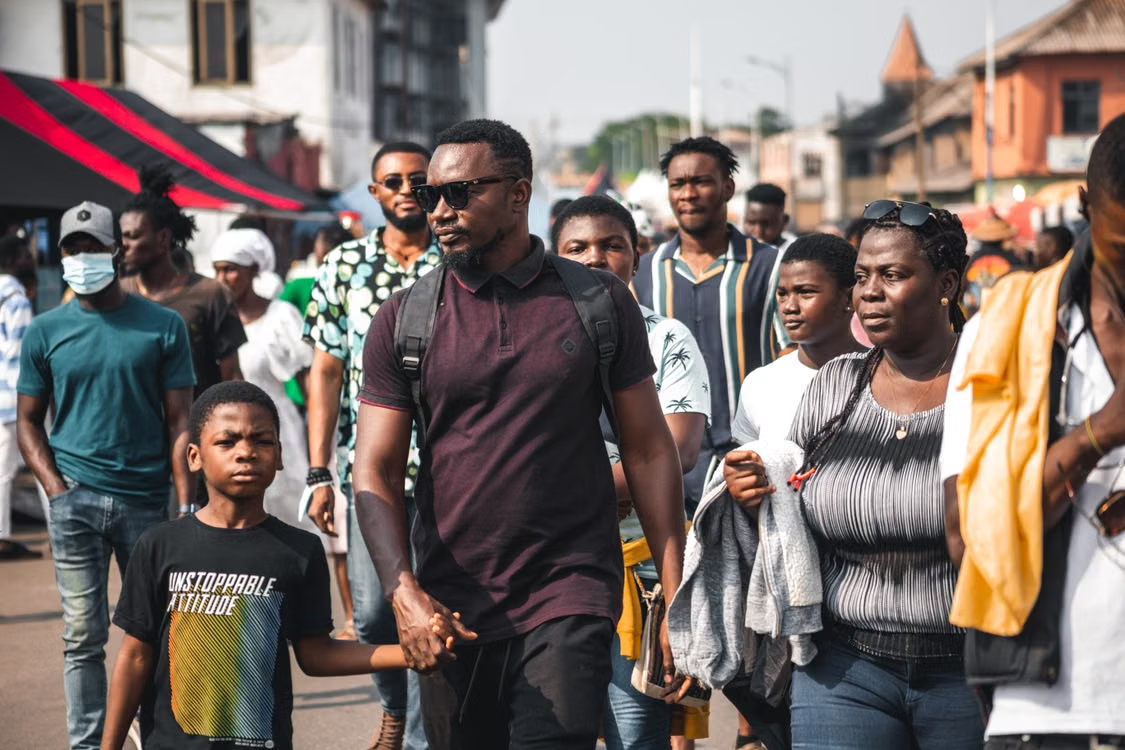
When state institutions fall short, communities step up. From Residents’ Associations building drains and negotiating with municipal authorities to youth-led movements cleaning gutters and greening public spaces, community groups have become indispensable actors in Accra’s urban governance. This ASJ article examines how these grassroots organisations are shaping the city.
Introduction: Filling the Gaps Left by the State
Accra’s rapid urbanisation has outpaced the capacity of state institutions to provide essential infrastructure and services. In peri-urban areas, where municipal presence is often delayed or limited, communities have organised themselves to fill the gaps .

These community groups—ranging from formal Residents’ Associations (RAs) to youth-led volunteer movements—are not just reacting to problems. They are proactively shaping their neighbourhoods through service provision, security arrangements, negotiation with authorities, and advocacy. This article explores the diverse roles these groups play and why they have become critical actors in Accra’s development.
📢 GET A DETAILED ARTICLES + JOBS
Join ASJ's WhatsApp Channel and never miss a post or opportunity.

Residents’ Associations: The New Urban Governors
The Rise of Neighbourhood Governance
Residents’ Associations have emerged in response to rapid urban expansion and the inability of municipal authorities to provide essential services . They have positioned themselves as critical actors in addressing development challenges, advocating for collective needs, and connecting residents with local governance structures .
In peri-urban Accra, these associations do far more than fill service gaps. Research has found that they are “proactive agents of transformation operating at the intersection of state and society” . Some have successfully negotiated for municipal zoning plans, secured access to utilities, and mediated the construction of roads, culverts, and drainage systems .

What Residents’ Associations Actually Do
Service Provision: Many RAs have collectively constructed culverts and police posts, installed streetlights and street signage, and facilitated access to potable water and electricity for households lacking these services .
Security: Community neighbourhood watch arrangements, often coordinated by RAs, patrol communities at night to reduce criminal activity and ensure safety .
Dispute Resolution: In areas affected by encroachments, land conflicts, and landguardism, RAs have instituted local dispute resolution mechanisms. They serve as trusted intermediaries between residents, landowners, municipal authorities, and security agencies .
Advocacy: Some RAs have moved from informal solidarity to structured governance, formally registering to increase their visibility and ability to negotiate with municipal officials and utility providers . Others have signed memoranda of understanding with local assemblies, effectively becoming co-governors of their neighbourhoods .
Financing Community Initiatives
Funding for these activities comes from membership dues, levies, voluntary labour, and community members’ benevolence . In one community, each household contributes to an annual levy specifically allocated for road maintenance and street lighting. Some RAs have adopted entrepreneurial strategies—one constructed a community hall, which it now rents out to generate revenue for ongoing interventions .
However, these collective efforts also reveal deep inequalities. Wealthier residents often dominate leadership roles and contribute more financially, shaping priorities in ways that can marginalise tenants and lower-income households .
Youth-Led Movements: Sanitation and Climate Action
Buz Stop Boys: Environmental Doctors
Perhaps the most visible community group in Accra is Buz Stop Boys, a volunteer organisation focused on environmental sanitation and community clean-up initiatives . Founded in 2023 by civil engineer Heneba Kwadwo Sarfo, the group started with a handful of volunteers and has grown into a movement of over 100 members .
Activities: Buz Stop Boys conducts regular clean-up exercises multiple times a week, clearing streets, gutters, and public spaces in parts of Greater Accra and other regions . They have been instrumental in restoring areas vulnerable to flooding due to poor sanitation, desilting clogged drains and gutters, and clearing overgrown grass . One of their success stories is eliminating the regular flooding cycle between Madina and Shiashie in Accra .
Recognition: The group has received high-profile support, including sanitation equipment from President John Dramani Mahama and a GH¢80,000 donation from President Mahama and dancehall star Shatta Wale for a waste compaction machine . They have won multiple awards, including the MTN Heroes of Change Sustainability and Transformation Award, and were named Changemaker of the Year at the 2025 YEN Entertainment Awards .

Broader Mission: Beyond environmental cleanliness, Buz Stop Boys promotes volunteerism, patriotism, and selflessness . Founder Heneba Kwadwo Safo has called for reintroducing environmental studies in school curricula and reviving traditional Ghanaian cultural practices that encourage environmental stewardship .
Let Love Lead NGO: Annual Sanitation Drives
Another significant community initiative is Let Love Lead NGO, which organised its 4th Annual Sanitation Drive in June 2026, bringing together close to 3,000 participants . The exercise focused on clearing waste from streets, drains, and public spaces, with a particular emphasis on flood prevention .
The initiative has grown into a significant civic event, with previous editions at Spintex and Kwame Nkrumah Circle. It has consistently involved survivors and victims of the June 3rd disaster, transforming remembrance into meaningful action .
Youth Climate Action Projects
The Accra Metropolitan Assembly, supported by Bloomberg Philanthropies, launched the Youth Climate Action Fund (YCAF) to advance youth-led climate resilience and greening initiatives . Projects include:
-
The ‘Apata’ Initiative at Accra Academy: Youth-driven project featuring cooling sheds constructed from reusable materials to provide relief from high temperatures .
-
Tree Guardians Project in Jamestown: Implemented by Green Stewards, designed to promote environmental restoration and community pride .
-
Community green park at Mamprobi: An open space being converted into a park to provide shade, seating, and promote social interaction .
Mayor Michael Kpakpo Allotey commended the youth groups for their dedication, describing their work as “a practical solution to one of the biggest challenges facing Accra’s extreme heat” .
Community Development Associations: Power and Advocacy
The Glefe Experience
The Glefe Community Development Association provides a powerful example of community groups using collective action to pressure state and corporate actors . The association has:
-
Mobilised the community for development and pressured the state to provide urban infrastructure and municipal services .
-
Engaged with Panbros Salt Manufacturing Limited to secure commitments for skip pads and access roads to refuse collection sites .
-
Negotiated with the Accra Metropolitan Assembly for drainage improvements after threats of demonstrations .
A standoff continues with Panbros Salt Manufacturing Limited over re-engineering the Gyatakpo estuary to minimise flooding—a classic case of “multiple realities of actors” where community knowledge and corporate goals conflict .
Leveraging Subordinate Power
The research reveals a “dialectics of control” where subordinate groups can influence more powerful actors . Residents of Old Fadama and Agbogbloshie, from their subordinate position, used discursive means to overturn the state’s decision to evict them forcefully, even after a high court refused their application for an injunction . This demonstrates how community associations can “manipulate” the Mayor of Accra and other authorities to provide services .
The “Shifting the Power” Strategy: Strengthening Civil Society
In December 2025, a new regional strategy was launched in Accra to reinforce civil society leadership and promote stronger local ownership of development initiatives . The “Shifting the Power” programme brings together partners from Ghana, Malawi, and Zambia to strengthen the autonomy, resilience, and long-term impact of civic actors .
Minister for Gender, Children and Social Protection, Agnes Naa Momo Lartey, emphasised “the urgent need to shift meaningful decision-making power to local organisations,” noting that strong, well-resourced civil society institutions are essential for inclusive development and the safeguarding of vulnerable populations .
President John Dramani Mahama has also affirmed the government’s commitment to working closely with civil society organisations, stating that “this government does not regard civil society as an adversary. We regard civil society as a strategic partner in nation-building” .

The Challenges: Funding, Trust, and Participation Fatigue
Funding Sustainability
The STAR-Ghana Foundation has noted that funding reductions from development partners threaten the sustainability of civil society work . The Executive Director has called for state funding rather than government funding to support civil society activities, as state-led financing would promote independence and prevent political influence .
The “Yes-Man Syndrome”
Research on participatory slum upgrading in Accra has identified a “yes-man syndrome” where residents fear to voice disagreements because they worry that contestations could cause international funders to pull out of projects . This is particularly acute in World Bank-funded projects, where residents feel the funder possesses the ultimate power to set the agenda and make decisions .
Participation Fatigue
Many residents expressed fatigue with participatory processes, citing project delays, high opportunity costs, and the everyday politics of engagement . The research recommends practical solutions: shortening meetings, providing transportation, conducting pop-up engagements at market centres, and offering modest remuneration to local committees .
The Gap Between State and Community
There is often a lack of trust between poor urban communities and the metropolitan assembly . Formal flood management structures in Accra do not lend themselves to social learning and cooperative governance . As one study noted, “an inadequate understanding of conditions on the ground can render invisible not only vulnerability, but even entire categories of people at risk, thereby exacerbating policy failure rather than reducing disaster risk” .
ASJ Conclusion
Community groups in Accra have become indispensable actors in urban governance. From Residents’ Associations building infrastructure and mediating disputes to youth movements cleaning drains and planting trees, these grassroots organisations are stepping in where the state has been unable to keep pace with urban growth.
The role of community groups extends beyond service delivery. They are reshaping citizenship and governance, forging new relationships with municipal authorities, and creating spaces for collective action. As the Buz Stop Boys founder said: “Without the environment, there is no us, our purpose, or the fact that we are walking around and feeling human” .
The challenge for policymakers is to move beyond viewing community groups as temporary gap-fillers and instead recognise them as strategic partners in urban development—a vision supported by both the President and civil society leaders . The ultimate goal is not the creation of another database or formal structure, but the creation of a coordinated system that recognises and harnesses the power of community action .
Quick Facts
| Topic | Details |
|---|---|
| Buz Stop Boys Founded | 2023, started with 7 volunteers, now over 100 members |
| Buz Stop Boys Activities | Multiple weekly clean-ups across Greater Accra, Kumasi, Cape Coast, Tamale |
| Let Love Lead Sanitation Drive (2026) | 3,000 participants, Nima-Mamobi area |
| President’s Support for Buz Stop Boys | Donated sanitation equipment; GH¢80,000 for compaction machine |
| YCAF Projects | Apata Initiative, Tree Guardians, Mamprobi green park |
| Residents’ Associations | Active in peri-urban Accra, negotiate with municipal authorities |
Frequently Asked Questions
1. Why are community groups important in Accra?
Community groups fill gaps left by state institutions, providing services, security, advocacy, and infrastructure in areas where municipal presence is limited .
2. What are Residents’ Associations and what do they do?
They are community organisations that negotiate access to basic services, manage land disputes, improve infrastructure, and foster social cohesion in peri-urban Accra. Some have successfully influenced municipal planning .
3. What is Buz Stop Boys?
Buz Stop Boys is a youth-led volunteer organisation focused on environmental sanitation and community clean-up initiatives. Founded in 2023, it now has over 100 volunteers and has received presidential recognition .
4. What are the YCAF projects in Accra?
The Youth Climate Action Fund supports youth-led climate resilience projects including cooling sheds at Accra Academy, the Tree Guardians Project in Jamestown, and a community green park at Mamprobi .
5. What is the “Shifting the Power” strategy?
A regional programme launched in Accra to strengthen civil society leadership and local ownership of development initiatives across Ghana, Malawi, and Zambia .
6. What challenges do community groups face?
Challenges include funding sustainability, the “yes-man syndrome” in internationally funded projects where residents fear contestation, participation fatigue, and lack of trust between communities and state institutions
Source: Accra Street Journal
Last Updated on September 1, 2026 by Samuel Kwame Boadu
Disclaimer: Some content on Accra Street Journal may be aggregated, summarized, or edited from third-party sources for informational purposes. Images and media are used under fair use or royalty-free licenses. Accra Street Journal is a subsidiary of SamBoad Publishing Hub under SamBoad Business Group Ltd, registered in Ghana since 2014.
For concerns or inquiries, please visit our Privacy Policy or Contact Page.

Samuel Kwame Boadu is a Ghanaian media entrepreneur and storyteller with a passion for amplifying urban voices and uncovering everyday truths. He is the Editor-in-Chief and Founder of Accra Street Journal, a dynamic digital platform dedicated to capturing the pulse of Ghana’s capital—its people, culture, challenges, business, sports and innovations.





