




14 min read
Introduction
Ghana’s agricultural sector employs more people than any other industry. It contributes roughly 21 percent to the country’s GDP and supports the livelihoods of millions of households, especially in rural areas . When people talk about the Ghanaian economy, agriculture is always part of the conversation.
But here is the problem. For decades, agriculture in Ghana has been treated more as a way of life than a business. Farmers grow what they can, sell at whatever price the market offers, and hope for the best. Many of them cannot access credit. Many lose a chunk of their harvest after the farm gate because of poor storage and bad roads. And many young people see farming as a last resort, not a career.
Key Takeaways
- The country fell short by about 181,000 tonnes, achieving only 94 percent self-sufficiency .
- Ghana produced 961,000 tonnes against demand of over 2 million tonnes, achieving just 48 percent self-sufficiency .
- Ghana spends over $3 billion every year importing food, mostly rice, poultry, and processed products .
This is changing, slowly. The government has launched ambitious programmes. The World Bank and other partners are putting serious money behind agricultural reform. And a new generation of agribusiness entrepreneurs is starting to see opportunity where their parents saw struggle.
This article looks at the business side of agriculture in Ghana. It explains how the sector works, where the money is, what the government is doing, the real challenges farmers and agribusinesses face, and why agriculture matters to every Ghanaian who eats food or earns a living.
Background: From Cocoa to Cassava
Ghana’s agricultural story is often told through cocoa. For decades, cocoa was the backbone of the economy. It brought in foreign exchange, supported hundreds of thousands of farmers, and gave Ghana a name on the world market. Cocoa still matters. It earns about $2 billion a year in export revenue .
But Ghana’s agriculture is much bigger than cocoa. The crops sub-sector alone contributes an average of 15.8 percent to national GDP . Cassava, yam, plantain, maize, and rice are the staples that feed the country. Cassava production reached over 21 million metric tonnes in 2025, and yam production hit nearly 10.9 million tonnes . These are huge numbers.
Yet production does not always translate into food security or wealth. In 2025, Ghana produced 2.77 million tonnes of maize, but demand was 2.96 million tonnes. The country fell short by about 181,000 tonnes, achieving only 94 percent self-sufficiency . Rice is worse. Ghana produced 961,000 tonnes against demand of over 2 million tonnes, achieving just 48 percent self-sufficiency . That gap is filled with imports.
The food import bill tells the story. Ghana spends over $3 billion every year importing food, mostly rice, poultry, and processed products . This is money that could be circulating in the local economy, supporting Ghanaian farmers and processors.
The sector has also been volatile. After growing by 8.4 percent in 2021, agricultural growth fell to 2.8 percent in 2024, partly due to dry spells that cut crop yields by at least 20 percent in some areas . This vulnerability to weather and global shocks is a constant reminder that Ghana’s agriculture is not yet resilient.
How the Business of Agriculture Works
Agriculture is not one business. It is a chain of businesses, from the farmer to the consumer. Understanding this chain is key to understanding where the money is and where it gets lost.

At the farm level, smallholder farmers produce most of Ghana’s food. They buy seeds, fertiliser, and other inputs. They labour on the land. They harvest. And then they sell. The problem is that many farmers sell at the farm gate to middlemen, often at low prices, because they lack storage, transport, or direct access to markets. Post-harvest losses can reach as high as 30 percent of output . That is food grown, paid for, and then wasted before it reaches a plate.
In the middle, there are aggregators, transporters, and processors. Aggregators buy from farmers and sell to traders or processors. Transporters move goods from farm to market. Processors turn raw produce into flour, oil, juice, feed, or other products. This is where value is added and where jobs are created. But Ghana’s processing capacity is limited. Much of the country’s cashew, for example, is exported raw and processed elsewhere. The government wants to change this, targeting 50 to 60 percent local processing of tree crops .

At the end, there are wholesalers, retailers, and consumers. Ghanaians buy food in markets, supermarkets, and increasingly online. The price consumers pay reflects all the costs along the chain: inputs, labour, transport, storage, processing, and margins.
Who pays? Ultimately, consumers pay. But everyone in the chain takes a cut. The farmer’s share is often the smallest, which is why many farmers remain poor despite producing the food the country eats.
How does the money flow? Farmers earn from selling produce. Aggregators earn from buying low and selling higher. Processors earn from adding value. Transporters earn from moving goods. Retailers earn from selling to consumers. Banks and input dealers earn from financing and supplying the chain. When any part of the chain breaks — a bad road, a lack of storage, a delay in payment — everyone loses.
What the Government Is Doing
The government has not been sitting still. Several major initiatives are underway, and they are worth understanding because they will shape the sector for years to come.
Feed Ghana Programme. This is the government’s flagship agricultural programme. It focuses on improving access to seeds, expanding irrigation, providing mechanisation support, building post-harvest infrastructure, and supporting agro-processing . The idea is to boost domestic food production and reduce dependence on imports.
AgriConnect Compact. Launched in 2026 with support from the World Bank, this is a national framework to strengthen food security, create jobs, and mobilise investment. It prioritises cocoa, oil palm, rice, maize, and poultry. In its first phase (2026–2030), it aims to improve food and nutrition security for nearly 3 million people and support the creation of over 2.6 million jobs by 2035. The financing needed is estimated at $3.5 billion, from government, development partners, and the private sector .
Tree Crop Development. President Mahama has set an ambitious target: $2 billion in annual export earnings from each of six priority tree crops by 2035 — cashew, coconut, oil palm, rubber, mango, and shea. That would total $12 billion. The government has also said it will stop exporting raw cashew, shea, and unprocessed rubber, and instead process them locally .
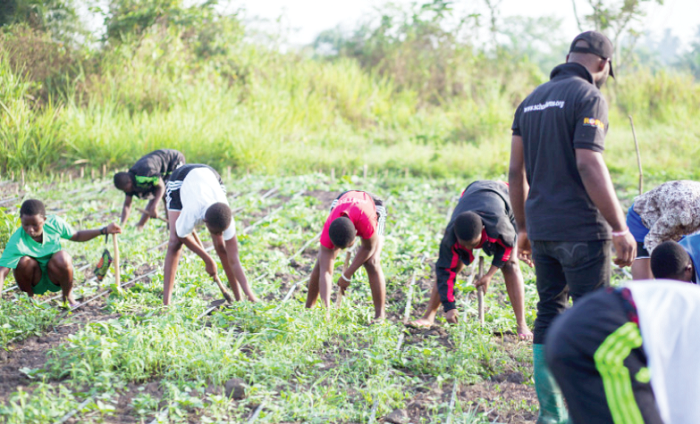
Youth in Agriculture. Programmes like the Youth Agriculture Estate Initiative aim to provide salaried employment for young people in commercial farming. The target is 16,000 youth across 100,000 acres, with training, machinery, and regular income . There are similar initiatives for aquaculture, poultry, and cocoa.
Financing. A $1 million revolving fund has been set up to provide low-interest loans to value chain actors in northern Ghana. A $20 million Agro-Input Distribution Project is targeting 50,000 farming households, with a focus on women and youth .
These programmes are ambitious. Whether they deliver depends on implementation, funding, and coordination. The IFPRI has noted that Ghana’s public investment in agriculture has consistently fallen short of continental commitments. It recommends raising agrifood spending from about 2 percent to 10 percent of the national budget, which could increase agrifood GDP by about 67 percent by 2035.

The Real Challenges
The government’s plans sound good on paper. But the challenges on the ground are real and stubborn.
Low productivity. Ghanaian farmers, especially smallholders, produce less per hectare than they could. This is due to limited use of improved seeds, fertiliser, and modern techniques. The Ministry of Food and Agriculture’s own assessment lists “low application of technology” and “low transfer of research findings” as major problems .
Access to land. Land tenure in Ghana is complicated. Many farmers do not have secure title to the land they work. This makes it hard to invest, borrow against land, or expand. The UN has warned that Ghana’s dual land tenure system leaves rural communities vulnerable to displacement .
Post-harvest losses. Losing up to 30 percent of what you produce is not just wasteful. It is an economic wound. It means the farmer’s investment of money, labour, and time is partly lost. It means less food available. It means higher prices for consumers.
Market access. Farmers often cannot sell what they produce at a fair price. The National Seed Trade Association of Ghana has warned that difficulties in selling farm produce are weakening farmers’ ability to recover investments and repay loans. One seed company reportedly sold seeds worth over GH¢7 million for less than GH¢1 million . When farmers cannot sell, the whole chain suffers.
Climate change. Erratic rainfall, drought, and flooding are making farming riskier. The 2024 dry spell cut yields significantly . Climate-smart agriculture is not a luxury; it is a necessity.
Financing. Agriculture is seen as risky by banks. Many farmers and agribusinesses cannot access credit at reasonable rates. The lack of insurance for smallholders makes it worse. Without finance, farmers cannot invest in inputs, equipment, or expansion.
Youth disinterest. The average farmer is ageing. Young people do not see farming as attractive, partly because it is associated with poverty and hard labour without reliable income. Until agriculture becomes a profitable business, young people will continue to look elsewhere.
Galamsey. Illegal mining is destroying farmland and polluting water bodies. The UN has described it as a rapidly expanding crisis that extends beyond mining areas . This is not just an environmental problem. It is an agricultural problem. Land that could grow food is being poisoned.
Why It Matters to Ordinary Ghanaians
Agriculture is not an abstract sector. It touches every Ghanaian every day.
Food prices. When farmers produce more and lose less, food becomes more affordable. When imports dominate, prices are tied to the dollar and global markets. Ghana’s rice import bill is a direct reason why rice prices are sensitive to exchange rate movements. Reducing imports and boosting local production would help stabilise prices.
Jobs. Agriculture employs about 38 percent of the population . But most of these are smallholder farmers, not salaried workers. The real opportunity is in agribusiness: processing, logistics, packaging, marketing, and finance. When a tomato processing factory opens in a rural town, it creates jobs for factory workers, truck drivers, and farmers who now have a reliable buyer.
Incomes. When farmers earn more, they spend more in their communities. They can pay school fees, buy medicine, and support local businesses. A thriving agricultural economy lifts rural incomes, which reduces poverty and slows migration to the cities.
Nutrition. Ghana produces enough calories overall, but not enough of the right kinds of food. Five of nine monitored crops achieved self-sufficiency in 2025, but rice and maize still fell short . Poor nutrition affects children’s development and adults’ productivity. A stronger agricultural sector can produce more diverse, nutritious food.
Foreign exchange. Cocoa and other agricultural exports bring dollars into Ghana. When exports grow, the cedi is stronger. When imports of food are high, dollars leave the country. Strengthening agriculture reduces the pressure on the currency.
The future of young people. About 160,000 young people enter the labour market each year . Agriculture and agribusiness can absorb many of them, but only if the sector is modernised and made profitable. If it is not, they will continue to leave the land, or the country.
Future Outlook
The direction of Ghana’s agriculture is becoming clearer. The question is speed and execution.
If current plans are implemented well, Ghana could significantly reduce its food import bill. Rice and poultry are the biggest targets. Local processing of tree crops could create jobs and increase export earnings. Youth programmes could bring new energy into the sector. The AgriConnect Compact could mobilise private capital at a scale not seen before.
The risks are equally clear. If funding does not materialise, if coordination between ministries is weak, if corruption diverts resources, or if climate shocks hit hard, the plans will fall short. The IFPRI has warned that without sufficient investment and systems thinking, key targets will be missed .
The most likely scenario is gradual progress. Some programmes will work. Others will underperform. The tree crop push may yield results because it has clear targets and private sector interest. Rice and poultry may improve slowly, but imports will continue for years. Youth programmes will create some jobs, but not enough to transform the labour market overnight.
The wild card is the private sector. If agribusinesses see real opportunity and invest, they can move faster than government programmes. A processing plant built by a private company creates jobs immediately. A contract farming scheme linking a buyer to hundreds of farmers can transform a value chain. Government can enable this, but the private sector must lead.
ASJ Conclusion
Ghana has the land, the labour, and the growing domestic market to feed itself and export to neighbours. It has the policies and the partners. What it has lacked is the consistent execution that turns plans into harvests, profits, and jobs.
The business of agriculture is not just about growing more food. It is about growing it profitably, processing it locally, storing it properly, transporting it efficiently, and selling it at a fair price. It is about making farming a career that young people want. It is about making sure that the money spent on food stays in Ghana, circulating through the economy, rather than flying out to pay for imports.
For ordinary Ghanaians, this matters because food is life. When agriculture works, food is affordable, jobs exist, and the economy is stronger. When it does not, everyone feels it.
Ghana’s agricultural potential is real. Unlocking it requires more than speeches and programmes. It requires investment, discipline, and a shift in how the country thinks about farming — not as a way of life, but as a business.
Quick Facts
Topic: The Business of Agriculture in Ghana
Contribution to GDP: ~21% (2025)
Employment: ~38% of population
Cocoa Export Revenue: ~$2 billion annually
**Food Import Bill:** Over $3 billion annually
2025 Maize Production: 2.77 million tonnes (94% self-sufficient)
2025 Rice Production: 961,011 tonnes (48% self-sufficient)
Post-Harvest Losses: Up to 30% of output
Key Export Crops: Cocoa, cashew, shea, oil palm, rubber, mango
Key Government Programmes: Feed Ghana, AgriConnect Compact, Youth in Agriculture
Major Challenge: Low productivity, market access, climate risk
Target: $12 billion annual tree crop exports by 2035
FAQ Section
1. How important is agriculture to Ghana’s economy?
Agriculture contributes about 21% of GDP and employs roughly 38% of the population. It is the second-largest employer and a key source of export earnings .
2. Why does Ghana import so much food?
Ghana does not produce enough of certain staples, especially rice and poultry. Rice self-sufficiency is only about 48%, meaning more than half of what Ghanaians eat is imported . Poor storage and processing also limit local supply.
3. What is the Feed Ghana Programme?
It is the government’s flagship agricultural programme aimed at boosting domestic food production through improved seeds, irrigation, mechanisation, and post-harvest infrastructure .
4. What is the AgriConnect Compact?
A national framework supported by the World Bank to strengthen food security, create jobs, and reduce imports. It targets $3.5 billion in financing and aims to create over 2.6 million jobs by 2035 .
5. What crops does Ghana export?
Cocoa is the biggest. Others include cashew, shea, oil palm, rubber, mango, coconut, and pineapple. The government wants to increase local processing before export .
6. Why is post-harvest loss a problem?
Up to 30% of food produced is lost after harvest due to poor storage, bad roads, and inadequate processing. This wastes the farmer’s investment and reduces food available .
7. Can young people make money in agriculture?
Yes, but mainly in agribusiness — processing, marketing, logistics, and services — rather than subsistence farming. Government programmes are trying to make commercial farming attractive to youth .
8. What is galamsey doing to agriculture?
Illegal mining is destroying farmland and polluting water sources used for irrigation. The UN has described it as a crisis affecting rural communities .
9. How does agriculture affect food prices in Ghana?
When local production is strong and losses are low, food is more affordable. When imports dominate, prices are tied to the dollar and global markets. Transport and storage costs also affect prices.
10. What is Ghana doing to process more food locally?
The government has set targets for local processing of tree crops and is providing matching grants to processors. The goal is to stop exporting raw materials and importing finished products .
11. Is farming profitable in Ghana?
It can be, but many smallholders struggle due to low yields, high input costs, and poor market access. Commercial farming and agribusiness have higher profit potential.
12. What is the biggest challenge facing Ghana’s agriculture?
There is no single challenge. Low productivity, post-harvest losses, limited financing, climate change, and market access all hold the sector back. Fixing one without the others will not transform the sector.
Source: Accra Street Journal
Last Updated on November 20, 2026 by Samuel Kwame Boadu
Disclaimer: Some content on Accra Street Journal may be aggregated, summarized, or edited from third-party sources for informational purposes. Images and media are used under fair use or royalty-free licenses. Accra Street Journal is a subsidiary of SamBoad Publishing Hub under SamBoad Business Group Ltd, registered in Ghana since 2014.
For concerns or inquiries, please visit our Privacy Policy or Contact Page.

Samuel Kwame Boadu is a Ghanaian media entrepreneur and storyteller with a passion for amplifying urban voices and uncovering everyday truths. He is the Editor-in-Chief and Founder of Accra Street Journal, a dynamic digital platform dedicated to capturing the pulse of Ghana’s capital—its people, culture, challenges, business, sports and innovations.
Use the following reference when citing or referencing this article.
Your feedback helps us improve our journalism.
Report an Error
Help us maintain accuracy. Let our editorial team know if you spot an issue in this article.
Report a problem with this article