
4 min read
Ghana is planning dedicated fish markets in Accra and Dambai to improve preservation, reduce post-harvest losses and strengthen the commercial link between inland fishing communities and urban buyers, as the country confronts an annual fish supply deficit of about 500,000 metric tonnes.
Ghana’s annual fish supply deficit of about 500,000 metric tonnes is raising the stakes for investment in inland fisheries infrastructure, with Government planning dedicated fish markets in Accra and Dambai to improve storage, handling and distribution.
Key Takeaways
- Beyond providing trading spaces, the projects are intended to improve fish preservation, reduce post-harvest losses and increase the incomes of people operating along the fisheries value chain.
- Vice President Professor Jane Naana Opoku-Agyemang announced the plans at the National Inland Fisheries Conference held at Fiapre, near Sunyani, as part of activities marking the 2026 World Fisheries Day.
- She said the country needed additional support to close existing gaps in inland fisheries and aquaculture production and address the domestic fish supply deficit, estimated at approximately 500,000 metric tonnes annually.
The proposed facilities are expected to strengthen the commercial link between fishing communities and urban markets, particularly for traders transporting catches from the Volta Lake and other inland fishing areas.
Beyond providing trading spaces, the projects are intended to improve fish preservation, reduce post-harvest losses and increase the incomes of people operating along the fisheries value chain.
The Announcement
Vice President Professor Jane Naana Opoku-Agyemang announced the plans at the National Inland Fisheries Conference held at Fiapre, near Sunyani, as part of activities marking the 2026 World Fisheries Day.
She said the markets, particularly the proposed facility at Dambai in the Oti Region, would improve fish handling, hygiene, storage, landing and trading conditions.
The investments form part of a broader Government commitment to transform fishing landing sites into integrated facilities equipped with improved landing infrastructure, fish-holding facilities and processing centres.
The Ministry’s Plan
The announcement comes as the Ministry of Fisheries and Aquaculture seeks to address structural weaknesses in Ghana’s fisheries supply chain while expanding domestic fish production.
Madam Emelia Arthur, Minister of Fisheries and Aquaculture, said the Ministry was developing a fishing village infrastructure project that would incorporate landing sites and fish markets.
She said the country needed additional support to close existing gaps in inland fisheries and aquaculture production and address the domestic fish supply deficit, estimated at approximately 500,000 metric tonnes annually.

The supply gap highlights the importance of improving not only fish production but also the infrastructure required to preserve and distribute available catches.
The Post-Harvest Loss Problem
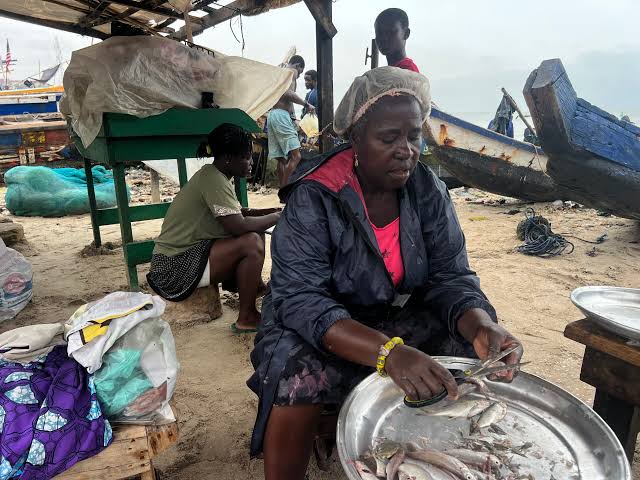
For traders, inadequate storage and handling facilities can result in spoilage, reduced product quality and losses before fish reaches consumers.

Women, who play a significant role in fish processing and trading, are expected to benefit from improved preservation and marketing opportunities under the proposed projects.
The gendered dimension is not incidental. Fish processing and trading in Ghana — particularly smoking, drying and market distribution — is overwhelmingly female-dominated and largely informal. Improvements in cold storage and hygienic handling facilities therefore translate directly into income gains for a segment of the workforce with limited access to capital for private infrastructure.
The Sustainability Caveat
Professor Opoku-Agyemang said infrastructure investments must be accompanied by sustainable management of the water bodies supporting inland fisheries.
She called for stronger enforcement of fisheries regulations and closer coordination among institutions responsible for fisheries, water resources and environmental protection.
That warning addresses a well-documented tension: expanding catch capacity in inland waters that are already overfished or subject to illegal methods would accelerate depletion rather than close the supply gap. Infrastructure that improves preservation without corresponding catch regulation can simply make the extraction of a declining resource more efficient.
The Conference
The conference was jointly organised by the Ministry of Fisheries and Aquaculture and the University of Energy and Natural Resources (UENR) under the theme “Sustaining Inland Fisheries for Food Security, Decent Jobs and a Resilient Blue Economy.”
Sixteen regional best fish farmers, four national best fish farmers and two Fisheries Extension Officers from the Northern and Southern zones were also honoured for their contributions to the development of the sector.
Quick Facts
Ghana faces an annual fish supply deficit of about 500,000 metric tonnes, and Government plans dedicated fish markets in Accra and Dambai to improve preservation, storage, handling and distribution, announced by Vice President Professor Jane Naana Opoku-Agyemang at the National Inland Fisheries Conference in Fiapre, near Sunyani, marking 2026 World Fisheries Day.
Fisheries Minister Madam Emelia Arthur said the Ministry is developing a fishing village infrastructure project incorporating landing sites and fish markets, with the Dambai facility in the Oti Region intended to improve handling, hygiene, storage and trading conditions.
The projects aim to reduce post-harvest losses, support women in fish processing and trading, and strengthen links between Volta Lake fishing communities and urban markets, with the Vice President calling for sustainable water body management, stronger fisheries enforcement and coordination with water resources and environmental protection agencies.

The conference was organised by the Ministry of Fisheries and Aquaculture and UENR under the theme “Sustaining Inland Fisheries for Food Security, Decent Jobs and a Resilient Blue Economy,” with 16 regional and 4 national best fish farmers<span class=””> and two Fisheries Extension Officers honoured.
Source: Accra Street Journal
Last Updated on November 23, 2026 by Samuel Kwame Boadu
Disclaimer: Some content on Accra Street Journal may be aggregated, summarized, or edited from third-party sources for informational purposes. Images and media are used under fair use or royalty-free licenses. Accra Street Journal is a subsidiary of SamBoad Publishing Hub under SamBoad Business Group Ltd, registered in Ghana since 2014.
For concerns or inquiries, please visit our Privacy Policy or Contact Page.

Samuel Kwame Boadu is a Ghanaian media entrepreneur and storyteller with a passion for amplifying urban voices and uncovering everyday truths. He is the Editor-in-Chief and Founder of Accra Street Journal, a dynamic digital platform dedicated to capturing the pulse of Ghana’s capital—its people, culture, challenges, business, sports and innovations.
Use the following reference when citing or referencing this article.
Your feedback helps us improve our journalism.
Report an Error
Help us maintain accuracy. Let our editorial team know if you spot an issue in this article.
Report a problem with this article