
11 min read
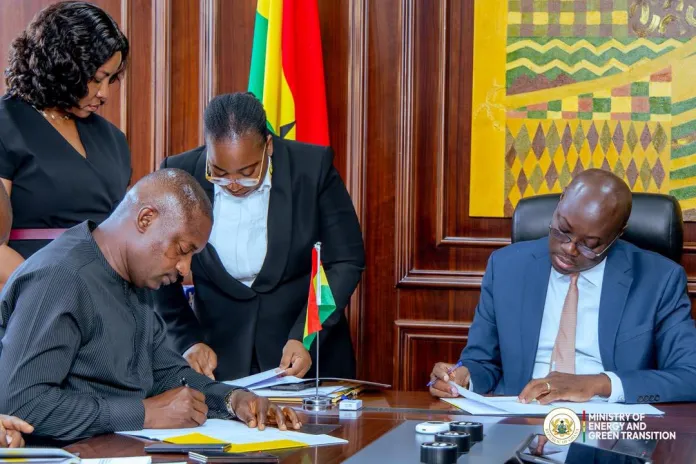
Ghana has signed a landmark agreement with Eni and its partners in the Offshore Cape Three Points (OCTP) project to increase domestic gas supply by approximately 30%, from current production of 270 million cubic feet per day (MMcfd) to a target of 350 MMcfd by 2028. The deal, covering the Sankofa and Gye Nyame fields, represents a strategic effort to strengthen energy security, support power generation, and reduce the country’s reliance on imported fuels—a vulnerability that has been starkly exposed by the recent Hormuz crisis and sustained high oil prices above $110 per barrel.
The expansion will be driven by further development of the Gye Nyame field and upgrades to gas processing and compression systems on the John Agyekum Kufuor floating production, storage and offloading (FPSO) vessel, which serves as the offshore hub linking the fields to the onshore gas network. Energy Minister John Abdulai Jinapor said the agreement signals continued investor confidence in Ghana’s upstream petroleum sector and reinforces the country’s commitment to a stable investment environment—a notable statement given the fiscal pressures and regulatory uncertainties that have characterized the sector in recent years.
Key Takeaways
- Once completed, the expansion is expected to strengthen Ghana's domestic gas availability, which is critical for electricity production and for reducing exposure to volatile global oil markets.
- Additional domestic gas reduces the need to import diesel and heavy fuel oil for thermal power plants, which are expensive and subject to global price volatility.
- Ghana's power generation mix includes hydro (Akosombo, Kpong), thermal (gas, diesel, heavy fuel oil), and a small but growing share of renewables (solar, biomass).
The OCTP block is operated by Eni with a 44.4% stake, alongside Vitol with 35.6%, and the Ghana National Petroleum Corporation (GNPC) holding 20%. Once completed, the expansion is expected to strengthen Ghana’s domestic gas availability, which is critical for electricity production and for reducing exposure to volatile global oil markets. For a country where gas already accounts for a significant share of power generation fuel, the additional 80 MMcfd could displace diesel and heavy fuel oil imports, saving foreign exchange and stabilizing electricity tariffs.
Key Developments: The Agreement, the Fields, and the Infrastructure
The OCTP project has been a cornerstone of Ghana’s gas strategy since production began in 2018. Initially, gas output stood at 210 MMcfd, rising to 270 MMcfd following earlier upgrades. The new agreement targets an additional 80 MMcfd by 2028, bringing total capacity to 350 MMcfd—a 30% increase from current levels and a 67% increase from initial production.
The expansion will focus on the Gye Nyame field, which has been less extensively developed than the Sankofa field. Additional wells will be drilled, and subsea infrastructure will be extended. Critically, the agreement includes upgrades to gas processing and compression systems on the FPSO, which are necessary to handle the increased volumes and maintain pressure in the reservoir.
The agreement establishes a framework of commercial principles to support the development of new gas infrastructure while ensuring stability in supply to the domestic market. This is a non-trivial achievement: gas pricing and volume commitments have been points of contention between the government and operators in the past. The framework provides certainty for Eni and Vitol to invest in the expansion, knowing that there will be a market for the additional gas at a predictable price.
The timing of the agreement is significant. Ghana’s power sector has been under strain due to transmission infrastructure weaknesses (highlighted by the Akosombo substation fire) and rising fuel costs. Additional domestic gas reduces the need to import diesel and heavy fuel oil for thermal power plants, which are expensive and subject to global price volatility. At current oil prices above $110 per barrel, the savings from displacing imported fuels are substantial.
The involvement of the GNPC as a 20% equity holder is also notable. The state-owned oil company has been under financial pressure, but its participation in the OCTP expansion ensures that Ghana captures a share of the upside. The Petroleum Commission, which regulates the sector, said the agreement establishes a framework of commercial principles to support the development of new gas infrastructure while ensuring stability in supply to the domestic market.
Energy Minister John Abdulai Jinapor emphasized that the deal signals continued investor confidence in Ghana’s upstream petroleum sector. This is a message aimed at both domestic and international audiences. Domestically, it reassures stakeholders that the government can negotiate commercially viable terms with international oil companies. Internationally, it signals that Ghana remains open for business despite the recent debt restructuring and fiscal challenges.
Analysis & Implications: Energy Security, Import Substitution, and Industrial Growth
The expansion of gas output from Sankofa and Gye Nyame has three interconnected benefits: improving energy security, reducing import dependence, and supporting industrial growth.
Energy security is the most immediate benefit. Ghana’s power generation mix includes hydro (Akosombo, Kpong), thermal (gas, diesel, heavy fuel oil), and a small but growing share of renewables (solar, biomass). The thermal plants are the flexible part of the system, ramping up and down to match demand. In recent months, those thermal plants have relied on imported fuels due to gas supply constraints. The OCTP expansion will increase domestic gas availability, reducing the need for imports and making the power system more resilient to global price shocks.

Import substitution is another big benefit. Ghana imports a large share of its fuel needs, including diesel for power generation, and at $110 per barrel, these imports are costly and drain foreign exchange reserves. Every cubic foot of domestic gas that replaces imported fuel saves money. The Ministry of Energy estimates that the additional 80 MMcfd could cut fuel import costs by about $150 million to $200 million a year, depending on global oil prices. This would help ease pressure on the current account and support the stability of the cedi.
Industrial growth is the third, more speculative benefit. Reliable, affordable energy is a prerequisite for industrial development. The government’s 24-hour economy proposal, mining localization policy, and manufacturing ambitions all depend on electricity that is both available and affordable. Gas-fired power generation is cheaper than diesel-fired generation, and domestic gas is cheaper than imported gas (since it avoids international shipping and liquefaction costs). The OCTP expansion will lower the marginal cost of electricity, making Ghana more competitive for energy-intensive industries such as aluminum smelting (VALCO), steel manufacturing, and cement production.

However, the benefits will only materialize if the gas is delivered reliably. The OCTP fields have experienced production issues in the past, including reservoir pressure decline and equipment failures. The planned upgrades to processing and compression systems are intended to address these issues, but execution risk remains. The 2028 target is four years away, and any delays would postpone the benefits.
The agreement also raises questions about gas pricing. The commercial principles framework will determine how much Eni and Vitol are paid for the additional gas. If the price is too high, the savings from import substitution are eroded. If the price is too low, the operators may not achieve acceptable returns on their investment. The balance must be struck carefully; the fact that an agreement was reached suggests that both sides believe a fair compromise exists.
What This Means for Ghana’s Power Sector, Industries, and Households
For the power sector, the additional gas will improve dispatch flexibility. Ghana’s thermal plants—including the Kpone Thermal Power Station (550 MW), Tema Thermal Power Complex (326 MW), and Takoradi Thermal Power Station (330 MW)—can run on gas or liquid fuels. Access to more domestic gas will allow operators to switch away from expensive liquids, reducing production costs. In theory, this could lead to lower tariffs, though the Public Utilities Regulatory Commission (PURC) would need to approve any tariff reduction.
For industries, lower electricity costs would improve competitiveness. VALCO, the state-owned aluminum smelter, is particularly sensitive to power costs; electricity accounts for approximately 30% of its operating expenses. A reduction in tariffs could make the smelter more profitable and encourage expansion. Similarly, mining companies (gold, manganese, bauxite) are large power consumers; lower tariffs would reduce their operating costs and improve margins.
For households, the impact is indirect but real. Lower power generation costs could reduce the need for tariff increases, or even allow for decreases. Transmission and distribution losses, however, remain significant (approximately 23% of generated power is lost before reaching customers). Those losses are not affected by gas expansion; they require investment in grid infrastructure.
The Accra Street Journal notes that the OCTP expansion should be viewed alongside other energy developments: the Akosombo substation repairs, the renewable energy pipeline, and the planned West African Gas Pipeline upgrades. Together, these projects could transform Ghana’s energy landscape, making power more reliable, more affordable, and less dependent on imports. However, coordination across these initiatives is essential; if any component fails, the benefits of the others are diminished.
For the Ghana National Petroleum Corporation (GNPC), the expansion represents both an opportunity and a challenge. As a 20% equity holder, GNPC will share in the production upside. However, GNPC’s financial position is weak, and it may struggle to fund its share of the capital costs. The agreement does not specify how the expansion will be financed; if GNPC cannot contribute, its equity stake could be diluted.
For the international oil companies, the agreement provides a template for future engagements with the Ghanaian government. Eni, in particular, has a long history in Ghana and has demonstrated a willingness to invest in long-term projects. The Vitol partnership is notable because Vitol is primarily a trading company, not an upstream operator; its involvement suggests that the commercial terms are attractive.
Wider Context: African Gas Development and Global Energy Transition
Ghana’s gas expansion is part of a broader trend across Africa. Mozambique is developing the Coral Sul FLNG project, which will produce LNG for export. Tanzania is exploring its deepwater gas resources. Senegal and Mauritania are developing the Greater Tortue Ahmeyim LNG project. Nigeria is struggling to monetize its associated gas due to regulatory and infrastructure challenges.
What distinguishes Ghana is the focus on domestic gas for domestic power generation, rather than LNG for export. Most African gas producers prioritize exports because international prices are higher than domestic prices. Ghana has chosen to prioritize domestic use, recognizing that reliable electricity is a prerequisite for economic development. This is a strategic choice, and the OCTP expansion is its most visible manifestation.

The global energy transition complicates the picture. Long-term, demand for fossil fuels is expected to decline as renewable energy scales up. However, gas is seen as a transition fuel—lower carbon than coal or oil, and capable of providing flexible generation to complement intermittent renewables. Ghana’s investment in gas infrastructure is therefore not inconsistent with its climate commitments; it can reduce emissions by displacing diesel and heavy fuel oil, while positioning the country to integrate more solar and wind power.
The global gas market has been volatile, with prices spiking after Russia’s invasion of Ukraine and the Hormuz crisis. For import-dependent countries like Ghana, volatility is costly. Developing domestic gas resources provides a hedge, insulating the economy from global price shocks to some extent. The OCTP expansion will not make Ghana self-sufficient—the country still imports refined products—but it will reduce exposure.
For the investors, the risk-reward balance has improved. Ghana’s macroeconomic stabilization, IMF program progress, and policy rate cuts have reduced country risk. The OCTP expansion is a long-term project (4 years to completion, plus 20+ years of production). Investors are betting that Ghana will maintain a stable investment climate over that horizon—a bet that is more plausible today than it was in 2022, but still not certain.
Outlook / What Happens Next
The agreement is signed, but the work has just begun. Eni and its partners will now proceed with front-end engineering and design (FEED) for the Gye Nyame development and FPSO upgrades. This phase will determine the precise capital cost, timeline, and technical approach. A final investment decision (FID) is expected by mid-2027, with construction and drilling commencing thereafter. First gas from the expansion is targeted for 2028.
The government’s role is to ensure that the enabling conditions remain in place: stable fiscal policy, predictable regulation, and security of onshore infrastructure (pipelines, receiving facilities). Any change in the fiscal regime—such as an increase in petroleum taxes or royalties—would undermine investor confidence. The agreement likely includes stabilization clauses, but these are only as reliable as the government’s willingness to honor them.
The Electricity Company of Ghana (ECG) and other power off-takers must also prepare. Additional gas requires additional power generation capacity, or more intensive use of existing capacity. The thermal plants must be maintained and, where necessary, upgraded. The transmission grid must be capable of handling the additional power without congestion or losses.
For the Accra Street Journal’s readers, the OCTP expansion is a positive development but not a panacea. Ghana’s energy challenges are multifaceted: aging transmission infrastructure, high distribution losses, illegal connections, and underinvestment in renewables. Gas is part of the solution, but not the whole solution. The agreement signed on May 11, 2026, is a step in the right direction. The journey to universal, reliable, affordable electricity is still long.
The 2028 target is distant but achievable. If the expansion is delivered on time and on budget, Ghana could add 80 MMcfd of domestic gas—enough to generate approximately 500 MW of additional power, or to displace a significant volume of imported diesel. The savings on fuel imports would be substantial, the foreign exchange benefits meaningful, and the industrial competitiveness impact significant. The government has made the right strategic choice. Now it must execute.
Source: Accra Street Journal
Last Updated on May 12, 2026 by Samuel Kwame Boadu
Disclaimer: Some content on Accra Street Journal may be aggregated, summarized, or edited from third-party sources for informational purposes. Images and media are used under fair use or royalty-free licenses. Accra Street Journal is a subsidiary of SamBoad Publishing Hub under SamBoad Business Group Ltd, registered in Ghana since 2014.
For concerns or inquiries, please visit our Privacy Policy or Contact Page.

Samuel Kwame Boadu is a Ghanaian media entrepreneur and storyteller with a passion for amplifying urban voices and uncovering everyday truths. He is the Editor-in-Chief and Founder of Accra Street Journal, a dynamic digital platform dedicated to capturing the pulse of Ghana’s capital—its people, culture, challenges, business, sports and innovations.
Use the following reference when citing or referencing this article.
Your feedback helps us improve our journalism.
Report an Error
Help us maintain accuracy. Let our editorial team know if you spot an issue in this article.
Report a problem with this article