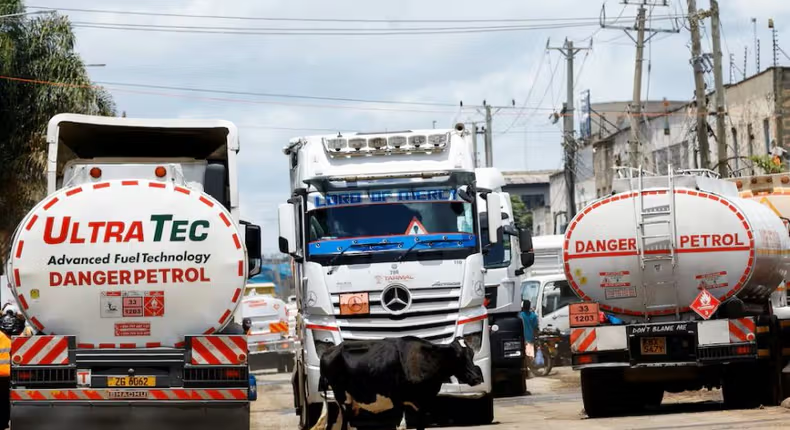
Kenya’s Energy Minister, Opiyo Wandayi, has defended the government’s fuel supply agreements with Middle Eastern countries following renewed criticism from opposition parties calling for their cancellation, as rising global oil prices push up domestic fuel costs and intensify pressure on households already grappling with a high cost of living. Wandayi said the government-to-government (G2G) arrangements have helped stabilise fuel supply and introduced more predictable freight and insurance costs, even amid volatile global energy markets triggered by the U.S.-Israeli conflict with Iran.
He added that Kenya’s fuel supply remains secure under the framework, describing it as a crucial buffer as global tensions disrupt energy flows. The current system has also expanded sourcing options, allowing Kenya to import fuel from a wider range of international markets, including Europe, the U.S. Gulf Coast, India, and the Red Sea region. Finance Minister John Mbadi dismissed opposition calls to terminate the agreements with Gulf suppliers such as Saudi Aramco and the Abu Dhabi National Oil Company (ADNOC), describing the move as “irresponsibility of the highest order.” Opposition politicians have argued that the deals lack transparency and may not always guarantee the most competitive fuel prices.

The debate comes as recent data showed inflation rose sharply in May for a second consecutive month, driven largely by higher fuel prices, triggering a transport strike last week that was called off after the government pledged to reduce diesel prices in June.
📢 GET A DETAILED ARTICLES + JOBS
Join ASJ's WhatsApp Channel and never miss a post or opportunity.

Key Developments: The G2G Framework, Opposition Critique, and Rising Fuel Costs
Kenya’s government-to-government fuel supply framework was introduced in 2023 to address challenges in the country’s Open Tender System (OTS), under which fuel imports were handled by private companies. The G2G system shifted procurement to state-backed entities, with the government negotiating directly with Gulf suppliers. The rationale was to stabilize supply, reduce the risk of shortages, and manage costs through predictable, long-term contracts.
The opposition has criticized the G2G deals on two grounds. First, transparency: the contracts have not been made public, and the pricing formula is unclear. Critics allege that the lack of transparency could mask inflated costs. Second, competitiveness: opposition politicians argue that the G2G framework may not guarantee the lowest prices for consumers, as competitive bidding under the OTS might have produced better terms.

Wandayi’s defense has focused on supply security and predictability. In a volatile global market—with the Hormuz crisis pushing oil prices above $105 per barrel—the G2G framework provides a buffer against supply disruptions. The expanded sourcing options (Europe, U.S. Gulf Coast, India, Red Sea region) reduce Kenya’s dependence on any single supplier or route. The government argues that these benefits outweigh any potential cost differential.
Finance Minister Mbadi’s characterization of the opposition’s call for cancellation as “irresponsibility of the highest order” reflects the government’s assessment that reverting to the OTS would destabilize the fuel market. The government notes that the OTS was plagued by shortages, corruption, and financing difficulties; the G2G system has resolved these issues.
The rising fuel costs are a political vulnerability. Recent data showed inflation rose sharply in May for a second consecutive month, driven largely by higher fuel prices. The spike triggered a transport strike last week, which was called off after the government pledged to reduce diesel prices in June. The opposition is leveraging public dissatisfaction with high energy costs to attack the G2G deals.
The pledge to reduce diesel prices in June is a tactical move. The government can achieve this by reducing taxes (VAT, excise duty) or by adjusting the pricing formula. However, tax reductions would reduce government revenue, while pricing formula adjustments may not be sustainable. The June reduction may be temporary.
The role of Gulf suppliers—Saudi Aramco and ADNOC—is central to the G2G framework. These are state-owned entities with deep pockets and long-term strategic interests. They are reliable suppliers, willing to enter into long-term contracts, and capable of offering credit terms that private traders cannot. The government values this reliability.
Analysis & Implications: Supply Security vs. Transparency, Cost Trade-offs, and Political Fallout
The G2G framework involves a classic trade-off between supply security and transparency. Under the OTS, private importers competed for contracts, and the pricing was (in theory) market-determined. However, the system was vulnerable to manipulation, corruption, and financing gaps. Private importers sometimes failed to secure letters of credit, leading to shortages. The G2G system eliminates these risks but at the cost of public scrutiny.
The cost question is more complex. The opposition argues that the G2G system does not guarantee the lowest prices. The government argues that the OTS’s lower headline prices were often illusory, as hidden costs (demurrage, financing charges, corruption) drove up the actual cost. Without transparent data, the debate cannot be settled.
The global context matters. The Hormuz crisis has made supply security paramount. A country that cannot secure fuel imports faces power cuts, transport paralysis, and economic collapse. In this environment, the government’s emphasis on reliability is rational. The opposition’s call for cancellation, absent a viable alternative, is indeed irresponsible.
The political fallout is manageable for now. The government has deflected criticism by emphasizing the security benefits and by promising to reduce diesel prices in June. However, if global oil prices remain high and fuel costs continue to rise, the opposition’s attacks will intensify. The government may need to provide more transparency—perhaps by publishing redacted contracts or commissioning an independent audit—to defuse the issue.

The transport strike is a warning. Kenya has a history of protests over high living costs; the 2023 protests over the cost of living were widespread and disruptive. The government’s pledge to reduce diesel prices in June was necessary to restore calm, but it also sets an expectation that the government can control fuel prices. If the June reduction is insufficient or not sustained, the protests may resume.
The comparison with Ghana is instructive. Ghana also faces high fuel prices driven by global markets. The Ghanaian government has responded with subsidies (diesel support of GHS1.07 per litre) rather than G2G contracts. Each approach has trade-offs; neither is perfect. Kenya’s G2G system reduces supply risk; Ghana’s subsidy reduces consumer pain but burdens the budget.
The Accra Street Journal notes that the debate in Kenya mirrors debates across Africa about the role of state intervention in energy markets. Governments are caught between the need to attract private investment (which requires market-based pricing) and the need to protect consumers (which requires subsidies or price controls). The G2G framework is a form of state intervention; its success will be judged by outcomes.
What This Means for Kenyan Consumers, Businesses, and the Energy Sector
For Kenyan consumers, the G2G framework’s impact is indirect. The government argues that the system stabilizes supply and prevents shortages, which benefits all consumers. However, if the G2G system results in higher prices than the OTS would have produced, consumers pay more. The lack of transparency makes it impossible to know.
For businesses, supply security is paramount. A manufacturer that relies on diesel for generators cannot afford supply disruptions. Transport companies that operate fleets of trucks need predictable fuel availability. The G2G framework provides this predictability, which is valuable even if prices are not the lowest.
For the energy sector, the G2G framework is part of a broader strategy to reduce Kenya’s dependence on imported refined products. The government is also promoting the development of the proposed Dangote refinery in Mombasa (650,000 bpd), which would refine crude oil domestically, reducing import dependence. However, that refinery is years away from completion.
The opposition’s transparency demands are reasonable. The government should publish redacted versions of the G2G contracts, with commercially sensitive information (pricing formulas, volume commitments) redacted but with enough detail to allow public scrutiny. The government should also commission an independent cost comparison between the G2G system and a simulated OTS.
The Accra Street Journal’s assessment: the G2G framework is defensible on supply security grounds, but the government has done a poor job of communicating its benefits and justifying its costs. The opposition’s call for cancellation is politically motivated but points to a genuine transparency gap. The government should close that gap by releasing more information.
Wider Context: Government-to-Government Fuel Deals in Africa
Kenya is not alone in using G2G deals for fuel imports. Several African countries have adopted similar arrangements to secure supply and manage costs. Ghana has used G2G deals for crude oil imports. Uganda has negotiated with Gulf suppliers. Ethiopia has state-to-state agreements with Sudan and Djibouti. The trend reflects a broader shift away from purely market-based procurement.
The rationale varies. For some countries, G2G deals are a response to financing difficulties: private importers cannot secure letters of credit because of limited foreign exchange. For others, G2G deals are a response to supply disruptions: private importers have failed to deliver. For Kenya, the rationale is a mix of financing and security.
The costs of G2G deals vary. In some cases, G2G deals have resulted in higher prices because of the lack of competition. In other cases, the deals have resulted in stable supply and predictable costs, which are valuable even if not the cheapest. The evaluation must be holistic, not focused solely on price.
The future of G2G deals in Africa depends on the evolution of global energy markets. If volatility persists (due to the Hormuz crisis, the Ukraine war, or other shocks), governments will value supply security over lowest cost. If markets stabilize, the pendulum may swing back toward competitive procurement.
The role of Gulf suppliers (Saudi Aramco, ADNOC, QatarEnergy) is likely to grow. These state-owned entities have long-term strategic interests in Africa, including downstream investments (refineries, storage terminals, retail networks). They are willing to accept lower margins on the crude supply to gain access to downstream markets. This vertical integration can benefit African consumers.
The Accra Street Journal’s conclusion: Kenya’s G2G fuel deals are here to stay, at least for the duration of the current global energy crisis. The opposition’s calls for cancellation are unrealistic without a viable alternative. However, the government must provide more transparency to defuse the political issue. The debate between supply security and lowest price will continue. In a volatile world, security often wins.
Source: Accra Street Journal
Last Updated on May 29, 2026 by Samuel Kwame Boadu
Disclaimer: Some content on Accra Street Journal may be aggregated, summarized, or edited from third-party sources for informational purposes. Images and media are used under fair use or royalty-free licenses. Accra Street Journal is a subsidiary of SamBoad Publishing Hub under SamBoad Business Group Ltd, registered in Ghana since 2014.
For concerns or inquiries, please visit our Privacy Policy or Contact Page.

Samuel Kwame Boadu is a Ghanaian media entrepreneur and storyteller with a passion for amplifying urban voices and uncovering everyday truths. He is the Editor-in-Chief and Founder of Accra Street Journal, a dynamic digital platform dedicated to capturing the pulse of Ghana’s capital—its people, culture, challenges, business, sports and innovations.