








EXECUTIVE INTRODUCTION
The standard economic models of the firm and the marketplace, developed in the temperate climates of the industrialised North, take for granted a stable, predictable, and largely benign physical environment. The factory operates year-round, insulated from the weather by its four walls and its climate-controlled interior. The supply chain moves along roads that are engineered to withstand the seasons. The customer’s journey to the point of sale is a predictable, all-weather commute. These assumptions, so deeply embedded in the conventional business curriculum as to be almost invisible, are profoundly inapplicable to the daily, physical, and deeply weather-exposed reality of commerce in Accra. In the markets of Ghana’s capital, the climate is not an external, occasional variable to be managed by the risk department. It is a primary, daily, and utterly decisive factor that dictates the rhythm of the trading day, the integrity of the supply chain, the health and income of the trader, the price and availability of food, and the very survival of the physical infrastructure of the marketplace itself.

This Accra Street Journal analysis is a ground-level examination of the specific, causal mechanisms through which Accra’s tropical climate—its seasonal rains, its intense sun, and its annual harmattan haze—shapes and constrains the city’s market activities. It is a study in the profound economic vulnerability of a commercial culture that is conducted, overwhelmingly, in the open air, under the direct and unmediated force of the elements. We trace the impact of the rainy season on the unsheltered trader, the flooded stall, and the rotting inventory. We examine the economic logic of the harmattan, with its dust, its cold, and its spike in demand for specific goods and services. We analyse the sun as a relentless destroyer of perishable produce and a driver of infrastructure costs. And we explore the quiet, ingenious, and often costly adaptations that the market women and men of Accra have developed to survive, and sometimes even to profit from, the inescapable weather of commerce. The climate is not just a backdrop to the Accra market; it is an active, powerful, and often brutal participant in every transaction.
THE RAINY SEASON: THE FLOOD, THE MUD, AND THE RACE AGAINST ROT
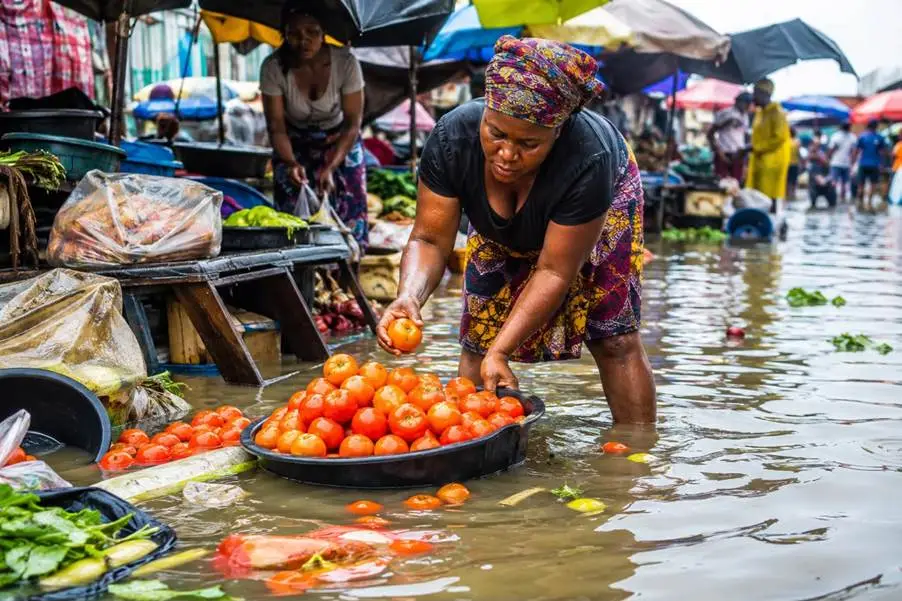
The onset of the major rainy season, typically from April through July, is the most dramatic and economically disruptive climatic event in the Accra market calendar. The sudden, intense, tropical downpours that characterise this period are not gentle, European-style drizzles. They are violent, overwhelming, and often brief deluges that can dump several inches of water on the city in a matter of hours, instantly overwhelming the city’s inadequate and poorly maintained drainage infrastructure. For the vast majority of Accra’s traders, who operate not from sealed, climate-controlled shops but from open-air stalls, tabletop displays on the pavement, or wooden kiosks with leaky roofs, the rain is not an inconvenience. It is a direct, immediate, and frequently devastating assault on their livelihood. The trader who sells textiles or second-hand clothing in the open air must scramble, with frantic speed and practiced efficiency, to cover their goods with tarpaulins and plastic sheets before the rain soaks through and destroys the value of their inventory. A single, unanticipated downpour can ruin a week’s worth of stock, a catastrophic and uninsurable loss for a micro-entrepreneur operating on the thinnest of margins.
📢 GET A DETAILED ARTICLES + JOBS
Join ASJ's WhatsApp Channel and never miss a post or opportunity.
Beyond the immediate damage to goods, the rain transforms the physical environment of the market itself into a hostile and commercially stifling quagmire. The unpaved walkways and open spaces of many of Accra’s major trading hubs become channels of thick, slippery, and clinging mud. Customer footfall, the lifeblood of the market, collapses. The affluent customer who might drive to the market decides to postpone the trip. The pedestrian customer, unwilling to wade through ankle-deep mud and risk ruining their clothes and shoes, stays home. The trader is faced with a double loss: the cost of goods damaged or rendered unsellable by the damp, and the cost of a day, or several days, of dramatically reduced sales. For the trader in perishable goods—the fresh vegetable seller, the fishmonger, the fruit vendor—the rainy season presents a particularly cruel race against time. The combination of high heat and extreme humidity accelerates the decomposition of fresh produce, while the damaged roads from the rural farmlands to the urban market slow the supply chain to a crawl. The trader watches their precious, costly inventory soften, wilt, and rot before their eyes, their potential profit turning to foul-smelling waste, the victim of a climate that is both too wet to transport and too hot to preserve.
THE HARMATTAN: THE DUST, THE COLD, AND THE SEASONAL ECONOMY
The harmattan, the dry, dusty, north-easterly trade wind that blows across West Africa from the Sahara Desert, typically arrives in Accra between late November and February. It brings with it a distinct set of climatic conditions that, while less immediately catastrophic than the rainy season, impose their own unique rhythm and economic logic on the market. The dust-laden haze reduces visibility, sometimes severely, disrupting transport and creating hazardous driving conditions that slow the movement of goods. The fine, penetrating dust settles on everything, coating the goods on display, clogging the mechanisms of electronic equipment, and posing a significant health risk to traders and customers, with a well-documented spike in respiratory infections and eye irritations during this period. The market operates under a physical blanket of dust that requires constant, laborious cleaning and degrades the perceived quality of the goods on offer.
Economically, the harmattan is characterised by the intense, dry cold of the early mornings and evenings, a sharp contrast to the tropical heat of the afternoon. This seasonal chill drives a predictable and significant surge in demand for a specific basket of goods and services. The sellers of warm clothing, jackets, gloves, and thick blankets, often imported second-hand goods specifically for the season, see their sales spike dramatically. The vendors of hot foods and beverages—the waakye seller, the tea and coffee stall, the hot soup joint—experience a surge in early morning and evening custom. The sellers of petroleum jelly, shea butter, and heavy-duty moisturisers, products designed to combat the dry, cracking skin caused by the harmattan’s low humidity, enjoy their peak season. The harmattan is a powerful seasonal segmentation tool, a natural, recurring marketing calendar that the seasoned Accra trader has internalised and integrated into their annual inventory planning. The trader who knows the rhythm of the harmattan has already stocked up on the cold-weather and dry-skin goods well in advance, ready to capture the predictable, weather-driven spike in demand.
THE SUN AND THE PERISHABLE: THE DAILY WAR AGAINST DECAY
While the rains bring dramatic, episodic destruction and the harmattan brings a seasonal chill, the most constant and pervasive climatic pressure on Accra’s market activities is the relentless, year-round intensity of the tropical sun. The sun is a powerful, invisible tax on the perishable goods trade, the single largest driver of post-harvest loss and daily waste in the city’s food markets. The fresh vegetables, the fruits, the raw meat and fish displayed on open-air tables, often with no more protection than a flimsy umbrella or a scrap of cloth, are under continuous, degrading solar assault. The sun wilts the leafy greens, it softens the tomatoes to an unsellable mush, it accelerates the bacterial decomposition of the fish, and it fades the vibrant colours of the displayed produce, robbing it of its visual appeal and its perceived freshness. The trader is engaged in a daily, desperate war against time and temperature, a war that is often lost.
The economic consequences of this solar tax are severe. The trader is forced to factor a high rate of spoilage and waste into their cost calculations, a hidden expense that is either absorbed in reduced profit or passed on to the consumer in higher prices for the goods that survive. The lack of a reliable, affordable cold chain—the absence of refrigeration at the market stall—is the critical missing infrastructure that makes this solar tax so devastating. The trader employs a range of traditional, low-tech, and only partially effective mitigation strategies. The strategic placement of the stall under the shade of a tree or a building. The constant, laborious sprinkling of water on leafy vegetables to keep them cool and crisp through evaporative cooling. The rapid, aggressive discounting of goods as the day progresses and the spoilage accelerates, a desperate attempt to salvage some revenue from produce that will be worthless by the evening. The sun is a silent, constant, and merciless commercial partner in the Accra market, taking its share of every perishable transaction.
THE ADAPTIVE RESPONSE: THE INGENUITY AND THE INFRASTRUCTURE DEFICIT
The market women and men of Accra are not passive victims of the climate. They have, over generations, developed a remarkable repertoire of adaptive strategies and ingenious, low-cost technologies to mitigate the impact of the weather on their livelihoods. The ubiquitous heavy-duty tarpaulin and the rapidly deployable plastic sheeting are the primary, essential defences against the sudden rainstorm. The wide-brimmed straw hat and the thick, protective clothing shield the trader’s body from the sun’s intensity. The meticulous covering of goods with cloths and the strategic use of shade are constant, disciplined practices. The annual inventory cycle is deeply attuned to the predictable rhythm of the rains, the harmattan, and the dry season. The trader is a skilled, if informal, climatologist, their business decisions calibrated to the expected weather patterns.
However, these individual, informal adaptations are increasingly insufficient in the face of the intensifying and increasingly unpredictable weather patterns associated with global climate change. The rainfall is becoming more erratic, with longer dry spells punctuated by shorter, more intense, and more destructive downpours. The flooding is becoming more severe, as rapid, unplanned urbanisation covers the city in impermeable concrete, overwhelming the neglected drainage channels. The fundamental vulnerability of the Accra market is not a failure of individual entrepreneurial ingenuity. It is a profound, collective, and long-neglected infrastructure deficit. The lack of adequate, covered, and properly drained market structures. The absence of a reliable, affordable, and accessible cold chain for the perishable goods trade. The failure of the public authorities to invest in the basic, climate-resilient infrastructure that would protect the city’s most vital commercial spaces and the livelihoods of the hundreds of thousands of citizens who depend on them. The market trader can deploy a tarpaulin against the rain, but they cannot build a storm-water drain. The climate is a collective problem, and it demands a collective, public, and infrastructural solution that has, to date, been woefully absent.
QUICK FACTS BOX: CLIMATE AND ACCRA’S MARKET ACTIVITIES
-
The Rainy Season (April-July): Sudden, intense downpours cause immediate damage to exposed goods, flood market walkways, collapse customer footfall, and accelerate the spoilage of perishable produce.
-
The Harmattan (November-February): Dry, dusty winds cause respiratory health issues, coat goods in fine dust, disrupt transport, and create a predictable, lucrative seasonal surge in demand for warm clothing, hot foods, and heavy-duty moisturisers.
-
The Perpetual Sun: The relentless tropical heat acts as a constant, invisible tax on perishable goods, driving high rates of daily spoilage and waste, and forcing traders into a desperate, daily war against temperature-driven decay.
-
The Core Vulnerability: The overwhelmingly open-air, physically exposed nature of Accra’s market infrastructure makes commerce uniquely and directly vulnerable to climatic conditions in a way that sealed, climate-controlled formal retail is not.
-
The Adaptation Gap: Individual trader ingenuity with tarpaulins, shade, and seasonal planning is no substitute for the profound, collective, and long-neglected public infrastructure deficit in covered market structures, reliable drainage, and affordable cold-chain access.
FAQ SECTION
1. How does a sudden heavy rainstorm immediately affect an open-air market trader in Accra?
The most immediate effect is a frantic rush to cover exposed goods with tarpaulins before they are soaked and destroyed. Simultaneously, customer footfall collapses as people take shelter, and the market floor turns to mud, making trading almost impossible.
2. What is the biggest climate-related cost for a fresh food seller in Accra?
Spoilage. The combination of high heat and humidity causes fresh vegetables, fruits, and fish to rot extremely quickly, especially without affordable refrigeration. This constant, daily loss of inventory is a massive, uninsurable drain on their income.
3. How does the harmattan season change what people buy in Accra’s markets?
It drives a huge seasonal demand for specific items: warm second-hand clothes and blankets to combat the early morning cold, heavy-duty skin moisturisers and shea butter for the dry air, and hot drinks and foods like hot waakye or tea.
4. Does the harmattan dust actually hurt a trader’s business?
Yes, in multiple ways. The fine dust settles on and dirties goods, making them less attractive. It can clog and damage electronics. It also causes health problems like coughs and eye irritation for both traders and customers, which can reduce overall market activity.
5. Are the modern shopping malls affected by the weather in the same way as the open-air markets?
Not nearly to the same extent. Malls are sealed, air-conditioned, and protected from the rain, sun, and dust. This climate immunity is a major structural competitive advantage the formal retail sector has over the informal, open-air economy.
6. What happens to the price of food in Accra after a period of very heavy rains?
Prices usually spike. Heavy rains damage farm crops and, crucially, wash out the rural roads, making it extremely difficult and expensive for trucks to bring fresh produce from the villages to the urban markets in Accra.
7. How do traders try to protect their goods from the sun if they have no refrigerator?
They use traditional methods like strategically placing the stall in the shade, constantly sprinkling water on leafy vegetables to cool them down through evaporation, and aggressively discounting prices as the day goes on to sell goods before they spoil completely.
8. Is the flooding in Accra’s markets getting worse, and why?
Yes. Rapid urban construction covers the ground with concrete, preventing rainwater from being absorbed. This, combined with the city’s poorly maintained drains, means even a normal heavy downpour can quickly cause destructive flash floods in market areas.
9. Is climate change affecting the traditional seasons that traders rely on?
Yes. The old, predictable patterns of the rainy and dry seasons are becoming more erratic. Rains can be delayed, or a whole season’s worth of rain can fall in a few, intensely destructive storms, making it harder for traders to plan their inventory.
10. What is the single biggest thing that could help protect market traders from the weather?
Massive public investment in climate-resilient market infrastructure. This means properly covered, raised, and drained market stalls, and critically, the provision of reliable, shared, and affordable cold storage facilities right within the markets to stop the daily loss of perishable food.
Source: Accra Street Journal
Last Updated on August 4, 2026 by Samuel Kwame Boadu
Disclaimer: Some content on Accra Street Journal may be aggregated, summarized, or edited from third-party sources for informational purposes. Images and media are used under fair use or royalty-free licenses. Accra Street Journal is a subsidiary of SamBoad Publishing Hub under SamBoad Business Group Ltd, registered in Ghana since 2014.
For concerns or inquiries, please visit our Privacy Policy or Contact Page.

Samuel Kwame Boadu is a Ghanaian media entrepreneur and storyteller with a passion for amplifying urban voices and uncovering everyday truths. He is the Editor-in-Chief and Founder of Accra Street Journal, a dynamic digital platform dedicated to capturing the pulse of Ghana’s capital—its people, culture, challenges, business, sports and innovations.