










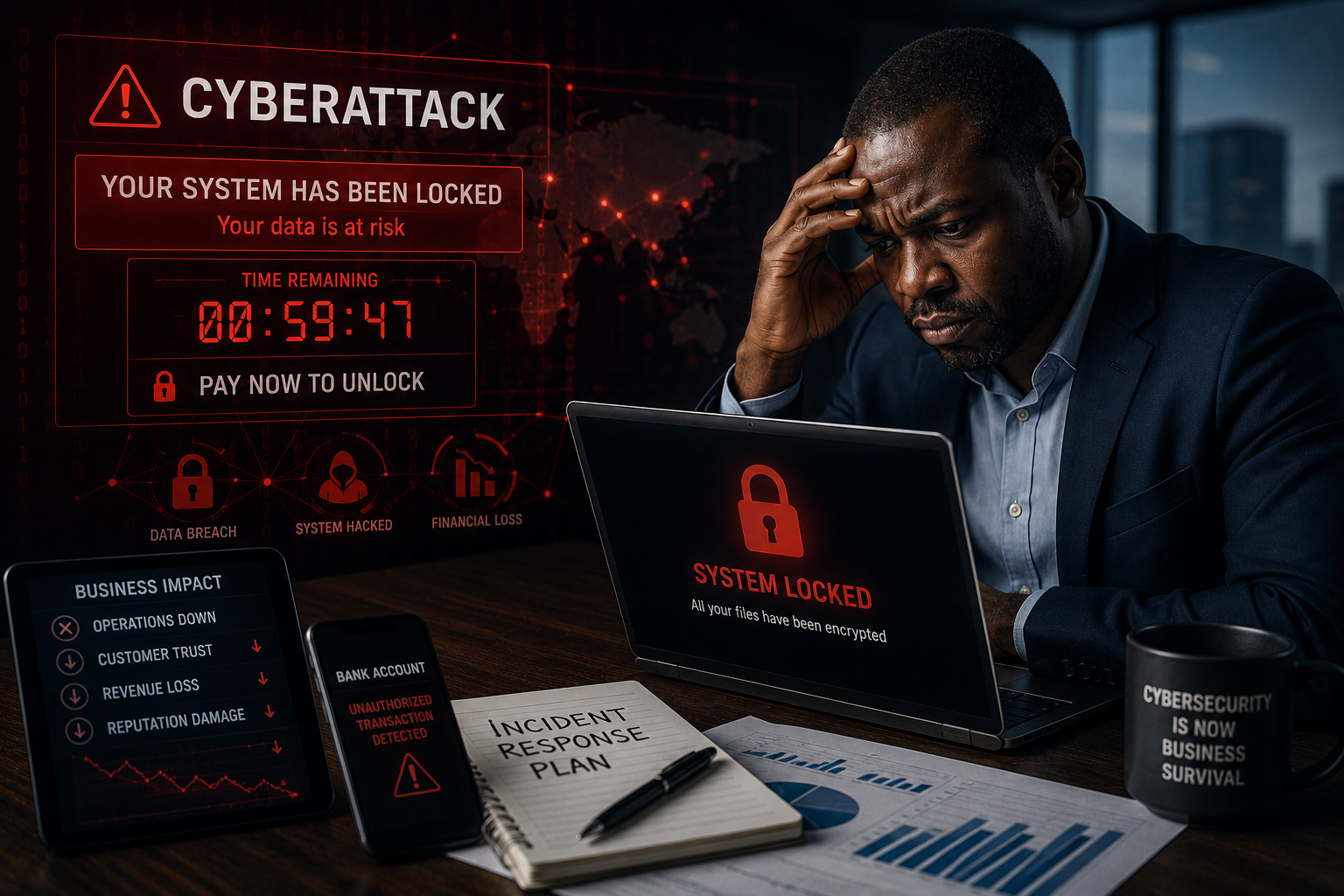
An Accra Street Journal Finance & Security Guide
Executive Introduction
When Ghanaians wake up in 2026, their financial lives are almost entirely digital. The street-level, cash-based economy of a decade ago has given way to a system where mobile money, digital wallets, and bank apps are the norm. In April 2026 alone, the total value of mobile money transactions reached GH¢493.2 billion, with 967 million transactions recorded .

But this digital shift has a shadow side. The Bank of Ghana’s 2025 Fraud Report shows a 48 per cent surge in total fraud cases, from 16,733 in 2024 to 24,778 in 2025 . Critically, mobile money and digital payment fraud is exploding while traditional banking fraud declines.
📢 GET A DETAILED ARTICLES + JOBS
Join ASJ's WhatsApp Channel and never miss a post or opportunity.

This ASJ report examines why cybersecurity matters for digital finance users: the scale of the threat, the most common attack vectors, the regulatory response, and the practical steps every user must take to protect themselves.
Part 1: The Threat Landscape – What the Numbers Reveal
The Fraud Surge
The headline number is stark: total reported fraud cases jumped 48 per cent in a single year . However, this masks a critical distinction: while traditional banking fraud is falling, mobile money and digital payment fraud is skyrocketing.

The banking sector is getting safer – Fraud cases in banks declined 34 per cent from 716 in 2024 to 472 in 2025, with the value at risk falling 24 per cent from GH¢75 million to GH¢57 million . Stronger internal controls and improved risk management are working.
The digital danger zone – Payment service provider (PSP) fraud cases—largely mobile money—nearly doubled in a single year (98 per cent increase), with the value at risk rising 42 per cent to GH¢37 million . Over a four-year period, PSP fraud cases increased by 98 per cent.
Why PSP Fraud Is Surging
The Bank of Ghana attributes the PSP surge to Ghana’s substantial financial inclusion success – a consequence of the ecosystem’s rapid expansion. More users, more transactions, and more interconnected systems create more opportunities for fraud. The interconnectedness of bank accounts, mobile wallets, and crypto platforms means a vulnerability in one system can affect multiple others.
The fundamental driver: As the Bank of Ghana’s Head of Fraud Investigations and Reporting Unit, Eric Cab-Beyuo, has explicitly stated, “The fraudsters don’t usually use many hacking techniques. They just play on our minds” . This is not a technical problem—it is a human one.
Part 2: The Most Common Threats – How Fraud Actually Happens
Social Engineering – The Primary Attack Vector
The Bank of Ghana has been unequivocal: mobile money fraud is driven by social engineering, not hacking. Fraudsters use deceptive tactics to manipulate victims into voluntarily disclosing sensitive information – verification codes, PINs, or security credentials . They create urgency or excitement through fake phone calls, fraudulent text messages, and fabricated promotions.
Common social engineering tactics:
| Tactic | How It Works |
|---|---|
| “Prize” Scams | You receive a message claiming you’ve won a competition you never entered |
| Fake Bank Calls | Someone calls claiming to be your bank, requesting “account verification” |
| Phishing Links | An SMS with a link to a fake website that looks like your bank’s |
| SIM Swap Fraud | Fraudsters convince your network provider to transfer your SIM to their phone |
| “Abu Trica” Trap | Someone asks to use your account for a transaction, promising a share of “profits” |
Internal Fraud – The Insider Threat
A persistent concern in the banking sector is internal fraud. In 2025, 219 bank staff were implicated in fraud, with 75 dismissed . Cash suppression (the removal of cash from circulation without proper documentation) accounted for 63 per cent of staff-related fraud cases . This highlights that cybersecurity is not just about external threats—it also requires robust internal controls and monitoring systems.
The Cybersecurity Threat to the Financial System
The interconnected nature of Ghana’s financial system creates systemic cybersecurity risks. The Bank of Ghana’s 2026 Cyber and Information Security Directive explicitly addresses this, warning that cyber threats can “disrupt financial stability, erode consumer trust, and impose significant economic losses” . Cyberattacks on financial infrastructure are not just individual crimes—they threaten the stability of the entire system.
Part 3: The Regulatory Response – What the Authorities Are Doing
The Bank of Ghana’s Cyber and Information Security Directive (CISD 2026)
In March 2026, the Bank of Ghana launched a revised Cyber and Information Security Directive, replacing the 2018 framework. Governor Dr Johnson Pandit Asiama explained: “A framework designed for the challenges of 2018 cannot adequately solve the problems of 2026. The threat landscape has changed, and so must we” .

The six strategic pillars of CISD 2026:
| Pillar | Purpose |
|---|---|
| AI and Machine Learning Governance | Ensuring transparency, fairness, and security as institutions adopt AI for fraud detection |
| Cloud Computing Security | Promoting responsible, risk-based cloud adoption while maintaining data sovereignty |
| Proportionality Framework | Tailoring cybersecurity requirements to the size and risk profile of institutions |
| Board-Level Accountability | Mandating at least one board member with verified cyber risk expertise |
| Inclusive Oversight | Expanding coverage beyond banks to include fintechs, microfinance, and partner regulators |
| Proactive Defence | Strengthening systems to anticipate, prevent, and respond to evolving threats |
The directive moves beyond “simple compliance toward a posture of active and collective cyber resilience . Second Deputy Governor Dr Zakari Mumuni emphasised that cybersecurity must be treated as “a national and economic security priority” .
The Financial Industry Command Security Operations Centre (FICSOC)
The FICSOC operates as the Sectoral Computer Emergency Response Team for the financial industry, providing coordinated cyber incident response. The BoG has borne the initial cost as “critical national infrastructure” .
The Revised AML/CFT Guidelines
In January 2026, the Bank of Ghana revised its AML/CFT guidelines, introducing enhanced due diligence for agency banking and requiring sophisticated transaction monitoring systems. Static, rule-based systems are no longer considered adequate .
Part 4: How to Protect Yourself – Practical Steps
The Golden Rule: Never Share Your Banking Credentials
This is the single most important rule. Your bank will never ask for your PIN, password, or token code via phone, SMS, or email.
What NOT to Share:
| Item | Why |
|---|---|
| PIN | Gives full access to your account |
| Internet banking login details | Anyone with these controls your account |
| Token codes | Used to authorise transactions |
| One-Time Passwords (OTPs) | Fraudsters use these to complete fraudulent transfers |
| Ghana Card details | Can be used to open accounts in your name |
Practical Security Measures
1. Shield Your PIN: When conducting transactions at ATMs or POS terminals, always shield your hand to protect your PIN from “shoulder surfing” fraudsters.
2. Verify Website URLs: When using internet banking, always type the official bank URL directly into your browser. Look for “https://” and ensure the URL matches your bank’s official domain exactly.
3. Subscribe to Transaction Alerts: Enable SMS or push notifications for all transactions. If you see a transaction you cannot explain, report it immediately to your bank.
4. Use Strong Passwords: Avoid using easily guessed passwords like your date of birth. “Anyone who knows you or is close to you can compromise you.” Create strong, complicated passwords and change them often.
5. Be Sceptical of Cold Callers: Seeing a phone number or email address you recognise does not mean it is genuine. If you receive an unsolicited call requesting banking details, end the call and report it.
6. Avoid Using Your Account for Others: Never allow others to use your bank account for sending or receiving money. You risk being implicated in money laundering or fraud investigations.
7. Use Prepaid Cards for Online Subscriptions: The Chief Executive of the Ghana Association of Banks, John Awuah, recommends using prepaid cards for online subscriptions to limit potential losses in the event of fraud.
What to Do If You Suspect Fraud
If you suspect your account has been compromised, act quickly:
-
Report immediately to your bank via their official customer service line.
-
Contact the Bank of Ghana for unresolved issues through their official channels.
-
Report suspicious transactions promptly—every hour counts.
Reporting Contacts:
-
Your Bank’s Official Customer Service: Use only the numbers on your bank’s official website or app.
-
Bank of Ghana Financial Stability Department: For unresolved complaints.
-
Police CID (Commercial Crime Unit): For criminal investigations.
ASJ Conclusion
Cybersecurity matters for digital finance users because the threat is both large and growing. The 48 per cent surge in fraud cases and the 98 per cent increase in PSP fraud demonstrate that the digital financial ecosystem is under sustained attack .
But the most important truth is this: the fraud is largely preventable. As the Bank of Ghana has made clear, fraudsters rely on psychological manipulation, not technical hacking . The strongest line of defence is an informed, vigilant consumer.
Your best protection is not technology—it is awareness. Protect your credentials. Verify everything. Trust your instincts. If something feels wrong, it probably is. A five-minute call to the SEC toll-free line (0800 100065) or your bank’s official customer service could save you from financial devastation.
Quick Reference: Fraud Protection Checklist
| Action | Why |
|---|---|
| Never share PINs or OTPs | Full account access |
| Shield your PIN | Prevent “shoulder surfing” |
| Use strong passwords | Avoid easily guessed dates |
| Verify website URLs | Avoid fake bank sites |
| Subscribe to SMS alerts | Catch suspicious transactions early |
| Report suspect transactions | Every hour counts |
| Ignore cold callers | Banks never ask for credentials |
| Avoid account-sharing | You could be implicated in crimes |
| Use prepaid cards online | Limit loss exposure |
Source: Accra Street Journal
Last Updated on July 13, 2026 by Samuel Kwame Boadu
Disclaimer: Some content on Accra Street Journal may be aggregated, summarized, or edited from third-party sources for informational purposes. Images and media are used under fair use or royalty-free licenses. Accra Street Journal is a subsidiary of SamBoad Publishing Hub under SamBoad Business Group Ltd, registered in Ghana since 2014.
For concerns or inquiries, please visit our Privacy Policy or Contact Page.

Samuel Kwame Boadu is a Ghanaian media entrepreneur and storyteller with a passion for amplifying urban voices and uncovering everyday truths. He is the Editor-in-Chief and Founder of Accra Street Journal, a dynamic digital platform dedicated to capturing the pulse of Ghana’s capital—its people, culture, challenges, business, sports and innovations.





