EXECUTIVE INTRODUCTION
In the cool, shaded courtyards of old Accra, and in the peri-urban villages that ring the capital’s frantic edge, a transaction of profound antiquity is still conducted daily. It is a transaction between the potter’s hands, the dark, plastic clay dug from specific riverbanks, and the memory of form passed down through generations of women. This is the world of traditional pottery and crafts in Accra—a world that the digital economy, the glass tower, and the plastic container have not managed to extinguish. It survives, adapts, and, in remarkable instances, thrives, precisely because it fulfils functions that no industrial substitute can replicate.
This Accra Street Journal spotlight is an analytical deep-dive into the material culture of the capital’s indigenous craft traditions. It is not a romantic tribute to a dying art. It is a forensic examination of the specific economic, ritual, and aesthetic logics that sustain the potter, the coffin-maker, the bead-trader, and the stool-carver in a city that is aggressively monetising every square metre of its land. We argue that these crafts are not merely decorative survivors from a pre-modern past. They are sophisticated, resilient, and economically active indigenous technologies. They encode and transmit spiritual knowledge, mark the most significant life-cycle transitions, and represent a form of embodied, gendered capital that has quietly resisted the homogenising pressures of global consumer culture. To understand the potter of Pokuase or the figurative coffin-maker of Teshie is to understand a stubborn, ingenious, and deeply rooted Ghanaian response to modernity.

THE POTTER’S HAND: GENDER, CLAY, AND THE RITUAL ECONOMY
In the indigenous Ga-Dangme and broader Ghanaian traditions that converge in Accra, the making of pottery is overwhelmingly, though not exclusively, a woman’s technology. The potter is typically a female elder, a master craftswoman whose knowledge is not acquired in a formal classroom but inherited through a lineage of mothers and grandmothers. The primary centres of ceramic production that supply Accra—the historic potting villages of the Shai Hills, the Ga settlements at Pokuase, and the Ewe potting communities in the Volta Region whose wares travel to the capital’s markets—are repositories of immense, orally-transmitted technical expertise.
📢 GET A DETAILED ARTICLES + JOBS
Join ASJ's WhatsApp Channel and never miss a post or opportunity.

The process is a masterclass in pre-industrial chemistry and engineering. The specific clay bodies are sourced from secret, often ritually protected, deposits along riverbanks. The clay is kneaded with grog—crushed, fired potsherds—to control shrinkage and prevent cracking during the open-pit or simple clamp firing. The potter builds the vessel using the coiling technique, a slow, meditative, additive process of rolling and stacking ropes of clay, then smoothing the walls with a corn cob, a piece of calabash, or a smooth stone. The final form emerges not from a blueprint but from the potter’s muscle memory and aesthetic intuition. The firing, conducted in a shallow pit covered with dry grass, palm fronds, and sometimes cow dung, is a high-risk, critical stage. The blackened, reduced surfaces of Ga cooking pots are achieved by smothering the fire with organic material at the peak temperature, a deliberate chemical process that carbonises the surface and seals the porous clay, creating a durable, non-stick cooking vessel.
The economic logic of this pottery is specific and non-industrial. The primary products are not decorative vases for the tourist market, though those exist. The core demand comes from the ritual and culinary economy of the Ga community itself. The earthenware cooking pot (kukuo in Akan, tsese in Ga) is considered essential for the proper preparation of certain ritual foods, including the palm nut soup served at Homowo and other traditional ceremonies. Food cooked in a clay pot is widely believed to have a distinct, superior taste, a belief that sustains a steady, premium market among discerning consumers. Even more critically, certain pottery vessels are irreplaceable in the sacred sphere. They are used for libations, for storing ritual medicines, and as containers for ancestral offerings. This ritual demand creates a market entirely insulated from competition from the Chinese plastic basin. The spirit world, in the Ga understanding, does not drink from plastic. It requires the vessel made by hand from the living earth, fired by wood, and shaped by a lineage-holder. This is the unshakeable economic and cultural foundation of the traditional pottery craft in Accra.

BEYOND THE POT: COFFINS, BEADS, AND THE ART OF TRANSITION
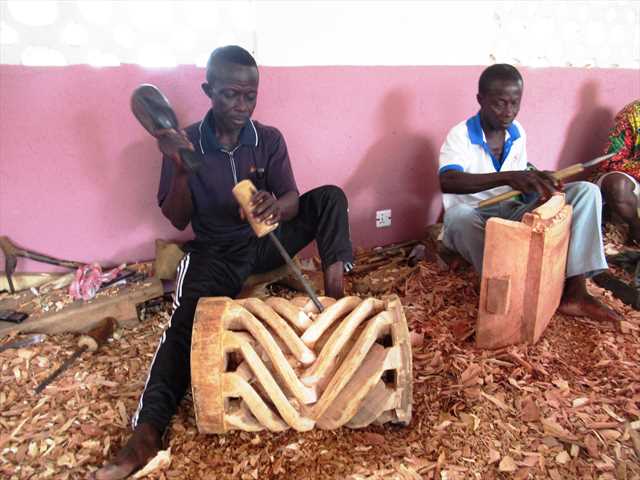
The craft traditions of Accra extend far beyond the ceramic vessel, into realms where art, spirituality, and the commerce of life’s great transitions intersect with striking power. The most globally famous of these is the fantasy coffin or abebuu adekai (literally, “proverb boxes”) tradition, centred in the Ga community of Teshie and associated with legendary workshops like that of the late Kane Kwei and his successors, including Paa Joe. These elaborate, figurative coffins—shaped like fish, eagles, cocoa pods, Mercedes-Benz cars, bibles, and mobile phones—are not a whimsical tourist novelty. They are a profound material statement of Ga funerary philosophy. The coffin is the final, public emblem of the deceased’s earthly identity, their profession, their status, or their clan symbol. It is a sculptural eulogy, a final act of honour that transforms the grave into a site of narrative and memory. The Teshie coffin workshops operate as small-scale, family-based enterprises, employing apprentice carvers and painters, and producing bespoke, high-value objects for a clientele that now spans the global art world. A Paa Joe coffin sits in the British Museum; another is commissioned by a wealthy Ghanaian family for a Saturday funeral in Teshie. The craft has successfully bridged the indigenous ritual economy and the international art market without entirely losing its funerary soul.
Similarly, the bead culture of Accra is a living economic and spiritual force. The production, stringing, and trading of beads—from the recycled glass powder beads of the Krobo and Ashanti regions to the antique Venetian trade beads that circulated along the old trade routes—is a major, female-dominated sector of the craft economy. Beads in the Ga and wider Ghanaian context are not merely decoration. They are a form of wearable text. Specific beads denote royal status, lineage membership, life-stage transitions, and spiritual protection. The bead market at the Accra Arts Centre, and the numerous smaller bead shops in Makola and Osu, are not simply selling trinkets; they are providing a crucial material for the performance of identity at traditional weddings, naming ceremonies, and funerals. The woman who strings a particular combination of old trade beads and new Krobo glass is making a deliberate, legible statement about her family, her resources, and her cultural knowledge.
The stool carving tradition, while more concentrated in the Akan heartland, has a vital presence in Accra as the seat of government and commerce. The stool remains the pre-eminent symbol of authority among the Akan and, through cultural diffusion, has been adopted into the symbolic language of Ga chieftaincy as well. The carving of a chief’s stool, with its complex symbolic motifs and its profound spiritual significance as the “soul” of the lineage, is a high-stakes commission undertaken by master carvers who operate with ritual protocols. This is a craft of immense political and spiritual consequence, far removed from the production of souvenir stools for the tourist market. The master carver is a custodian of symbolic knowledge, a visual philosopher in wood.
THE ECONOMIC STRUCTURE OF THE CRAFT: APPRENTICESHIP, INFORMALITY, AND THE MARKET
The business model of the traditional craftsperson in Accra is overwhelmingly informal, micro-enterprise, and family-based. The primary mode of knowledge transmission is the apprenticeship system, a lengthy, often years-long, period of intensive training under a master craftsperson. This is not a classroom model; it is a form of embodied learning, where the apprentice absorbs technique, material knowledge, and the social and ritual protocols of the craft through observation, imitation, and gradual participation in the full cycle of production. The apprentice typically receives no formal wage but is provided with food, accommodation, and training, a form of pre-capitalist vocational education that has produced generations of highly skilled artisans.
The primary market channels are the open-air markets—the Arts Centre in Accra being the most visible tourist-facing node, but the regional markets and the direct workshop sales being equally important. The “market queen” system, where powerful female traders control access to specific commodity stalls and networks, also operates in the craft sector, particularly for beads, pottery, and textiles. The craftsperson is often in a position of economic dependency on these intermediaries, who control the point of sale and the customer relationship. The challenge for the sector is the classic artisanal trap: the producer receives a fraction of the final retail price, the pressure to cheapen materials and simplify designs for the tourist mass market is relentless, and the transmission of skills to the next generation is threatened by the aspirational pull of formal education and “office” employment. The potter’s daughter increasingly prefers the laptop to the clay, a generational rupture that is the single greatest existential threat to the continuity of these traditions.
THE CONTEMPORARY TWIST: THE CRAFT OBJECT IN THE GALLERY AND THE DESIGN STUDIO
The most significant recent development in the Accra craft economy is the emergence of a self-conscious, globally networked, urban creative class that is re-valuing and re-contextualising traditional craft. Contemporary Ghanaian designers, artists, and architects are not merely copying tradition; they are engaging in a sophisticated, and often commercially lucrative, dialogue with it. High-end interior design firms in East Legon and Airport Residential are commissioning bespoke, large-scale ceramic installations and furniture pieces that draw directly on traditional forms and materials but are executed for a modern architectural context.
The fashion industry, a major economic and cultural force in Accra, is deeply engaged with traditional crafts. Contemporary womenswear designers are working with local weavers and bead-stringers to produce limited-edition accessories that place indigenous craft techniques directly on the high-fashion runway and the Instagram feed. The artist El Anatsui, while operating on a global stage, remains the ultimate exemplar of this strategy: his work transforms the logic of the traditional craftsman—the patient, rhythmic assembly of thousands of small, recycled elements—into monumental, museum-dominating installations that command millions of dollars. This gallery and design-studio economy for craft is still a niche sector, but it is a high-value, high-visibility one that creates a powerful aspirational model. It re-frames the craft object not as a souvenir of poverty but as a luxury artefact of sophisticated cultural knowledge, a repositioning that can, if carefully managed, trickle down to elevate the entire sector.
CONCLUSION: THE EARTH REMEMBERS
The traditional pottery and crafts of Accra are not a charming footnote to the city’s relentless march towards glassy modernity. They are a coherent, resilient, and deeply intelligent material culture system. The potter in her compound, turning a wet coil of clay with the same gesture her grandmother used, is not just making a pot. She is enacting an inherited technology, fulfilling a ritual market demand that the plastic factory cannot satisfy, and maintaining a tangible link to the earth from which the city is made. The fantasy coffin builder, the bead trader, the stool carver—they are all engaged in a similar act of material memory.
The challenge is not to preserve these crafts in amber, as static displays in a museum, but to ensure the economic and social conditions under which they can continue to evolve, adapt, and transmit their knowledge to a generation navigating the powerful, seductive currents of global consumer culture. The survival of the crafted object in Accra will depend on the capacity of the craft economy to offer a viable livelihood, to command respect rather than pity, and to convince the potter’s daughter that the clay in her hands holds possibilities that the laptop cannot provide. The fired earth of Accra carries an immense, concentrated memory of the civilization that built this coast. It is a memory that the city, in its scramble for the future, cannot afford to let crumble into dust.

QUICK FACTS BOX: TRADITIONAL POTTERY AND CRAFTS IN ACCRA
-
Primary Pottery Centres Supplying Accra: Shai Hills, Pokuase (Ga), Volta Region (Ewe) potting villages.
-
Core Technique: Hand-coiled earthenware, open-pit or clamp-fired, often with a deliberate reduction (smothering) process to create blackened, durable cooking vessels.
-
Key Pottery Products: Ritual cooking pots (kukuo/tsese), libation vessels, water storage jars, incense burners, mortuary pots.
-
Gender of Potters: Predominantly female, with knowledge transmitted through matrilineal family lines.
-
Other Major Craft Traditions: Teshie fantasy coffins (abebuu adekai), bead-making and stringing, Akan stool carving, smithing.
-
Economic Model: Informal, family-based micro-enterprises; apprenticeship-based training; sales through open markets, direct workshops, and tourist-oriented retail at the Arts Centre.
-
Primary Market Drivers: Indigenous ritual and culinary demand (pottery), funerary culture (coffins), life-cycle and status performance (beads), chieftaincy and political authority (stools).
-
Contemporary Challenges: Generational skills flight towards formal employment, competition from cheap industrial substitutes, exploitative intermediary pricing, land pressure on clay sources.
-
Contemporary Opportunities: High-value commissions from the design and fashion sectors, the global African art market (coffins), cultural tourism, and a growing local middle-class interest in “authentic” heritage goods.

Last Updated on July 24, 2026 by Samuel Kwame Boadu
Disclaimer: Some content on Accra Street Journal may be aggregated, summarized, or edited from third-party sources for informational purposes. Images and media are used under fair use or royalty-free licenses. Accra Street Journal is a subsidiary of SamBoad Publishing Hub under SamBoad Business Group Ltd, registered in Ghana since 2014.
For concerns or inquiries, please visit our Privacy Policy or Contact Page.

Samuel Kwame Boadu is a Ghanaian media entrepreneur and storyteller with a passion for amplifying urban voices and uncovering everyday truths. He is the Editor-in-Chief and Founder of Accra Street Journal, a dynamic digital platform dedicated to capturing the pulse of Ghana’s capital—its people, culture, challenges, business, sports and innovations.