


15 min read
EXECUTIVE INTRODUCTION
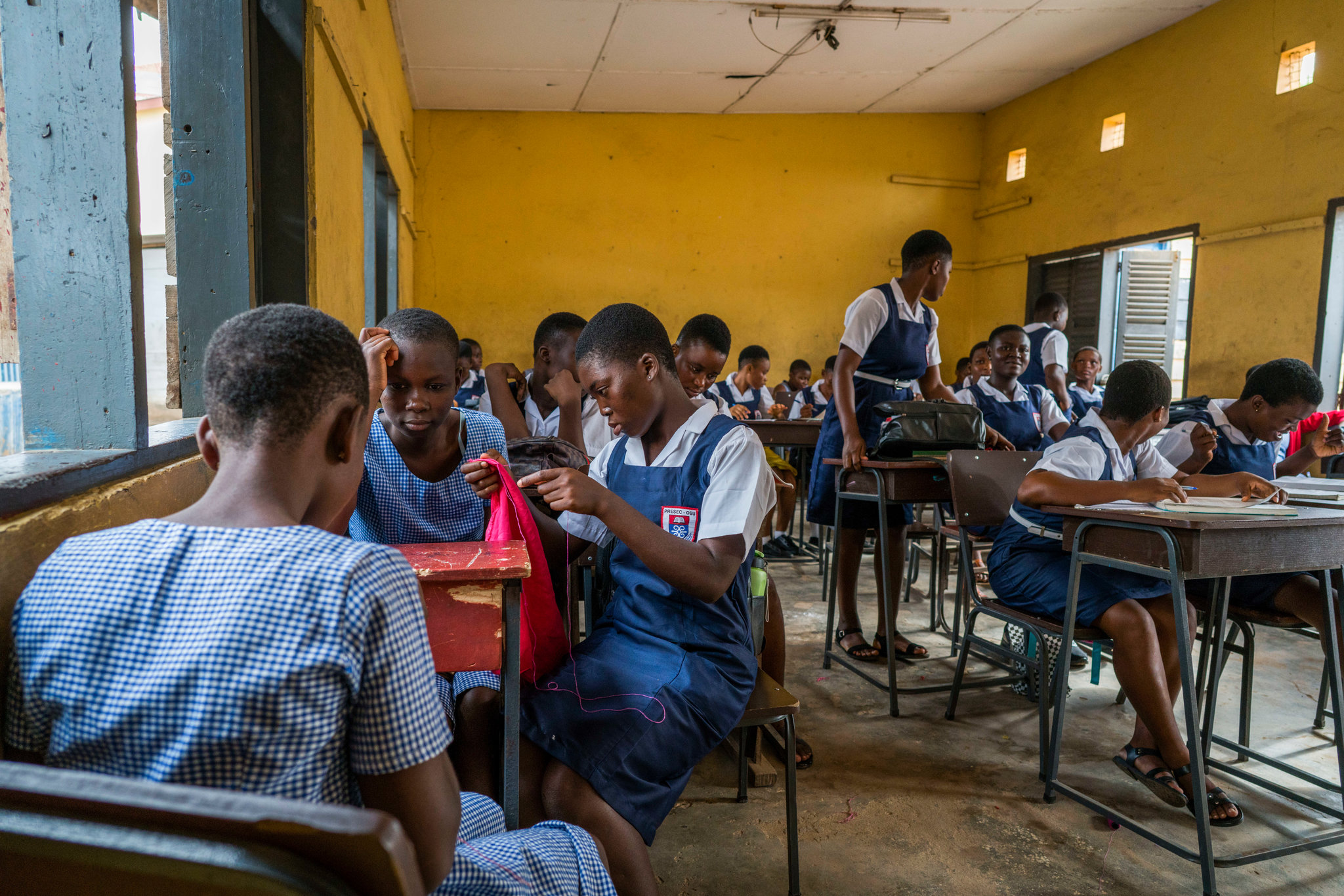
The image of the Ghanaian school, deeply etched into the national consciousness, is a powerful and enduring one. It is a physical place: a plot of land, often dusty and well-trodden, with a cluster of concrete-block classrooms, their corrugated iron roofs amplifying the heat of the afternoon sun. It is the sound of hundreds of young voices reciting a lesson in unison, the chalk dust hanging in the air, the worn, shared textbooks, and the strict, formal hierarchy of the teacher standing at the front of the room, the sole, undisputed fountain of knowledge. This is the school we know. It is the school that educated the nation. And for all its deep familiarity and its profound, enduring importance, this physical model has a set of inherent, stubborn, and inescapable limitations. It is bound by geography, accessible only to the child who can physically walk or travel to its gate. It is bound by time, operating on a rigid, factory-style schedule of bells and periods. And it is bound, most critically, by the profound, heartbreaking inequality of resources, where the quality of a child’s education is often determined, before she even speaks her first word, by the accident of whether she was born near a well-stocked, well-staffed school in Accra or in a remote, underserved rural community.
This is the ancient, intractable problem that a quiet, powerful, and increasingly vital new model of schooling is beginning to address. This is the rise of the cloud-based school, a term that describes a spectrum of technology-enabled learning, from the fully virtual, online-only institution to the innovative hybrid model that blends the best of the physical classroom with the limitless resources and the personalised, data-driven power of the digital cloud. This Accra Street Journal analysis is a clear-eyed, ground-level examination of this emerging phenomenon in the Ghanaian context. This is not a breathless, utopian prediction that the physical school will disappear, or that a laptop can replace a great teacher. It is a recognition that, driven by the forced digital experiment of the pandemic, enabled by the rapid, mass adoption of the smartphone, and fuelled by the urgent, unquenchable demand of a young, aspirational population, a new, more flexible, more accessible, and more resilient architecture of learning is being built. The classroom without walls is not a distant, futuristic fantasy. It is being built, one online lesson, one digital assignment, and one virtual classroom at a time, in Ghana, today.
Key Takeaways
- The Core Concept: A spectrum of technology-enabled learning, from fully virtual, online-only schools to hybrid models that blend digital platforms with the traditional physical classroom.
- The Economic Model: A potentially more affordable and scalable alternative to the traditional capital-intensive private school, by shifting investment from expensive physical infrastructure to high-quality digital content and teaching talent.
- Are these cloud-based schools only for wealthy, private-school families in Accra?
THE PANDEMIC ACCELERANT AND THE BIRTH OF A NATIONAL CONVERSATION
The quiet, gradual growth of digital learning tools in Ghana was not a new phenomenon before the year 2020. Forward-thinking private schools had been experimenting with digital content, and a handful of international virtual schools served a tiny, affluent diaspora market. But the idea of a Ghanaian school conducting its core, daily educational mission entirely online was, for the overwhelming majority of parents, educators, and policymakers, a fringe, almost unimaginable concept. The physical school was the school. Then, in a matter of weeks, the global COVID-19 pandemic slammed the door of every physical classroom in the nation shut. The ancient, universal, and unquestioned ritual of the morning assembly, the crowded classroom, and the face-to-face lesson was abruptly, and indefinitely, suspended. The crisis was immediate, profound, and terrifying. The education of an entire generation of Ghanaian children was suddenly, perilously, at risk.
It was in this moment of enforced, desperate necessity that the national conversation about what a school could be, fundamentally and permanently changed. The government, with remarkable speed and ambition, launched the Ghana Learning TV channel, beaming pre-recorded lessons into homes via the familiar, accessible medium of the television set. Private schools, often with no prior experience and no dedicated budget, scrambled to adopt a patchwork of freely available digital tools, the video conferencing platforms, and the messaging apps, to maintain some fragile, virtual thread of connection with their students. The results were profoundly, and predictably, uneven. The deep, painful chasm of the digital divide was laid bare as never before, as millions of children in poorer, rural, and unconnected homes were effectively locked out of any form of continued learning for months. The experiment was messy, chaotic, and deeply inequitable. But it was an experiment. And it demonstrated, irrevocably, to parents, to teachers, and to the nation, that technology could, in a crisis, serve as a vital, if imperfect, educational lifeline. The pandemic did not create the cloud-based school, but it shattered the old, comfortable, and unchallenged assumption that the physical classroom was the only possible container for serious learning. It opened the door, and the questions it forced us to ask about access, equity, and the very nature of schooling are now the urgent, driving forces behind the quiet, but unmistakable, rise of the cloud-based model.
THE GEOGRAPHIC LIBERATION: THE SCHOOL THAT COMES TO THE CHILD
The single most profound, and most democratising, promise of the cloud-based school is its power to liberate a quality education from the brutal, binding constraint of geography. In the traditional, physical-only model, a child’s access to a great teacher, a well-stocked library, a fully equipped science laboratory, and a rich, diverse curriculum is almost entirely determined by where her parents happen to live or can afford to send her. A brilliant young mathematician in a remote village in the Upper East Region, whose local school lacks a specialist teacher for advanced calculus, is simply out of luck. Her talent, and her potential, is capped not by her ability, but by her postcode. The cloud-based school, by placing a significant portion of the curriculum, the instructional content, and the live, interactive contact with expert teachers onto a digital platform accessible from a smartphone or a laptop, fundamentally shatters this ancient, unjust, and economically wasteful constraint.
This is a liberation on multiple fronts. It now offers, for the first time, a viable, high-quality, and socially connected homeschooling alternative for the small but growing number of Ghanaian parents, both in the diaspora and at home, who seek a more personalised, flexible, and globally-benchmarked education for their children. It enables a specialised, expert teacher in Accra to deliver a live, interactive, and inspiring class to a small group of talented students scattered across multiple regions, a model of distributed excellence that was previously impossible. And it is beginning to transform the in-school experience itself, in the innovative, forward-thinking schools that are pioneering the hybrid model. In these classrooms, the teacher is no longer the sole, overworked, and often undertrained dispenser of generic content, lecturing to a passive, uniform audience. The student engages with the core, foundational material at their own pace, through a beautifully designed, interactive, and multi-media-rich online learning platform, pausing the video, rewinding the complex explanation, and taking the self-assessment quiz as many times as they need. The precious, irreplaceable, face-to-face time in the physical classroom is then liberated for the deeply human, high-value work that only a great teacher can do: the personalised coaching, the Socratic dialogue, the small-group collaborative project, and the patient, one-on-one mentoring of the child who is struggling. The cloud does not replace the teacher; it empowers the teacher, transforming their role from a tired, generic broadcaster of information into a dynamic, engaged, and deeply responsive learning coach. The school is no longer just a building you must travel to; it is a service that can follow the child, wherever her curiosity and her potential may take her.
THE DIGITAL ECONOMY OF EDUCATION: AFFORDABLE, ACCESSIBLE, AND SCALABLE
The second, and equally powerful, driver of the cloud-based school is the cold, hard, and compelling logic of economics. A world-class, traditional, physical-only private school is an immensely capital-intensive enterprise. Its primary, and constantly escalating, cost is the physical plant itself: the precious, expensive land in a prime location, the sprawling complex of buildings, the constant, grinding maintenance, the security, and the immense, recurrent operational cost of electricity and water. These immense, fixed costs inevitably make a top-tier, high-quality education unaffordable for the vast majority of Ghanaian families. The cloud-based school model, by its very nature, is designed to dramatically strip out the most crushing of these physical infrastructure costs. The primary investment is not in bricks and mortar, but in the quality of the digital curriculum, the training and the talent of the online teaching faculty, and the secure, reliable technology platform.
This different cost structure has the potential to be profoundly democratising. It can deliver a level of curriculum design, instructional quality, and personalised, data-driven learning support, at a fraction of the price of a traditional, elite private school. The model of the specialist, outsourced, cloud-based service is also emerging as a powerful, practical tool for the government school system. Instead of a struggling, under-resourced rural school having to rely on the limited expertise of its own, often inadequately trained teachers for every single subject, it can now, through a simple internet connection and a shared screen at the front of the classroom, tap directly into a live, interactive, and brilliant masterclass from one of the nation’s best teachers, beamed in from the capital. This is not a replacement for the local teacher, but a powerful, cost-effective way to augment their skills, to expose their students to a world of knowledge and a standard of teaching that the constraints of their physical location would otherwise deny them. The digital school allows the scarce, precious resource of expert teaching to be scaled, shared, and democratised.
THE PERSISTENT CHASM: THE DIGITAL DIVIDE AND THE RISK OF A TWO-TIER FUTURE
The quiet rise of the cloud-based school is a story of immense, transformative promise, but it is also a story that must be told with a deep, sobering honesty about its most significant, and most dangerous, limitation. The cloud-based school runs on two things, both of which are still far from universally available in Ghana: a reliable, affordable, high-speed internet connection and a functional, capable digital device. To speak of the liberating power of the virtual classroom while millions of Ghanaian children, in rural communities, in impoverished urban households, and in the vast, sprawling informal settlements, lack access to a stable internet connection or even a basic smartphone that can handle a video call, is to risk not closing the educational inequality gap, but widening it into an unbridgeable chasm. The grave, and very real, danger is the emergence of a deeply unjust, two-tier educational future, where the children of the connected, affluent, and digitally literate receive a rich, personalised, globally competitive, and cloud-enhanced education, while the children of the poor, the rural, and the disconnected are left further behind, their educational experience remaining stubbornly analog, under-resourced, and fundamentally inadequate.
Addressing this profound digital divide is not a peripheral, charitable concern; it is the absolute, non-negotiable central policy challenge of the entire digital education project. The solution does not lie in a naive, utopian faith in the market alone. It demands a massive, sustained, and concerted national effort. It requires the government and the telecommunications companies to collaborate on a bold, ambitious “Education Data” initiative, a zero-rated, free-to-access data policy for all approved, high-quality educational websites and platforms, ensuring that the cost of a data bundle is never the barrier that locks a child out of learning. It requires a deliberate, fast-tracked national programme to equip every single school, starting with the most underserved, with a reliable, high-speed broadband internet connection, treating this not as a luxury, but as the essential, modern public utility it has become. And it requires a shift in the development of the digital curriculum itself, moving towards an “offline-first” design philosophy, where the core, rich, and interactive content can be downloaded once, perhaps at a local library or a community centre, and then consumed, engaged with, and learned from, on a low-cost device, without the need for a constant, expensive, and unreliable streaming connection. The digital school can be a great equaliser, a powerful force for justice and opportunity. But only if we have the collective will, the policy foresight, and the deep, unwavering commitment to equity to build the physical and financial infrastructure that ensures the cloud can reach, and lift, every single child, not just the privileged few.
QUICK FACTS BOX: CLOUD-BASED SCHOOLS IN GHANA
-
The Core Concept: A spectrum of technology-enabled learning, from fully virtual, online-only schools to hybrid models that blend digital platforms with the traditional physical classroom.
-
Primary Driver: The urgent, unmet demand for accessible, high-quality, and flexible education, dramatically accelerated by the forced digital experiment of the COVID-19 pandemic.
-
The Geographic Liberation: The power to decouple a quality education from a specific physical location, enabling expert teachers and rich curriculum to reach students in remote or underserved areas.
-
The Economic Model: A potentially more affordable and scalable alternative to the traditional capital-intensive private school, by shifting investment from expensive physical infrastructure to high-quality digital content and teaching talent.
-
The Critical Barrier: The persistent and profound digital divide, the vast inequality in access to reliable internet and capable devices, which threatens to create a deeply unjust, two-tier educational future if not urgently and systematically addressed.
FAQ SECTION
1. What is a cloud-based school, in simple, practical terms?
It is a school that uses the internet and digital platforms to deliver a significant part of its teaching and learning. This can range from a fully online school with no physical building, to a traditional school that uses online lessons and digital tools to enhance what happens in the physical classroom.

2. Is a fully online, virtual education as good as going to a physical school every day?
For some students, particularly those who are self-motivated, need a flexible schedule, or do not have access to a good local school, it can be an excellent, transformative option. It provides access to a world-class curriculum and expert teachers that geography would otherwise deny them. However, it lacks the crucial daily, face-to-face social interaction of a physical school.
3. What is a “hybrid” school model, and why is it becoming popular in Ghana?
A hybrid school blends the best of both worlds. A student might spend part of their week on campus, engaging in labs, sports, and face-to-face collaborative projects with their peers, and the other part of their week learning online, at their own pace, from home, using a rich, digital curriculum. It offers flexibility and personalisation.

4. Was it the COVID-19 pandemic that started the idea of online learning in Ghana?
The pandemic did not start it, but it forced it into the mainstream. Before 2020, online learning was a niche experiment. The sudden, prolonged closure of all physical schools forced every parent, teacher, and the government to seriously consider digital alternatives, and it shattered the old assumption that learning could only happen inside a classroom.
5. How does a child in a remote village, with no internet, benefit from a cloud-based school?
This is the critical, unsolved challenge. The most promising model is the offline-first, technology-enhanced physical classroom. The school itself receives a reliable internet connection and a shared device, and the teacher uses the rich, downloaded digital content to dramatically enhance their own lessons, exposing the students to a world of knowledge they could never access before.
6. Are these cloud-based schools only for wealthy, private-school families in Accra?
The fully online, private, fee-paying schools currently are. But the more transformative potential lies in the hybrid model and the use of digital tools to empower teachers in the public and low-fee private school systems, making a far higher quality of instruction accessible and affordable at scale.
7. What is the biggest obstacle to the growth of cloud-based schooling in Ghana?
The deep, persistent, and profoundly unfair digital divide. The high cost of a reliable internet connection and a functional learning device (a laptop or a tablet) shuts out millions of children from poor and rural families, and this gap must be addressed as a matter of urgent national priority.
8. How can parents be sure a fully online school is legitimate and not a scam?
You must verify the school’s physical and legal registration with the appropriate government regulatory bodies. You should demand to speak to current parents, to see a detailed, structured curriculum, and to understand the qualifications of the teaching staff. A legitimate school will be transparent and welcoming of such scrutiny.
9. What about the social development of a child who learns mostly online?
This is a valid and important concern. The best virtual schools address this directly by organising regular, in-person social gatherings, field trips, sports days, and community service projects for their students, creating a deliberate, structured social life beyond the screen. The hybrid model, by design, builds this social interaction into the weekly rhythm.
10. Does a cloud-based school mean a computer is replacing the teacher?
Absolutely not. The goal of the best models is the opposite. The technology is used to automate the routine, repetitive parts of instruction, freeing the precious, irreplaceable human teacher to focus on what they do best: providing personalised coaching, inspiring a love of learning, and mentoring the whole child. The teacher becomes more, not less, important.
Last Updated on August 10, 2026 by Samuel Kwame Boadu
Disclaimer: Some content on Accra Street Journal may be aggregated, summarized, or edited from third-party sources for informational purposes. Images and media are used under fair use or royalty-free licenses. Accra Street Journal is a subsidiary of SamBoad Publishing Hub under SamBoad Business Group Ltd, registered in Ghana since 2014.
For concerns or inquiries, please visit our Privacy Policy or Contact Page.


Samuel Kwame Boadu is a Ghanaian media entrepreneur and storyteller with a passion for amplifying urban voices and uncovering everyday truths. He is the Editor-in-Chief and Founder of Accra Street Journal, a dynamic digital platform dedicated to capturing the pulse of Ghana’s capital—its people, culture, challenges, business, sports and innovations.
Use the following reference when citing or referencing this article.
Your feedback helps us improve our journalism.
Report an Error
Help us maintain accuracy. Let our editorial team know if you spot an issue in this article.
Report a problem with this article