From sacred dishes to late-night street bites—the flavours that define Ghana’s capital
An Accra Street Journal Culture & Intelligence Brief
Executive Introduction
If you want to understand Accra, you must understand what its people eat. For a visitor, the city’s indigenous food culture is both vibrant and hidden—vibrant because it is everywhere, hidden because it is not found in glossy restaurant menus or hotel buffets. It is found on street corners, at lorry stations, in the bustling chop bars of Osu, and in the kitchens where home cooks preserve culinary traditions passed down across generations.

Indigenous food in Accra is not a niche interest. It is the city’s primary food system, feeding the majority of its residents daily. Yet its full depth remains underappreciated—even by Ghanaians who consume it. This ASJ report examines Accra’s indigenous food culture through three lenses: the everyday staples that define the city’s palate, the more complex dishes reserved for special occasions, and the street food economy that operates at the intersection of tradition and modern urban life.
📢 GET A DETAILED ARTICLES + JOBS
Join ASJ's WhatsApp Channel and never miss a post or opportunity.

Part 1: The Staples—Everyday Food, Deeply Embedded
The main dishes of Accra are humble but foundational. They reflect the Ga-Dangme, Akan, and Ewe traditions that converge in the capital, adapted to the rhythms of urban life.
Kenkey with Fried Fish and Pepper
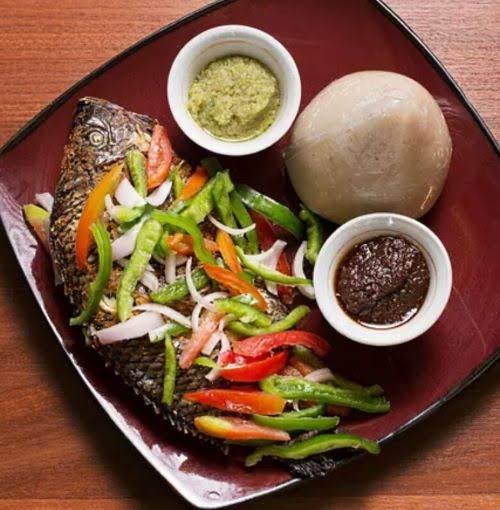
Perhaps the most iconic Accra meal, kenkey is fermented corn dough wrapped in corn husks and steamed until firm. It is served with fried fish (often mackerel or tilapia), fresh pepper sauce, and sometimes onions and tomatoes. For many Accra residents, this is not just a meal—it is a daily ritual, often purchased from street vendors on the way to work or after a long day.

Banku with Okro Stew, Pepper, or Groundnut Soup
Banku is another fermented corn and cassava dough dish, similar to kenkey but with a softer, smoother consistency. It is eaten with the hands, dipped into okro stew (which is slimy and rich), groundnut soup (nutty and comforting), or a fiery pepper sauce with fried fish. Banku and tilapia is a weekend favourite in many Accra households.
Red Red (Yo-Ko-Gari)
Red red is a bean stew made from black-eyed peas, cooked in red palm oil, and served with fried plantain. The name comes from the deep red colour of the palm oil. It is a filling, protein-rich meal that is both affordable and satisfying.
Waakye
Though originally from northern Ghana, waakye has become a beloved breakfast and lunch dish throughout Accra. It is a blend of rice and beans—typically red or black-eyed beans—cooked with sorghum leaves, which give it its distinctive reddish-brown hue. It is commonly served with gari (grated cassava), spaghetti, and a choice of meat or fish. For many, waakye is the breakfast of champions, sold by vendors who set up early and often sell out before noon.
Part 2: The Special Occasion Dishes—Food as Ritual
Beyond the everyday staples, Accra has dishes that carry deeper cultural weight—foods that are not consumed casually but reserved for specific occasions.
Akplijii (Aprapransa, Akpledze)
Akplijii is a dish of the Ga-Dangme people of the Greater Accra Region, known as Aprapransa to Akan speakers and Akpledze to the Ewe. Its name—”Aprapransa”—derives from the Akan phrase “prapra wo nsa,” meaning “wipe your hand,” reflecting that it is a complete meal where the soup is integrated so fully that you only need to wash your hands afterward.
The dish is prepared by blending roasted corn flour (known locally as tom brown) with a sacred palm nut soup. The ingredients include roasted corn flour, palm fruit, beans, tomatoes, onion, pepper, ginger, garlic, and seafood such as smoked fish, dried fish, salted fish, or crabs.
Akplijii is not everyday food. It is served on special occasions: marriage ceremonies, naming ceremonies, birthday celebrations, and family cookouts. It is rarely found on the streets of Accra, and it is not commonly prepared in Ghanaian households as a daily meal. Its preparation is labour-intensive and its ingredients are more expensive than those of simpler dishes.
The sacred connection: The palm nut soup used in Akplijii is considered a sacred soup of the Ga-Dangme people, always prepared as a complement to another sacred corn flour meal—Kpokpoi—during the Homowo harvest festival.
Fufu
Fufu is ubiquitous across Ghana and West Africa, made by pounding boiled cassava or plantain into a dough-like consistency. It is shaped into balls and served with a variety of soups: palm nut soup, light soup, and groundnut soup. In Accra, fufu is a Sunday lunch staple, often served with goat or chicken soup.

The preparation is physically demanding—traditionally, fufu is pounded in a large wooden mortar with a pestle, requiring two people working in rhythm. This communal preparation is itself a cultural practice, often bringing families together on weekends.
Part 3: The Street Food Economy—Kelewele and Beyond
Perhaps the most visible expression of Accra’s indigenous food culture is its street food. In this category, kelewele stands out as a uniquely Ghanaian phenomenon.
Kelewele: The Spicy Heartbeat of the Night
Kelewele is a dish of fried ripe plantain cubes, marinated in a spicy ginger and pepper paste. The name comes from the Ga dialect—”kele” meaning cut into small pieces, and “wele” meaning fried. While it originated in southern Ghana among the Ga and Akan people, it is now a fixture in cities across the country—especially Accra, Kumasi, and Cape Coast.
Kelewele is made by peeling ripe plantains (the soft, deep orange-red variety preferred for its sweetness and caramelisation) and cutting them into bite-sized cubes. These are tossed in a spice paste made from fresh ginger, garlic, onion, kpakpo shito peppers, cloves or nutmeg, and salt, then deep-fried in groundnut oil until golden brown and caramelised at the edges.
Why it works: The combination of sweet ripe plantain, savoury ginger, and spicy pepper creates a complex flavour that is both addictive and deeply satisfying. The aroma alone is a powerful lure: “The warm wave of ginger and pepper normally drive consumers to the vendors.”
Serving: Kelewele is served hot, traditionally in a paper wrap with a handful of roasted groundnuts. It is a ready-to-eat street food, sold at bus terminals, night markets, and by roadside vendors.
The economic reality of kelewele: The price of kelewele has become a point of contention. A small wrap of kelewele costs GHS 15, while a whole bunch of ripe plantain sells for around GHC 5.
Why the gap? Vendors explain that the cost is not just the plantain. Good frying oil is expensive, and kelewele requires litres of it. Fuel costs—charcoal or gas—have risen sharply. The price of spices has also soared. Vendors pay for the preparation process, not just the raw ingredients. As one vendor explained: “Customers pay for all the preparation process and not only the ripe plantain.”
The Street Food Ecosystem
Kelewele is just one part of a broader ecosystem. Accra’s streets are lined with vendors selling fresh pepper sauce, bofrot (doughnuts), shito (a black pepper and fish sauce), kebabs, roasted plantain, and sobolo (a hibiscus drink). Chop bars—small, informal eateries—are found on every corner of Ghana’s towns and in major cities abroad.
Part 4: Changing Palates—The Evolution of Accra’s Food Culture
Accra’s food culture has always evolved, shaped by migration, urbanisation, and economic pressure. What is less understood is how these changes are affecting traditional dishes.
The Price Barrier
The gap between the cost of raw ingredients and the cost of finished street food is a structural tension that vendors are forced to manage. A small wrap of kelewele at GHS 15 is far more than the cost of the plantain—but the vendor is paying for oil, fuel, spices, rent for the spot, transport, and packaging.

The Urban-Time Trade-Off
Many Accra residents no longer have the time to prepare traditional dishes. The preparation of Akplijii is labour-intensive, and the pounding of fufu requires two people working in rhythm—a luxury many in the city cannot afford. The rise of street food vendors is, in part, a response to this: the city’s food culture is increasingly outsourced to specialists.
The Health Equation
The health implications of deep-fried street food have drawn attention. Dr Godfred Owusu Ansah, a Sunyani-based medical practitioner, notes that kelewele—deep-fried—adds significant trans fats and saturated fats to the plantains, which are otherwise nutritious. He warns that high consumption of fried foods can contribute to weight gain, high blood pressure, and increased cholesterol. Kelewele is often consumed late at night, which can lead to digestive discomfort or acid reflux. Despite these risks, its popularity endures.
Conclusion: Tradition, Taste, and the City
Accra’s indigenous food culture is not a static tradition—it is a dynamic ecosystem shaped by migration, commerce, urbanisation, and the struggle for affordability. The dishes that define the city—kenkey, banku, red red, waakye, fufu, and kelewele—are both deeply rooted and constantly adapting.
The street food economy is not a separate category from indigenous food culture; it is its most visible expression, a daily transaction between tradition and the demands of modern urban life. The kelewele vendor is not just selling fried plantain; they are preserving a recipe that has travelled through centuries, adjusting only the price to keep pace with a changing world.
Quick Reference: Accra’s Indigenous Food Culture
| Dish | Key Ingredients | When to Eat |
|---|---|---|
| Kenkey | Fermented corn dough, fish, pepper | Daily staple, breakfast/lunch |
| Banku | Fermented corn/cassava dough, okro soup/pepper | Daily staple, lunch/dinner |
| Red Red | Black-eyed peas, red palm oil, fried plantain | Lunch/dinner |
| Waakye | Rice, beans, sorghum leaves, gari, fish/meat | Breakfast/lunch |
| Fufu | Pounded cassava/plantain, soups | Weekend lunch |
| Akplijii | Roasted corn flour, palm nut soup, seafood | Special occasions |
| Kelewele | Ripe plantain, ginger, garlic, pepper | Night/late evening |
Source: Accra Street Journal
Last Updated on July 23, 2026 by Samuel Kwame Boadu
Disclaimer: Some content on Accra Street Journal may be aggregated, summarized, or edited from third-party sources for informational purposes. Images and media are used under fair use or royalty-free licenses. Accra Street Journal is a subsidiary of SamBoad Publishing Hub under SamBoad Business Group Ltd, registered in Ghana since 2014.
For concerns or inquiries, please visit our Privacy Policy or Contact Page.

Samuel Kwame Boadu is a Ghanaian media entrepreneur and storyteller with a passion for amplifying urban voices and uncovering everyday truths. He is the Editor-in-Chief and Founder of Accra Street Journal, a dynamic digital platform dedicated to capturing the pulse of Ghana’s capital—its people, culture, challenges, business, sports and innovations.